Get Full Government Meeting Transcripts, Videos, & Alerts Forever!
Get email alerts on the Corrections Capacity topic
No spam. Unsubscribe anytime.
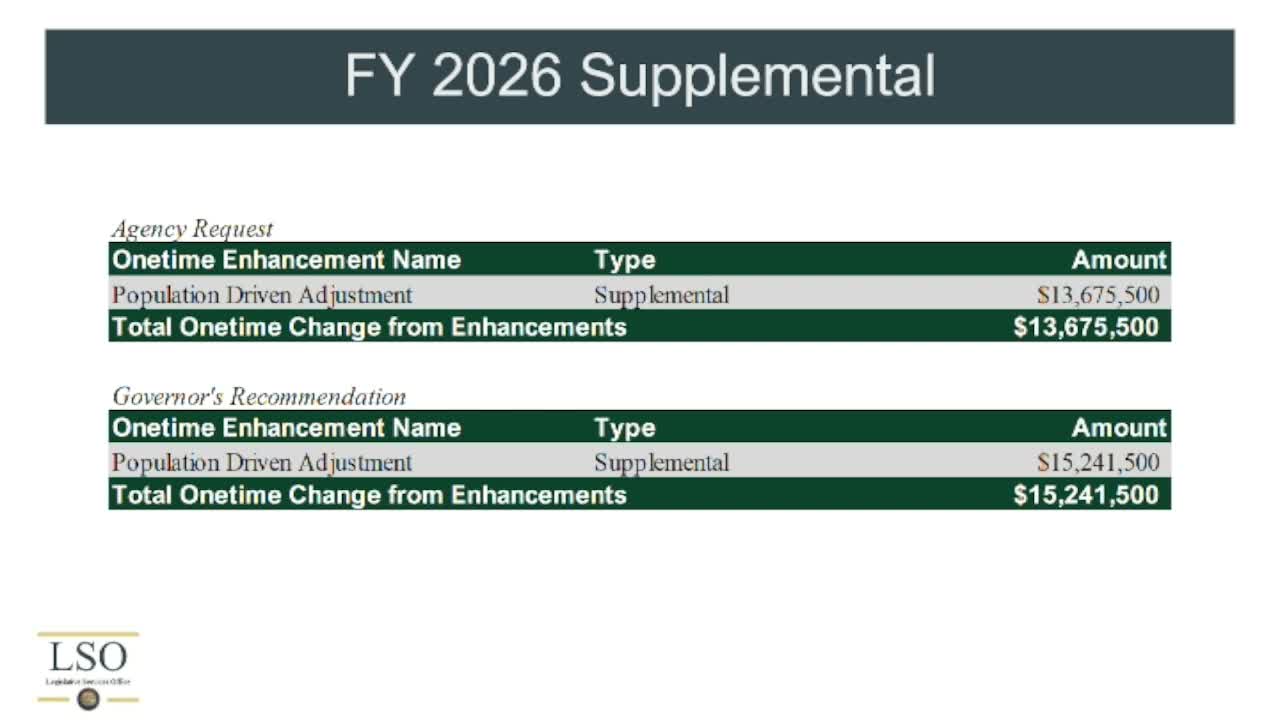
Spike in Idaho prison population drives $13.6M–$15.2M supplemental request for county and out‑of‑state housing
Summary
Analysts told lawmakers that updated population forecasts and high capacity use in state facilities are driving a FY2026 supplemental request (agency: $13.6M; governor: $15.2M) to cover county jail and out‑of‑state housing costs; more recent actuals narrowed the estimate to about $14.3M.
Noah Peterson, the Legislative Services Office budget analyst, told the joint appropriations committee that volatile population forecasting has driven large supplemental requests to cover county jail and out‑of‑state placements. The agency requested $13.6 million for fiscal year 2026 and the governor recommended $15.2 million; Peterson said updated December actuals reduced the current estimate to about $14.3 million.
Peterson explained the statutory county rate in Idaho (Idaho Code §22‑37A) sets $55 per day for the first seven days and $75 per day thereafter, plus $2.50 per day for county medical costs. He also said the current out‑of‑state contract rate is about $83.20 per day and is expected to rise to approximately $85.70 later this year. Using recent counts, Peterson said there were roughly 1,213 people in county jails and about 581 in out‑of‑state placements at the time of the briefing.
Director Bree Derek told lawmakers that the department is supplying updated monthly population numbers to analysts and DFM and expects the figure to continue to fluctuate. She emphasized the difficulty of predicting housing needs many months out and said the supplemental amount will be refined as more actuals arrive.
Why it matters: rising incarceration levels are increasing pressure on the general fund and on county facilities; the supplemental requests reflect the uncertainty of population forecasting and have direct budgetary impact on next fiscal year appropriations.