Get Full Government Meeting Transcripts, Videos, & Alerts Forever!
Get email alerts on the Budget Funds topic
No spam. Unsubscribe anytime.
Idaho corrections budget shortfall tied to falling dedicated funds prompts holdback exemption
Summary
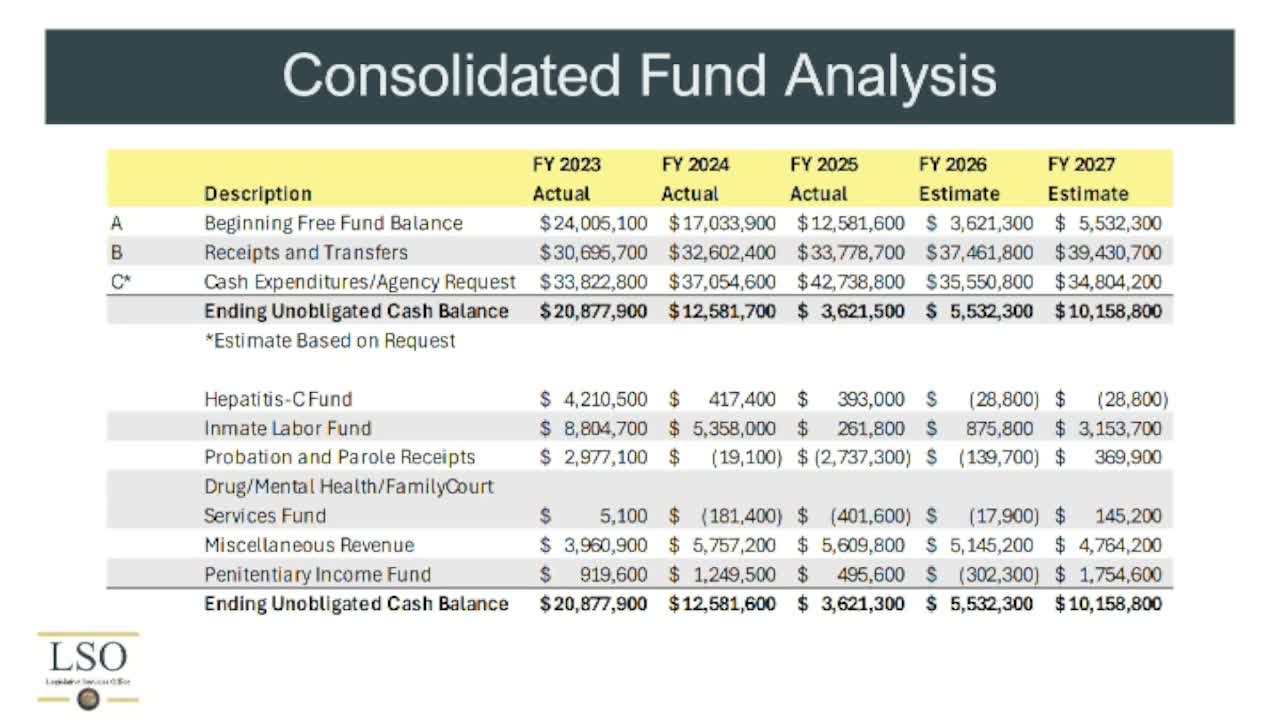
Analysts told a joint Senate‑House budget panel that declines in the inmate‑labor and probation/parole receipts funds drove DOC’s exemption from the governor’s 3% holdback and forced use of general funds to cover bills that dedicated revenues once paid.
Noah Peterson, a budget policy analyst with the Legislative Services Office, told the Joint Senate Finance and House Appropriations committee that falling cash balances in two dedicated funds prompted the Department of Correction’s exemption from the governor’s proposed 3% holdback. "Those cash balances are really the story," Peterson said, highlighting the inmate labor fund and the probation/parolee receipts fund as key pressures.
Peterson said the inmate labor fund receives revenue from contracts for inmate work crews and 35 percent of inmates’ gross wages, and the probation/parole receipts fund is derived from supervision fees capped by statute at $75 per month; the department currently charges $60 monthly as a standard fee and $30 for limited supervision. With revenues declining and appropriations rising, Peterson said bills normally paid from those dedicated funds have had to be supplemented with general fund dollars.
Department of Correction Director Bree Derek confirmed that the agency had prepared a holdback plan that would have included furloughing staff, and said the exemption averted what the department estimated could have been furloughs for about 2,000 employees. Derek added that the agency nonetheless implemented many of the reductions planned under the holdback, including cuts to contracts and some technologies, to manage the budget.
Why it matters: the shortfall shifts costs to the general fund, reduces funding available for programs tied to those dedicated funds and helps explain why the agency is pursuing supplemental requests elsewhere in the budget. Committee members pressed analysts and the director for more detail about the lost inmate contracts, the uses of the dedicated funds, and what the department will do to restore those revenue streams.
The committee did not take any formal votes during the presentation; budget decisions and any supplemental appropriations will be addressed in later committee work groups and deliberations.