Get Full Government Meeting Transcripts, Videos, & Alerts Forever!
Get email alerts on the State Budget topic
No spam. Unsubscribe anytime.
Committee adopts median-based revenue projections and approves letter to JFAC
Summary
The Economic Outlook and Revenue Assessment Committee voted 10–8 to adopt median-based general fund revenue projections for FY2026 and FY2027 and unanimously (17–1) approved a report letter that will be presented to JFAC tomorrow; a spreadsheet formula error prompted a short recess for corrections.
The Economic Outlook and Revenue Assessment Committee voted to adopt median-based general fund revenue projections of $5,000,000,665,100,000 for fiscal year 2026 and $5,000,000,816,600,000 for fiscal year 2027, and approved a report to be presented to the Joint Finance-Appropriations Committee (JFAC) the following morning.
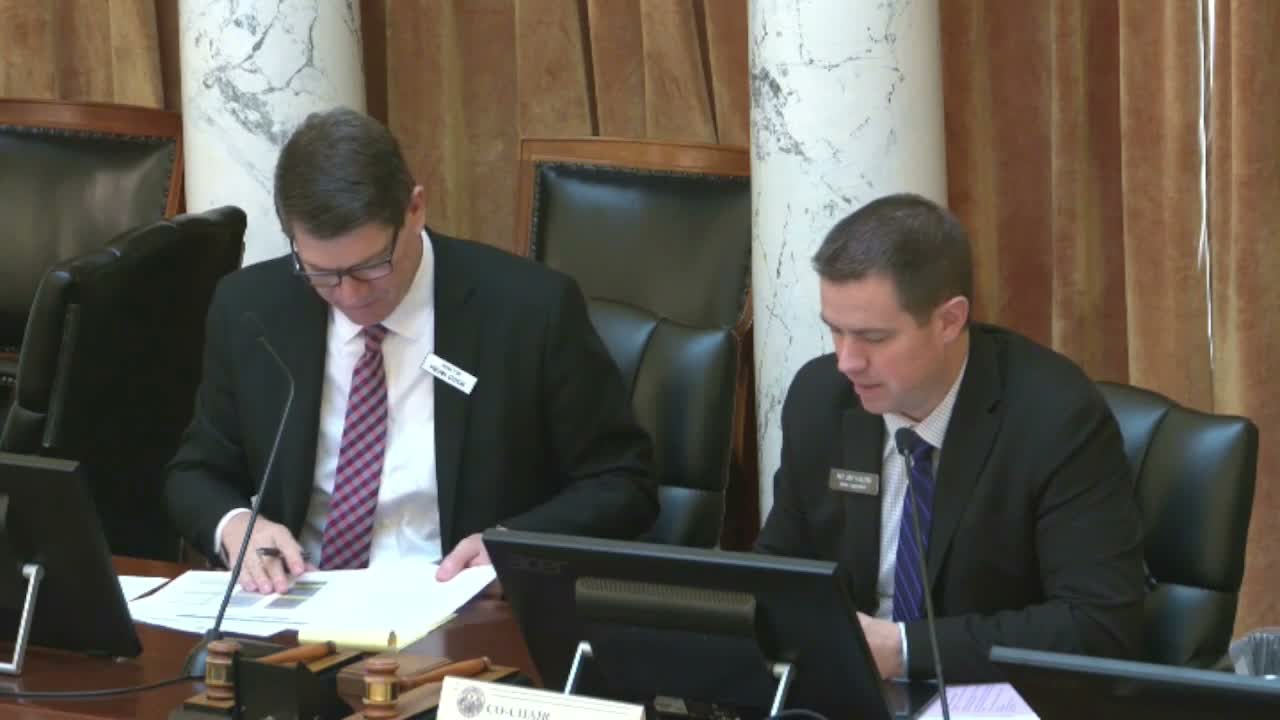
Christopher Lahoset, a budget and policy analyst with the Legislative Services Office, opened the committee’s presentation and walked members through the worksheet showing left-column FY2026 estimates, middle-column FY2027 and comparisons to the governor’s recommendation. He apologized after members identified a copying/formula error in the spreadsheet and said, “My sincerest apologies to the committee, there was a formula issue in the spreadsheet.” The panel recessed briefly so staff could verify original inputs and return with corrected numbers.
Committee members debated which method to use to set the official projections. Representative Blaylock initially moved a set of projections and Representative Miller offered a substitute based on committee averages; Representative Monks then offered an amended substitute using the committee median. Senator Grohl cautioned against setting projections too low given uncertainty about potential tax conformity changes and said he was “nervous to pull money out of stabilization funds” if revenues proved worse than projected. Representative Blaylock argued the projections should reflect anticipated receipts to avoid overestimating revenue next year, saying the state has historically spent the dollars it expects to receive.
Representative Tanner described the economy as relatively strong compared with other states and said his estimate fell near the committee’s middle, calling the median-based number “conservative” in his view. Senator Cook, who joined discussion in support of a more conservative approach, said she preferred erring on the side of lower revenue so any surplus could be returned or used cautiously.
After discussion, the committee voted on the amended substitute motion adopting the median-based projections. The roll-call vote resulted in a 10–8 margin in favor of the median-based projections. The chair said the adopted numbers would be inserted into the committee’s report to JFAC.
Members then reviewed a standard template letter that would accompany the projections to JFAC; staff had populated the motion language and the chosen numbers. Representative Van der Rato moved to adopt the language of the report as shown on screen; the motion was seconded and the committee voted to approve the report language. The roll call produced 17 ayes and 1 nay. The chair said the committee’s work was concluded and that the report will be presented to JFAC the next morning. The committee adjourned.
The meeting record shows two formal actions: the adoption of the revenue projections (10–8) and adoption of the report language to JFAC (17–1). The committee noted the spreadsheet correction and a roughly one-tenth of a percent adjustment to FY2026 estimates following the correction; members discussed tax conformity risk and tradeoffs between conservative forecasting and the risk of understating available resources.