Get Full Government Meeting Transcripts, Videos, & Alerts Forever!
Get email alerts on the Police Oversight topic
No spam. Unsubscribe anytime.
Residents demand answers after Nov. 25 ICE operation; council OKs investigations and policy review
Summary
Hundreds of residents, legal observers and journalists testified that St. Paul police used chemical agents and other crowd-control tools while federal agents conducted a November 25 immigration operation. The council pledged multiple investigations, a financial audit of police expenditures and an ordinance review to limit city support for federal immigration actions.
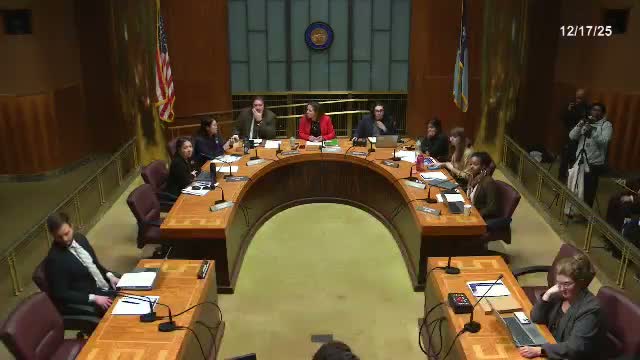
Hundreds of residents, legal observers and local journalists told the St. Paul City Council on Dec. 17 that the city’s police department used tear gas, pepper spray and impact projectiles while federal agents conducted an immigration operation on Nov. 25 on the East Side.
"We want answers," independent journalist Georgia Ford said, recounting video she recorded and posting evidence alleging SPPD used excessive force and coordinated with federal agents. "How long will the investigation take? When will body camera footage be released?"
Multiple speakers described the same sequence: federal agents arrived at a private residence; St. Paul officers then formed lines, deployed chemical agents and used less‑lethal munitions, and at times appeared to secure a boundary for federal agents. Miguel Bridal, a West Sider who said he was on the front lines, said, "The presence of the St. Paul Police Department escalated the situation," and urged the council to stop SPPD from legitimizing federal arrests that community members say lacked warrants.
Speakers included community leaders, veterans and nonprofit directors who noted long-term harms to trust and neighborhood safety. "Our immigrant neighbors are being terrorized," said Jelani Hussain of Care of Minnesota. Witnesses also described attacks on journalists; three reporters were injured during the Nov. 25 events, testimony said.
Council members acknowledged the testimony and outlined immediate follow-up steps. Councilmember Molly Jost said the council will review records compiled by the police department’s internal affairs unit and seek the full investigatory record rather than a summary of findings. Vice President Kim urged that city resources not be used to aid federal immigration enforcement and said she has been consulting peers in other cities about stronger separation measures.
Councilmember Amy Coleman listed three investigations the council is pursuing: an internal affairs probe within SPPD, a POST‑board investigation into uses of force and possible violations of model policies, and an audit by the Office of Financial Services to account for overtime and other costs tied to the operation. Coleman also said the council will prioritize a review of the separation ordinance and work on clearer limits for staging federal agents in public spaces.
Several speakers asked the council to move faster than the typical pace of municipal investigations. "This investigation needs to happen sooner than later," Michelle Gross, president of Communities United Against Police Brutality, told the council, adding that the department violated model policies on crowd engagement and press protections.
Council members asked community members to file specific complaints where required for POST‑board review and offered staff assistance in navigating investigatory pathways. The council committed to pursue additional policy options early in 2026 and to hold further public hearings so residents can continue to share testimony.
The council closed the hearing after extended testimony and stated it would return to the agenda of investigatory steps and ordinance drafts in January. The next formal council meeting is scheduled for Jan. 7, 2026.