Get Full Government Meeting Transcripts, Videos, & Alerts Forever!
Get email alerts on the State Of City topic
No spam. Unsubscribe anytime.
Kenosha mayor highlights infrastructure, housing and public-safety gains in 2026 State of the City
Summary
Mayor David told the Common Council the city reduced its share of property taxes while maintaining core services, expanded public-safety programs (blood on ambulances), advanced downtown redevelopment and committed tens of millions to stormwater and road projects.
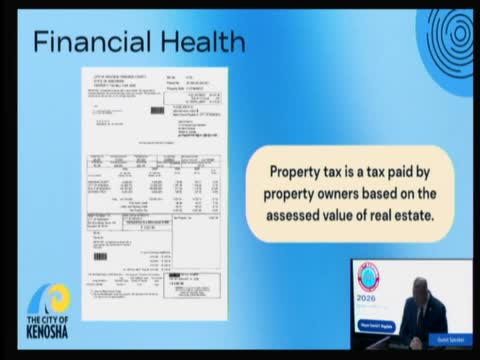
Mayor David delivered his 2026 State of the City address to the Kenosha Common Council, saying the administration balanced a difficult budget while preserving core services and cutting the city's portion of the property tax.
The mayor framed 2025 as a year of transition and transformation, citing investments in workforce and higher-education partnerships, the opening of the Kenosha Innovation neighborhood and progress on downtown redevelopment. "No mayor governs alone," he said, thanking council members and city staff for what he described as cooperative governance.
The address included several specific budget and program claims. The mayor said the 2026 budget avoided cuts to public safety, parks and public works while lowering the city's portion of property taxes. He highlighted public-safety measures: the Kenosha Fire Department became the first in Wisconsin to carry blood on frontline ambulances; since launching the program in April paramedics administered 16 units of blood to 12 patients, the mayor said. He also said overall crime in 2025 dropped about 11% compared with 2024.
On infrastructure, the mayor said the city is investing in resurfacing and larger projects: $3,500,000 planned for citywide resurfacing in 2026, nearly $10,000,000 in stormwater projects for 2026 to protect against flooding, and a multi-year investment approaching $48,000,000 through 2030 to strengthen critical systems. He announced plans to start reconstruction of 22nd Avenue from 50th Street to Washington in 2026 and noted completed work on 39th Avenue and improvements along 20th Avenue.
Economic development and placemaking were also front and center. The mayor touted higher-education partners (Carthage College, University of Wisconsin–Parkside, Gateway Technical College and Herzing University) as talent pipelines and highlighted the city’s push to be a college town that retains graduates. He pointed to the Carrick building opening and the Innovation neighborhood as evidence of downtown revitalization. He named local entrepreneurs and community events to illustrate the city's cultural and economic progress.
Why it matters: The address laid out the administration's priorities for 2026—public safety, housing, jobs and infrastructure—while offering concrete program claims that will guide council oversight and committee work. Several items noted by the mayor will require continued council action or capital planning, including ongoing street reconstructions and multi-year stormwater projects.
What happens next: Council members thanked the mayor during alderpersons’ comments and the meeting proceeded to public comment and regular agenda business. Funding, project schedules, and any subsequent ordinance or bond measures will be considered through the committee process and future council meetings.