Get Full Government Meeting Transcripts, Videos, & Alerts Forever!
Get email alerts on the Rail Trail Acquisition topic
No spam. Unsubscribe anytime.
Council hears detailed plan to buy Bonita‑Estero rail corridor; staff seeks direction on purchase vs. lease
Summary
Trust for Public Land briefed the Estero Village Council on a proposed acquisition of an 11.4‑mile rail corridor (4.1 miles in Estero) and two contract options: a direct purchase (target close Oct. 2026) or a two‑year lease‑purchase. TPL reported a renegotiated price near $60 million and outlined due diligence, estimated costs and a March decision timeline.
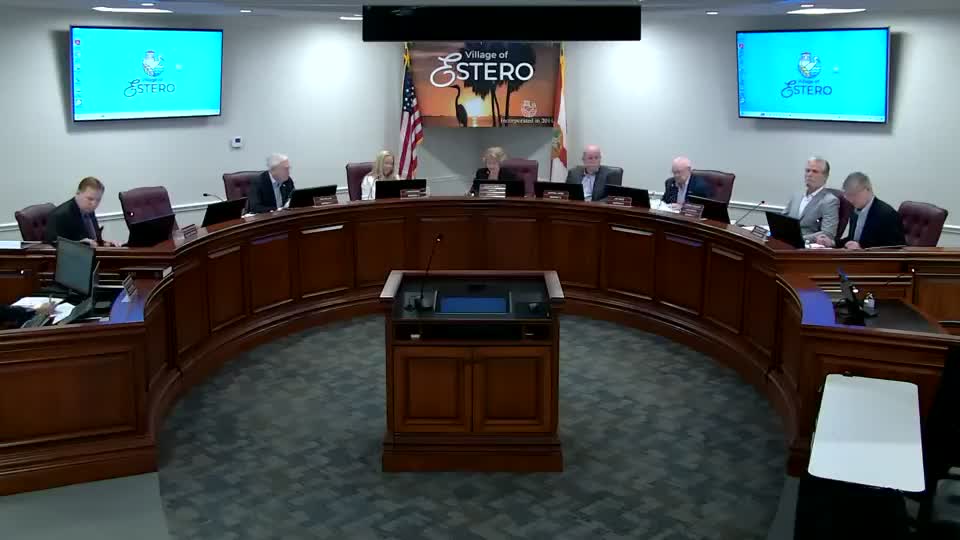
Doug Hathaway, Southeast regional conservation director for the Trust for Public Land, told the Village of Estero council at a Feb. 18 workshop that the group seeking to acquire the Bonita‑Estero rail corridor has narrowed the current phase to 11.4 miles — about 4.1 miles of which lie inside Estero — and is presenting two options to the village: a straightforward purchase or a two‑year lease‑purchase agreement.
The presentation said the corridor had been under a prior contract for 14.9 miles at $70,440,000; after renegotiation with the owner, Seminole Gulf, the current phase price was reported at about $60,000,000. Hathaway described the Trust’s role as interim buyer: TPL would purchase from Seminole Gulf, complete due diligence, and then convey the property to participating local governments according to negotiated shares.
Hathaway told the council the acquisition is intended to plug a regional trail gap, connect communities along the Gulf Coast Trail, and deliver safety, public‑health and economic benefits associated with rail‑to‑trail conversions. He said the village’s portion is roughly 19.8 percent of the current price allocation, while partner shares were shown as Bonita Springs ~28.5 and Collier County ~11.6 (presented as rounded values).
The Trust outlined the required due diligence and an anticipated schedule. Key steps include two updated appraisals, title work, a boundary survey and a Phase‑1 environmental site assessment (with Phase‑2 sampling if needed). Hathaway gave ballpark costs: appraisals and title research in the low‑to‑mid $30,000 range each, a boundary survey perhaps $150,000–$200,000 for the corridor, and potential Phase‑2 ESA sampling in the ~$50,000 ballpark. Combined due‑diligence costs shared among partners were described as roughly $250,000 as a working estimate.
Hathaway also explained railbanking — the federal interim‑use program that preserves corridor continuity while allowing trail use. He said rail reactivation is rare and would require a Surface Transportation Board process; reactivation would also trigger reimbursement calculations under contract terms and could be costly to a later reactivating operator.
Council members asked detailed questions about environmental review timing, appraisal methodology, the relative costs of purchase versus lease‑purchase, and what local financial commitments might be required. Staff and the Trust said a purchase and sale would likely close in October 2026 if due diligence and appraisals are satisfactory; the lease‑purchase option was described as a two‑year term with an initial payment (TPL’s memo lists roughly $15,000,000 in base rent for year one and a second‑year payment of $2,396,105 as part of the seller’s proposed lease terms) and additional finance carrying costs that would not be credited if the village chose not to close.
Members of Friends of Burt, a local advocacy and fundraising group, spoke during public comment to urge moving forward. Speakers said the group has raised about $140,000 in cash with approximately $160,000 in pledges for amenities and maintenance — funds they said would not be applied to the purchase price but could accelerate construction and amenities after land acquisition.
The workshop closed with staff requesting council guidance and a March timeline for a formal decision on whether to proceed with a purchase or the lease‑purchase path and to authorize the due‑diligence work. Several council members signaled they were willing to proceed with additional briefings and one‑on‑ones; at least one member registered opposition to moving forward at this time. Staff said they would schedule follow‑up briefings, provide more detailed cost breakdowns, and return with materials ahead of a March authorization vote if the council wishes to proceed.