Get Full Government Meeting Transcripts, Videos, & Alerts Forever!
Get email alerts on the Emergency Alerts topic
No spam. Unsubscribe anytime.
Saint Paul emergency management explains IPAWS, Everbridge and opt‑in ENS — emphasizes trust and roles
Summary
The city’s emergency management director briefed council on public alerting systems: IPAWS (FEMA/WEA, sent by Ramsey County for life‑threatening events), Everbridge (localized community alerts), and the city’s ENS (opt‑in administrative messages). The director emphasized preserving trust by limiting loud alerts to true emergencies.
Director Schuch, who leads Saint Paul’s emergency management functions, told the council that alerting is a trust decision and described the mix of tools the city uses to reach residents.
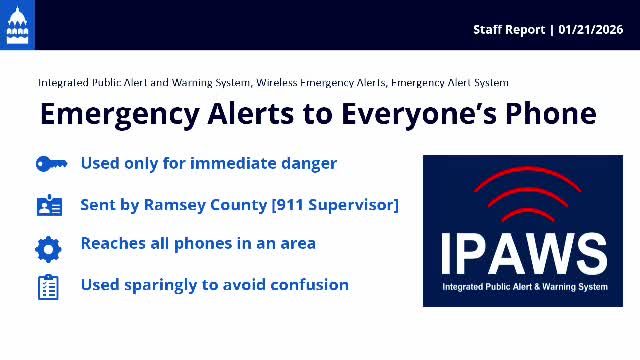
He explained that IPAWS (the Integrated Public Alerts and Warnings System) — the system that delivers wireless emergency alerts — is governed by FEMA and the FCC and is used only for immediate life‑saving threats; notably, IPAWS messages are transmitted by Ramsey County’s emergency communications center, not directly by the city. “This is the loudest alerting tool available... It’s used only for immediate life saving threats,” Schuch said.
For localized threats the city relies on Everbridge, which allows precise, polygon‑based opt‑in alerts and is similarly sent by Ramsey County for community messages; the city also uses Everbridge for internal workplace coordination. Schuch described ENS (managed by the city clerk) as an administrative opt‑in messaging service for legislative and administrative notices and encouraged careful separation of systems so residents do not become desensitized to emergency alerts.
Schuch concluded that roles and responsibilities are intentionally separated to protect credibility and avoid overuse. The council thanked staff and requested a deeper policy briefing at a future policy meeting to explore use and customization of the systems for ward‑level messaging.
Next steps: Staff to return with a longer report and options for ward‑ or district‑level opt‑in messaging, including administrative steps for district councils to use ENS opt‑ins.