Get Full Government Meeting Transcripts, Videos, & Alerts Forever!
Get email alerts on the Ohv Education topic
No spam. Unsubscribe anytime.
Committee weighs extending mandatory OHV safety course to operators and rental customers
Summary
The committee discussed expanding the existing mandatory OHV course requirement to include operators (not just owners), asked whether rentals should require on-the-spot training, and heard public testimony proposing a statewide ambassador education nonprofit to support outreach.
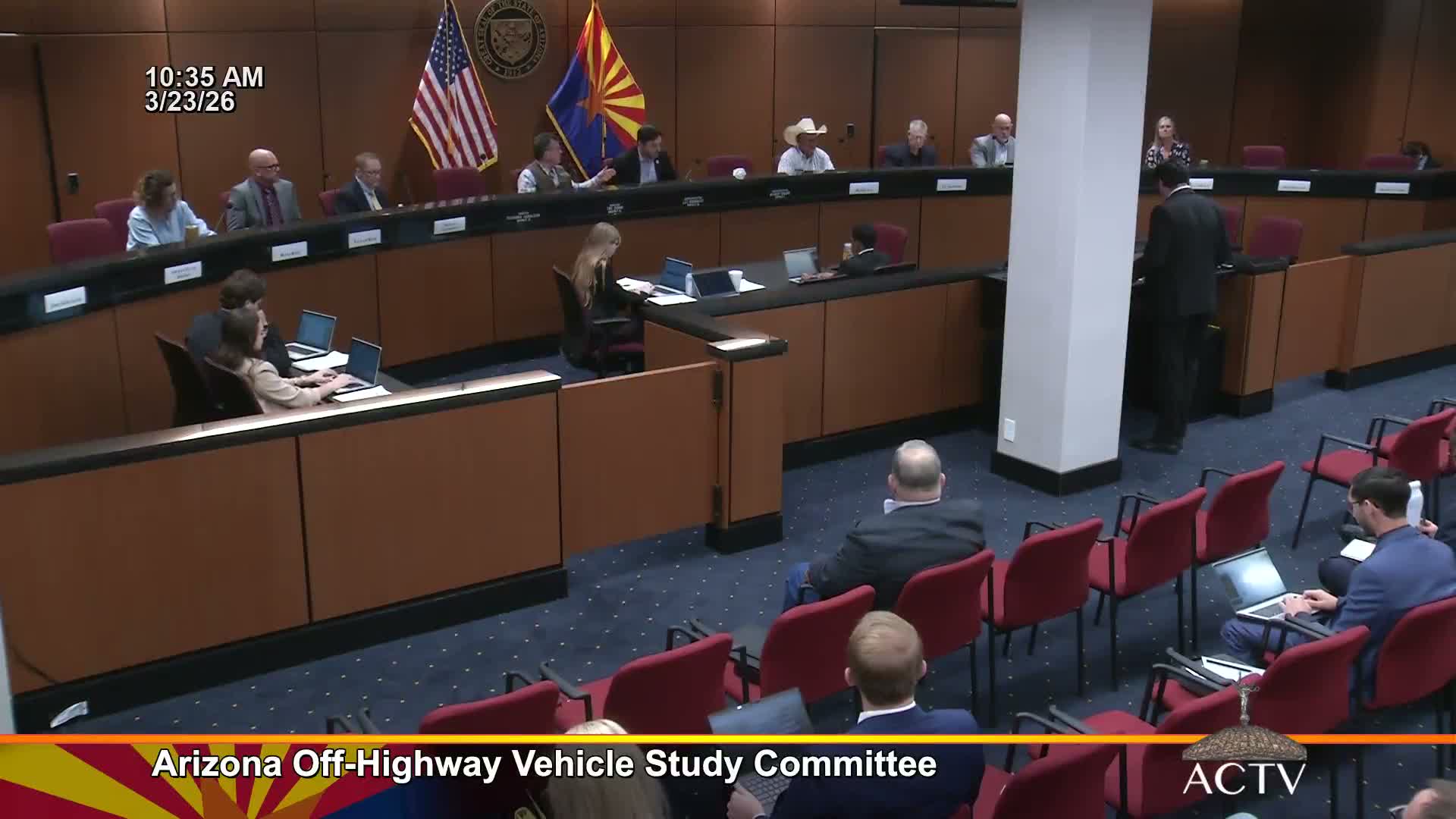
The Arizona Off Highway Vehicle Study Committee discussed whether the OHV education requirement now in law should be expanded from owners to all operators and whether rental operators should be required to provide certified training.
Sawyer Bessler told the committee that Senate Bill 1567 (passed in 2024) requires completion of an OHV course before ADOT may issue a resident or nonresident OHV user indicia and that Arizona Game and Fish must submit a report on implementation, revenues and costs by 12/01/2026. "By 12/01/2026, the Arizona Game and Fish Department is required to submit a report ... regarding the results of implementing the OHV course," Bessler said.
An Arizona Game and Fish OHV law enforcement program coordinator described observed, anecdotal safety improvements since mandatory education took effect, noting particularly that "children wearing helmets" has increased, but said they do not yet have accident statistics. Several committee members argued that a single statewide, standardized online course would create consistency and make enforcement and verification easier for officers.
David Quine of the nonprofit Riding Arizona said his group is reviving an ambassador program to provide on‑the‑ground education and outreach and that the organization expects to be operational by the fall riding season. Quine said such grassroots efforts could supplement any statutory training requirement and endorsed extending the requirement to operators, not just owners.
Committee members debated a phased approach: one suggestion was to require renters to take training first, similar to some boating rules, with broader operator requirements considered later. The committee did not adopt a formal recommendation on expanding the statutory requirement but incorporated the education discussion into its broader deliberations on mitigation and enforcement funding.