Get Full Government Meeting Transcripts, Videos, & Alerts Forever!
Get email alerts on the Tax Policy topic
No spam. Unsubscribe anytime.
Idaho House passes tax-conformity bill after heated debate over fiscal impact
Summary
The Idaho House passed House Bill 5 59, a tax-conformity measure estimated in a fiscal note at about $155 million for the fiscal year, after floor debate that questioned the size and reliability of that estimate and potential cuts to state services. The bill moves to the Senate.
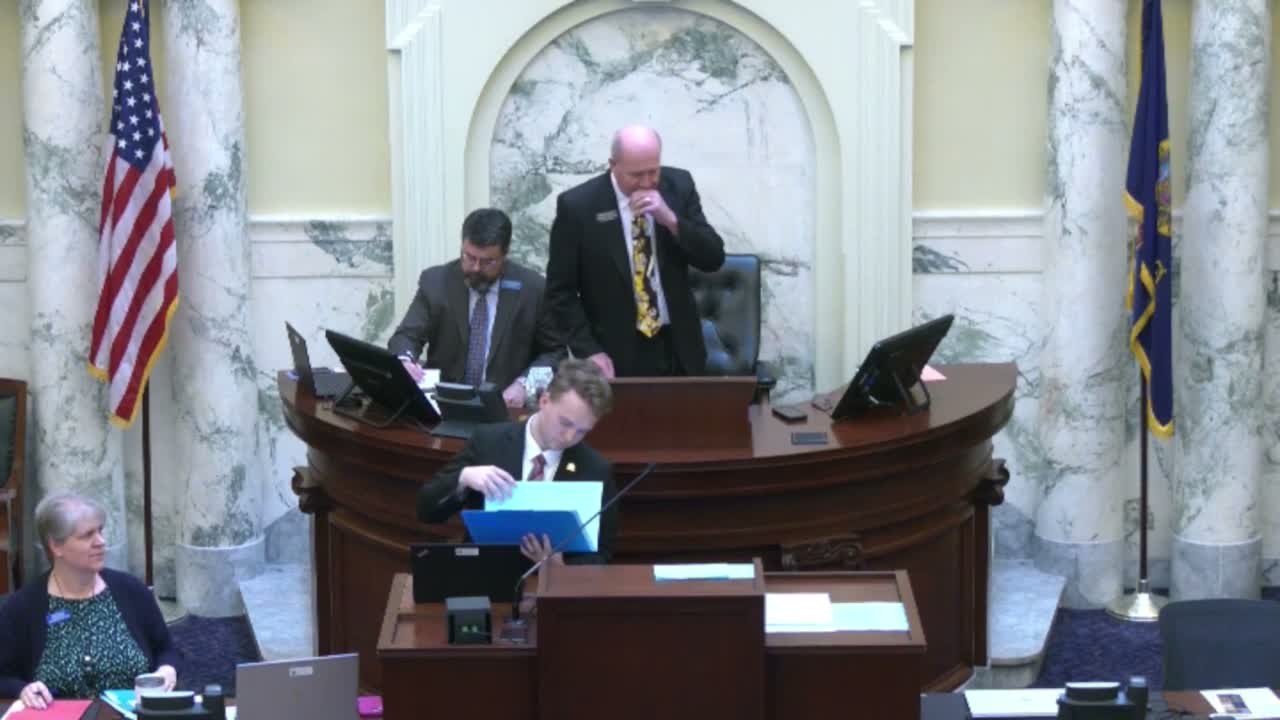
The Idaho House voted to pass House Bill 5 59 on Feb. 2, 2026, a statute to conform portions of the state tax code to recent federal changes, after extended floor debate over its fiscal consequences. The electronic tally was recorded as 59 yes, 9 no, and 2 absent; the Speaker announced the bill passed and will be transmitted to the Senate.
Supporters said the bill eases compliance and delivers tax relief to working families and seniors. The bill’s floor sponsor described HB 559 as "about tax cuts for the people of Idaho" and said the measure includes provisions to align research-and-experimentation (R&E) deductions so businesses can deduct current-year R&E spending beginning in 2025 while smoothing prior accumulated R&E amortization over several years.
Sponsors pointed to the Idaho Tax Commission’s analysis and to a midpoint fiscal note of roughly $155,000,000 for fiscal year 2026, with the sponsor noting the commission’s low and high estimates ranged about $111,000,000 to $192,000,000. The sponsor also emphasized that the bill does not adopt federal bonus depreciation, which would materially increase conformity costs.
Opponents said the fiscal uncertainty makes the proposal risky while the state faces budget shortfalls. One member warned that "when you're in one [a hole], stop digging," arguing that reductions of this scale would force cuts to services such as disability care, nursing care and mental-health programs. Members opposing the bill urged deferral, a scaled-down conformity, or more vetting of the fiscal estimate before adopting broad tax changes.
Members also raised administrative questions about corporations that previously underpaid under nonconforming rules. A member asked what protections businesses would have for penalties or interest; the sponsor replied that companies that underpaid did so under the prior law and that penalties and interest apply under current tax law.
The bill’s passage followed multiple rounds of debate in which lawmakers traded policy and fiscal arguments: proponents framed conformity as simplifying tax administration and putting money back in taxpayers’ pockets; critics emphasized the timing and the potential need to preserve revenue to fund essential services.
After the vote the House approved the bill title and completed routine floor business; members announced committee schedules and recognized visitors from the community. The bill will now proceed to the Senate for further consideration.