Get Full Government Meeting Transcripts, Videos, & Alerts Forever!
Get email alerts on the Utilities topic
No spam. Unsubscribe anytime.
Sunrise warns of roughly $200 million in unfunded utility mandates; commission approves rate study and sludge-hauling contract
Summary
City staff told the Sunrise City Commission that new federal and state mandates on PFAS, biosolids and cybersecurity could require roughly $200 million in capital and operating spending; the commission approved a revenue-sufficiency (rate) study and a temporary sludge-hauling contract to keep service while a regional solution is designed.
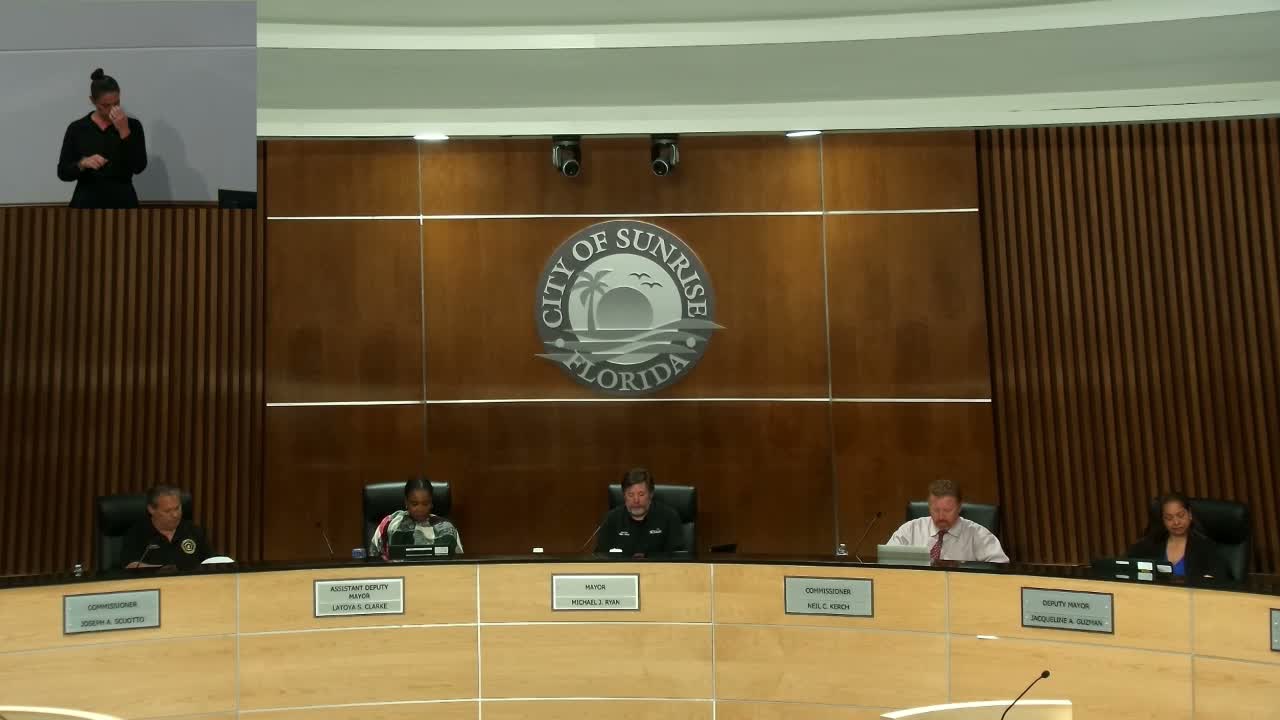
City Manager Mark Lubelski and Utilities Director Rodrigo De Castro told the Sunrise City Commission on March 10 that new federal and state regulations—most notably EPA drinking-water limits for PFAS and stricter state rules on biosolids—will require large, largely unfunded investments in the city’s water and wastewater system.
"It is expected that more than $200,000,000 in investment on both capital improvements and operational costs will be necessary to comply with all those unfunded mandates," Rodrigo De Castro, director of utilities, said during a presentation to the commission.
Why it matters: Sunrise owns and operates a utility system that serves more than 63,000 meter accounts across Sunrise and parts of neighboring municipalities. Staff said the city already has some treatment capacity at the Sawgrass plant that removes PFAS, but other plants need upgrades before the EPA compliance deadline, and biosolids disposal rules are shrinking available land-application sites statewide, driving disposal costs sharply higher.
PFAS and treatment plans: De Castro said the EPA established maximum contaminant levels (MCLs) for several PFAS compounds in 2024 and set a compliance schedule that staff now treat as effectively 2031. Sunrise’s testing found PFAS in raw-water well fields at Sawgrass, Springtree and Southwest. The Sawgrass facility already uses nanofiltration and requires no PFAS retrofit, he said. Springtree and Southwest will require conversions and expansions: phase one at Springtree is under construction as a nano-filtration conversion (about $4.7 million and nearing completion), phase two is in design (roughly $7 million), and a larger expansion could run near $100 million.
Biosolids and regional solution: De Castro described steep increases in disposal cost and shrinking availability of permitted land-application sites in Florida. The utilities working group’s consultant recommended a county-owned, regional thermal-drying facility sized for 270,000 wet tons per year at a county site near Powerline Road, with an estimated capital cost of $500 million. Sunrise’s estimated share of that project was described as a $5 million design share and about $45 million toward construction reflecting an approximate 10% allocation of capacity; staff said operating costs for Sunrise’s share could be in the $1.3–$1.5 million per year range once the facility is built. De Castro noted Sunrise is also entitled to roughly $14 million in PFAS settlement funds tied to its withdrawal from the Biscayne Aquifer.
Short-term procurement and rate work: To manage near-term needs while larger regional solutions and capital projects move forward, the commission approved two items tied to utilities planning: a resolution to contract with Raftelis for a 2026 revenue-sufficiency update (a rate study) and a resolution to award a sludge hauling and disposal contract to H and H Liquid Sludge Disposal Inc. The commission voted 5–0 on both items. De Castro told the commission the new hauling price under the contract is about $132 per wet ton (up from the prior contract’s roughly $84 per wet ton), reflecting statewide disposal-market pressures.
Mayor Michael J. Ryan framed the issue as an urgent regional challenge: "We're truly facing a financial crisis if we don't—if the communities as a whole in South Florida don't figure out a way to deal with this," he said, urging close review of interlocal agreements, operating allocations and protections for Sunrise ratepayers.
Next steps: Staff told the commission a revenue-sufficiency study will take approximately six to nine months after a notice to proceed; the city will return with a second reading of the budget amendment and with interlocal agreement language for the regional design work later this year. Staff also said they will continue to pursue grants and other funding opportunities to offset capital needs.
What the commission decided: The commission approved the Raftelis revenue-sufficiency contract and the H and H sludge-hauling contract, and directed staff to provide more detailed legal and financial protections when the interlocal agreement for design and construction returns to the commission for approval.