Get Full Government Meeting Transcripts, Videos, & Alerts Forever!
Get email alerts on the Hb 4134 Lodging Tax Wildlife Funding topic
No spam. Unsubscribe anytime.
Senate committee hears hours of pro and con testimony on bill to raise lodging tax for wildlife funding
Summary
The Senate Committee on Finance and Revenue heard extensive public testimony Feb. 25 on House Bill 4134, a proposal to raise the state transient lodging tax by 1.25 percentage points to fund wildlife conservation, wolf compensation and the Oregon Conservation Corps; testimony was split and no vote was taken.
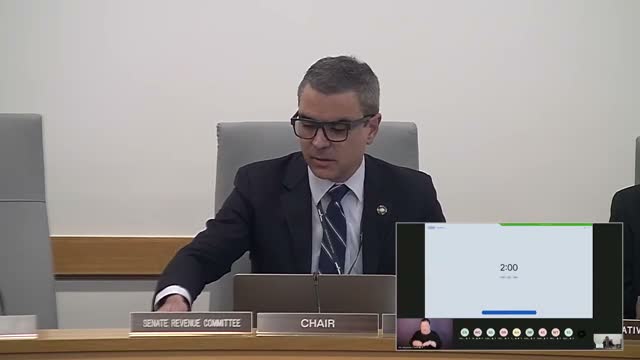
The Senate Committee on Finance and Revenue heard hours of testimony on Feb. 25 over House Bill 4134, a proposal to raise the state transient lodging tax by 1.25 percentage points to provide stable funding for wildlife conservation programs, wolf depredation compensation and the Oregon Conservation Corps. The committee took testimony for and against the measure and carried over remaining testimony to the following day; it did not take a vote.
Supporters said the modest increase would provide predictable funds to implement the State Wildlife Action Plan, unlock federal matching grants and sustain programs that underpin the state’s outdoor recreation economy. Representative Ken Helm said a broad coalition backs the bill and pointed to “roughly 90 organizations” and 125 businesses that support the proposal. “We view this as a complement to tourism,” Helm said, urging the committee to pass the bill to the Senate floor.
Senator Todd Nash, who testified in support, described wolf-compensation needs as chronically underfunded and told the committee that his office’s estimate for the current biennium is about $4,300,000 for wolf compensation; he said HB 4134 would provide roughly $3,600,000 toward that need. “Ranchers are losing tens of thousands of dollars,” Nash said, and the dedicated stream would provide relief for rural constituents.
Conservation groups and natural-resources organizations repeatedly framed the increase as an investment in the resource that drives tourism. Danielle Moser of Oregon Wild argued the bill funds the State Wildlife Action Plan to stem species decline; Charlie Plyben of Surfrider Foundation and others stressed the economic link between healthy ecosystems and coastal recreation. Supporters also highlighted wildfire-risk reduction through expanded funding for the Oregon Conservation Corps, with Travis Worthington testifying that predictable funding means more acres treated and more trained crews in the field.
Opponents, including the Oregon Restaurant and Lodging Association and several destination-management organizations, urged the committee to reject the increase or seek alternate funding sources. Jason Brandt, president and CEO of the Oregon Restaurant and Lodging Association, described the proposal as an $38,000,000 annual increase in statewide lodging taxes and warned it would harm the competitiveness of Oregon’s visitor economy. “A yes vote today would dismantle one of our last remaining revenue streams dedicated for economic development,” Brandt said.
Destination managers and convention planners said the bill changes the statutory purpose of the state lodging tax, which has historically been used to promote tourism and reinvest visitor dollars in marketing and events. Megan Conway, who leads destination marketing for Portland, said raising the statewide rate would put Portland at a competitive disadvantage for large multi-day conventions and cited data showing the Portland region’s visitor volume and employment remain below pre-pandemic levels.
Several speakers argued the bill would mostly be paid by out-of-state visitors; other witnesses and representatives disagreed about how much of the burden would fall on Oregon residents and small economy hotels. Representative E. Warner Raschke characterized the measure as a tax that could reduce tourism and called wolf compensation a budget-priority issue rather than one that requires a lodging-tax increase. Independent and economy-hotel operators warned the increase would hit patrons with low margins or cash payments and could further strain fragile lodging markets.
Witnesses on both sides raised numeric estimates: proponents and conservation groups repeatedly cited roughly $37 million to $38 million in projected annual revenue and argued that amount would allow agencies to match federal grants and to fund habitat and species work; opponents emphasized localized impacts, citing examples of hotels in receivership and losses in room-night volume in downtown Portland.
The hearing featured repeated appeals to the committee’s policy choices: supporters urged longstanding underfunded wildlife programs be addressed with a dedicated funding stream tied to visitor benefits; opponents cautioned against setting a precedent that would divert statutorily dedicated tourism funds to other state agencies. After hours of testimony, the chair carried over further public testimony to the next scheduled hearing day and adjourned without taking formal action.
The committee is scheduled to continue receiving public testimony the next day; no committee vote was held on HB 4134 on Feb. 25.