Get Full Government Meeting Transcripts, Videos, & Alerts Forever!
Get email alerts on the State Budget topic
No spam. Unsubscribe anytime.
JFAC reviews proposed 2026 rescissions and cash transfers; votes set for Friday amid tax‑conformity uncertainty
Summary
The Joint Finance‑Appropriations Committee heard a detailed packet from DFM division manager Keith Ivy outlining proposed 2026 rescissions, agency exemptions, and recommended cash transfers. Members agreed to vote on options Friday but warned uncertainty over tax conformity and revenue puts final cuts at risk.
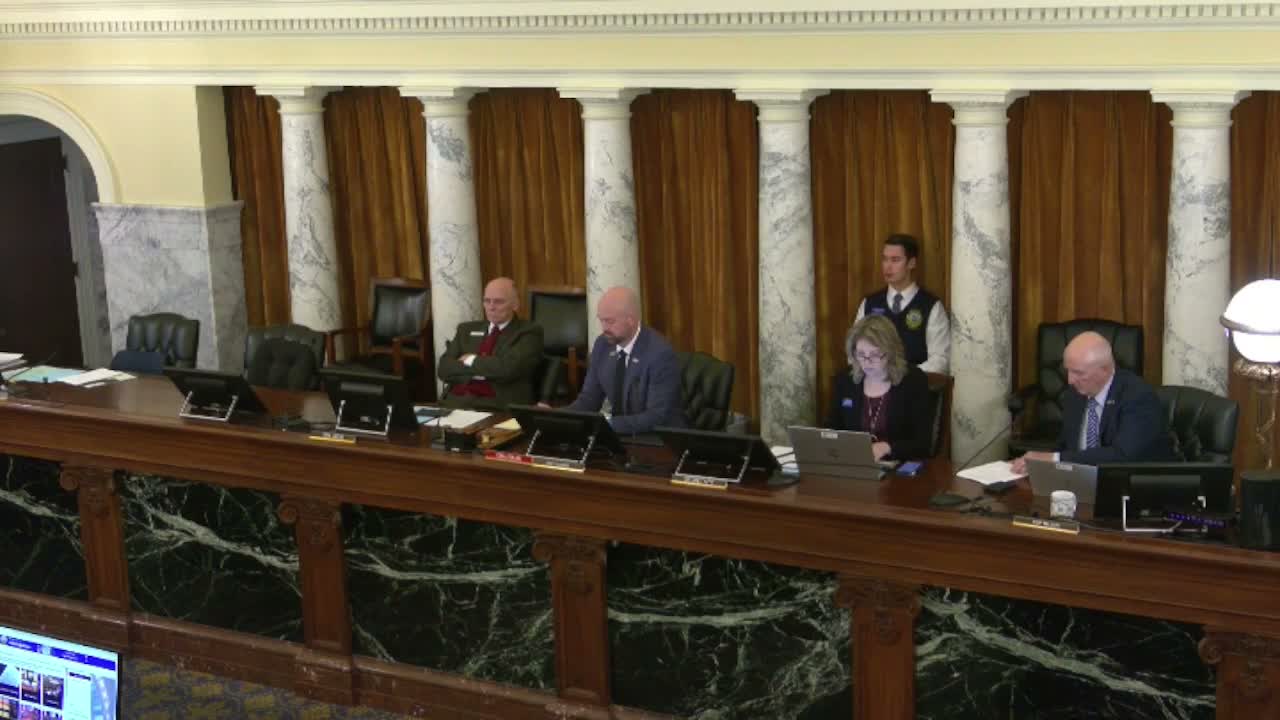
The Joint Finance‑Appropriations Committee heard a presentation from Keith Ivy, division manager for budget policy analysis, on proposed 2026 budget rescissions, agency‑level impacts and recommended cash transfers; the committee will take votes Friday to choose among reduction scenarios.
Ivy told members the packet includes a governor's holdback approach approximating a 3% reduction and additional scenarios agencies were asked to prepare. He presented figures the packet lists as $116,000,000 in general‑fund reductions, $9,000,000 from dedicated funds, $52,000,000 from federal funds — a total presented in the packet as $177,495,600 — and a reduction of almost 196.36 full‑time equivalent positions. Ivy said agencies supplied side‑by‑side spreadsheets and narrative reports to help work groups evaluate the options.
Why it matters: committee members said the size and timing of cuts — and whether they are treated as ongoing base reductions or as one‑time measures — will affect agency operations, supplementals and services across education, health and corrections. Multiple lawmakers cautioned that uncertainty about the prospective cost of tax‑conformity changes and recent revenue volatility make it difficult to lock in ongoing cuts without risking underfunding core functions.
Key details from the packet and presentation include: public K‑12 funding and Medicaid trustee/benefit dollars were largely held harmless in the additional scenarios, the Department of Correction’s $5,000,000 reduction was shown as unchanged under the 12% scenario, and Idaho State Police was not reduced under the 12% scenarios. Ivy noted the Secretary of State had renegotiated contracts and proposed a one‑time $850,000 return instead of taking the additional 1–2% holdback.
Ivy also reviewed recommended 2026 cash transfers that the packet ties to the General Fund daily update and said motions will be offered on each transfer. The packet lists a total presented as $106,000,745 (shown in materials as “$106,000,000, 745,000”) comprised of line items including $10,000,000 from the In Demand Careers Fund (Launch), $15,000,000 from the Water Pollution Control Fund, $45,000,000 pulled back from the Strategic Initiatives Fund, $3,000,000 from the Idaho Opportunity Scholarship Fund and $33,745,000 from the Permanent Building Fund. Ivy said each transfer will be a separate motion on Friday.
Committee members pressed several technical points. Representative Pesky asked why dedicated and federal columns showed large impacts when the governor's 3% holdback was described as a general‑fund holdback; Ivy explained those columns reflect agency responses about long‑term vacant positions and unallocated CEC reversions (from Senate Bill 1110 (2025)) that produce hits in non‑general funds as prepared in the packet. Senator Hart asked whether the legislature has authority to move funds in the treasury; Ivy said he knew of no statutory prohibition and reminded the committee that the legislature has plenary power to balance the budget.
The committee discussed mechanics for implementing personnel‑cost adjustments and statewide decision units. Ivy said the governor's budget included personnel benefit increases with a general‑fund impact of $62,491,400 and an all‑funds impact of $83,300,900 (the largest driver noted as a 14.4% health‑insurance increase). He presented two approaches committees might use to fund those increases: pay 95% of the recommended increase for agencies with more than 125 FTE or fund increases at agency‑specific filled rates; Ivy showed those approaches produce modest differences versus the governor’s recommendation.
Members repeatedly returned to the central uncertainty point: the potential fiscal impact of a separate tax‑conformity measure. Lawmakers cited working estimates (a figure of about $155 million was mentioned in committee discussion) but emphasized a wide range of possible outcomes and said that uncertainty is a principal reason the co‑chairs are presenting multiple reduction options now so work groups can refine agency adjustments.
What’s next: Ivy said members will vote on rescission options and cash‑transfer motions on Friday and that work groups this week (education and health and welfare were scheduled immediately after adjournment) are expected to dig into agency detail to add back or further trim appropriations as needed. The committee adjourned and will reconvene at 8 a.m. the following morning.
Quotes used with attribution are drawn from the hearing record. "My name is Keith Ivy. I'm the division manager for budget policy analysis," Ivy said while introducing the packet. "The word is uncertainty," a committee member said during debate about the need for conservative planning.
The committee did not take final action in this session; members prepared to take motions and votes at the Friday meeting.