Get Full Government Meeting Transcripts, Videos, & Alerts Forever!
Get email alerts on the Session Roundup topic
No spam. Unsubscribe anytime.
Oregon Senate advances broad slate of House and Senate measures; votes at a glance
Summary
The Oregon State Senate on March 3 opened with ceremonial remarks, heard floor remonstrances on liability and transportation, and moved dozens of House and Senate measures to passage — including bills on motor‑vehicle dismantler certificates, student attendance data, homeless‑student protections, EMS reimbursement flexibility, and behavioral‑health worker safety. Votes were recorded for multiple measures.
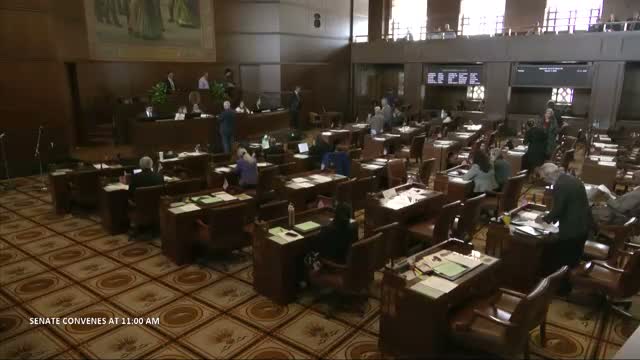
The Oregon State Senate convened March 3 in the State Capitol, opening with the Pledge of Allegiance and an invocation performance before the chamber moved through a fast‑paced third‑reading calendar that produced recorded votes on a broad package of House and Senate measures.
Sen. Robinson, speaking during a remonstrance period, criticized the current liability system for recreational facilities and contingency‑fee arrangements for trial lawyers, saying the pattern of lawsuits has become "a high stakes extortion racket" that increases costs for providers. Sen. Gorsek warned the Oregon Department of Transportation rebalance would shift funds to fill a reported $297,000,000 shortfall and cited cuts to programs including Safe Routes to Schools and Connect Oregon that she said could delay projects statewide.
On the floor, the senate suspended the constitutional requirement that bills be read section‑by‑section for the day's third‑reading calendar after a successful motion to expedite the slate. Senators then debated and recorded votes on multiple measures.
Notable measures that passed on third reading
- Senate Bill 1544 (third reading and final passage): Sen. McLean described the measure as updating motor‑vehicle dismantler‑certificate requirements, removing a renewal approval step while retaining notice to adjacent property owners for expansions or relocations. The bill was declared passed after a roll‑call vote recorded as a constitutional majority (28 ayes).
- House Bill 4149 (homeless‑student protections): Carried to the floor as a codification of McKinney‑Vento protections, the bill places federal student‑stability protections into Oregon statute to preserve enrollment, transportation and dispute‑resolution rights for students experiencing homelessness. The measure passed on third reading (26 ayes recorded).
- House Bill 4154 (student attendance data): The bill directs the Department of Education to compile and publish key attendance metrics four times per year, including chronically absent rates disaggregated by student groups; sponsors described it as a low‑cost tool to address chronic absenteeism. The measure passed on recorded roll call (26 ayes recorded).
- House Bill 4156 (EMS reimbursement flexibility): Carried by Sen. Patterson, the bill broadens statutory language so Oregon can pivot to federally approved alternative reimbursement mechanisms for ground emergency medical transport payments if federal rules change; sponsors said the change preserves critical supplemental payments to EMS providers. The bill passed on third reading.
- House Bill 4157 (hearsay exception for trafficking survivors): The measure expands existing hearsay exceptions to allow certain statements taken by trained professionals or limited digital testimony to be submitted for survivors of human trafficking; sponsors and advocates urged the change would help victims participate in prosecutions. The bill passed on third reading (29 ayes recorded).
- House Bill 4160 (AEDs and cardiac response in schools): Supporters argued accessible automated external defibrillators and clear cardiac response plans can save lives; the bill passed on third reading.
Other bills that passed included measures addressing scrap‑metal theft and utility definitions (HB 4140), urgent‑care definitions and requirements (HB 4107), seed contract payment reporting (HB 4065), behavioral‑health statutory updates and workplace safety plans (HB 4070 and HB 4069), energy siting adjustments for surplus interconnection (HB 4076B), and a slate of additional house measures transmitted and referred by the clerk during the session.
Votes at a glance (selected third‑reading roll calls recorded on the floor)
- Motion to suspend section‑by‑section reading: carried (motion carried; roll call recorded). - Senate Bill 1544: passed (declared passed; recorded as a constitutional majority, 28 ayes). - House Bill 4107 (urgent care): passed (constitutional majority recorded). - House Bill 4137 (transfer of motor‑vehicle interest): passed (29 ayes recorded). - House Bill 4140 (metal property/scrap theft): passed (27 ayes recorded). - House Bill 4149 (McKinney‑Vento codification): passed (26 ayes recorded). - House Bill 4154 (attendance data): passed (26 ayes recorded). - House Bill 4156 (EMS reimbursement flexibility): passed (constitutional majority recorded). - House Bill 4157 (hearsay exception for trafficking survivors): passed (29 ayes recorded). - House Bill 4160 (AEDs in schools): passed (constitutional majority recorded). - House Bill 4076B (energy siting / surplus interconnection): passed (constitutional majority recorded).
What happened next
The senate recessed for lunch and returned to continue the third‑reading calendar, completing votes and advancing remaining referrals. The presiding officer adjourned the session with the senate set to reconvene at 10 a.m. on Wednesday, March 3.
Who said what (representative floor quotes)
- Sen. Robinson on liability litigation: "This has become a high stakes extortion racket with legal facilitators taking a large cut." (floor remonstrance urging reform.)
- Sen. Gorsek on ODOT: "The ODOT rebalance shifts funds from projects to fill the agency's $297,000,000 budget hole." (floor remarks raising concern about cuts to Safe Routes to Schools and Connect Oregon.)
- Sen. McLean on SB 1544: "This measure removes that renewal approval requirement... the fiscal impact of the measure is anticipated to be minimal." (bill presentation.)
Context and next steps
Several bills that passed will now be transmitted to the governor for signature or further processing as required by legislative rules. Many of the measures passed with bipartisan support on the floor; a few drew recorded or individual explanations of vote. Where the floor recorded roll‑call tallies, those results are listed above.
This recap focuses on substantive floor debate, formal motions and recorded outcomes. The transcript also contains a large number of ceremonial courtesies, visitor recognitions, and procedural announcements that are omitted here as non‑substantive.