Get Full Government Meeting Transcripts, Videos, & Alerts Forever!
Get email alerts on the Infrastructure Assessments topic
No spam. Unsubscribe anytime.
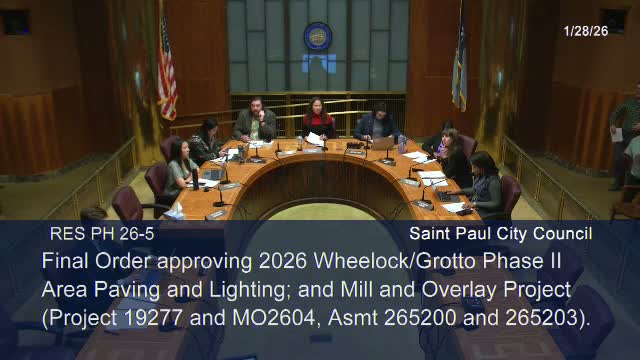
Council approves Wheelock Grotto and Earl Street final orders amid strong resident concern over special assessments
Summary
St. Paul council approved final orders for the Wheelock Grotto Phase 2 ($15.5M) and Earl Street reconstruction projects while residents criticized estimated special assessments and staff outlined assessment methodology, hardship deferrals and timing for final ratification.
The St. Paul City Council voted to approve final orders for two capital street projects — Wheelock Grotto Phase 2 and the Earl Street reconstruction — after staff presented project scope, estimated costs and a summary of assessment methodology, and after a series of residents testified about steep estimated special assessments.
Wheelock Grotto Phase 2: public works staff described a $15.5 million project that includes roughly two miles of reconstruction, new curb and gutter, 53,000 square feet of sidewalk replacement, sanitary sewer and water main replacements and green‑infrastructure work including three infiltration basins. Staff said about $3 million of the estimate is for utilities and the remainder is street reconstruction funded largely by street reconstruction bonds; estimated assessments for some properties were described as in the thousands.
Several residents told the council they were shocked by the preliminary assessment notices. Tom, a first‑time homeowner, said he and his wife were "shocked and dismayed" to receive proposed special assessments totaling "nearly $14,200" and asked the council to consider spreading more of the cost across the broader beneficiary pool. Another resident, Nathan Edmondson, said his estimated bill was about $10,000 and asked whether the city could use a higher share of bond financing to reduce individual assessments.
Office of Financial Services staff (Ms. Rolfe) explained the assessment process: the city begins with 25% as the assessable portion and 75% as city cost, then compares the calculated assessment to a special‑benefit cap determined from estimated market‑value increases; the final assessment is the lower of those two figures. She reiterated that current mailed amounts are estimated assessments; a later public hearing and final order will ratify final assessment totals after bids and actual costs are known. Ms. Rolfe also described a hardship deferral program for qualifying owners (age 65+, homestead, permanently disabled, active military) that postpones collection rather than forgives the assessment.
Earl Street: Transportation staff (Brian Graveland) presented the Earl Street reconstruction (full reconstruction from Maryland to Minnehaha, with future phases funded separately) and noted funding from the common‑sense sales tax plus assessments. Residents raised affordability concerns similar to Wheelock; council members noted the project is reconstruction (not simply mill and overlay) and that mill overlays are less durable.
Council action: With those staff clarifications, the council approved final orders for the listed reconstruction projects and confirmed that property owners will receive a separate ratification/public hearing once bids and final costs are known. Staff emphasized that estimated assessments are not due immediately and that payment terms (20 years for reconstruction, 10 years for mill/overlay) and appeal processes will be available.
Why it matters: Residents face substantial outlays if assessed, and the timing and structure of financing can determine whether homeowners absorb large immediate costs or spread them over years. Council members asked for a deeper public explanation of third‑party special‑benefit appraisals and for better public outreach to explain repayment options and appeals.