Get Full Government Meeting Transcripts, Videos, & Alerts Forever!
Get email alerts on the Law Enforcement Identification topic
No spam. Unsubscribe anytime.
Council advances ordinance to require visible identification for officers; public hearing set
Summary
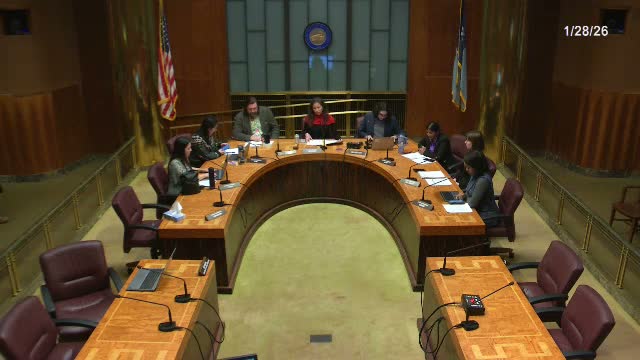
St. Paul council introduced ordinance 26-6 to require law‑enforcement officers performing duties in the city to visibly display identifying agency and name or badge number; council members pressed staff about exemptions and legal sourcing and laid the item over for a public hearing on Feb. 4.
The St. Paul City Council advanced a proposed ordinance that would require law‑enforcement officers performing duties in the city to visibly display agency and either a name or badge number on the outermost layer of their uniform. Council members laid the proposal over to the next meeting for a public hearing and potential amendments.
City staff member Mr. Greenfield, presenting the draft ordinance, described its intent as increasing transparency and accountability. He said the measure "requires law enforcement officers in the city of Saint Paul performing law enforcement duties to display visible identification" and walked the council through definitions of "law enforcement duties," "visibly display," and a set of initial exemptions.
Why it matters: Council members said the proposal responds to recent federal‑level enforcement operations and community anxiety over officers whose affiliation is unclear. Several members pressed staff on the scope of exemptions and the legal authority behind them, citing both local concerns and language drawn from other jurisdictions.
Council questioning focused on exemptions for undercover work, exigent circumstances and reasonable accommodations. Council member Bowie asked whether the "specific articulable particularized reason" language is rooted in state law or borrowed from other municipal codes; Mr. Greenfield said the drafters had reviewed statutes and similar California legislation and adapted language used elsewhere but that city attorneys will continue refining the text.
Council member Yang framed the proposal as a transparency measure, saying, "We want accountability. We want transparency," and cited local incidents in which residents said they were unable to obtain badge numbers after contact with federal agents. Vice President Kim said the ordinance is part of a sequenced approach of enforceable local measures the council is pursuing.
The draft includes limited exemptions (active undercover operations, investigative activities, exigent circumstances and occupational‑health accommodations) and attaches a misdemeanor offense under section 1.05 for willful, knowing violations. Staff said the ordinance is written to be effective 30 days after passage, mayoral signature and publication, but the council chose to hold a public hearing next week to solicit testimony and consider amendments before any final adoption.
Next steps: The council laid the item over to its Feb. 4 meeting for a second reading and public hearing. Council members and staff said they expect to continue refining exemption language with input from law‑enforcement partners and city attorneys.