Get Full Government Meeting Transcripts, Videos, & Alerts Forever!
Get email alerts on the Wastewater topic
No spam. Unsubscribe anytime.
Thompson's Station updates wastewater reservation rules, proposes percent-based nonresidential allocation
Summary
Staff presented a rewrite of the town's wastewater reservation ordinance to move routine approvals to staff and clarified the standard reservation agreement, automatic reversion provisions, and a shift from a fixed nonresidential allocation to a percentage-based model (15% commercial, 2.5% emergency). A developer requested six extra EDUs (approx. $70,000) for Thomas Downs; no final votes were taken.
Town staff presented a coordinated set of wastewater policy updates at the March work session, describing changes to the reservation process, the standard agreement, and allocation policy that the board will consider at a formal meeting.
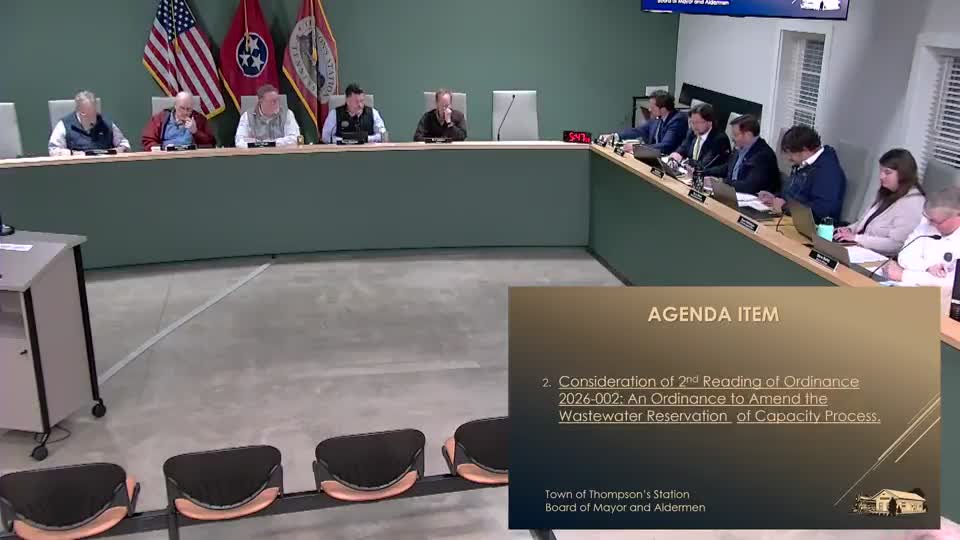
Staff framed Ordinance 26-002 as a process improvement to the wastewater reservation system adopted in 2020. The biggest operational change would be to move non-discretionary approvals from mandatory BOMA review to staff review and approval unless the standard reservation agreement is changed. Staff said the ordinance clarifies active versus inactive capacity, ties a one-year clock to an engineering letter and required milestones, and sets an extension process that brings milestone commitments back to the board for approval.
An accompanying update to the standard reservation agreement (Resolution 26-007) clarified that obtaining a reservation does not vest development rights, adds definitions for active and inactive capacity, and formalizes an "automatic reversion" process to allow the town to reclaim capacity for public safety or system integrity after notice and with the holder's right to contest.
Separately, staff described a proposed shift from a fixed 150,000-gallon-per-day economic-development allocation to a percentage model tied to active capacity: 15% for nonresidential/economic development and 2.5% for emergency/contingency uses. At the town's projected full buildout of 3,300,000 gpd, staff noted 15% would equal about 495,000 gpd and 2.5% about 82,500 gpd; staff emphasized the board retains discretion to approve or deny allocations.
The meeting also previewed a memorandum of understanding for the Thomas Downs subdivision: the developer seeks six additional EDUs (1,500 gallons per day) to expand from 12 to 18 lots and would pay upfront under current policy (estimated at about $70,000). Staff emphasized this discussion is preliminary; formal votes were not recorded and items will be on next week's BOMA agenda.
Board members asked for clearer cross-references between ordinance and agreement language and for explicit criteria tying reservation milestones to objective approvals (for example, PDP approval, plat recording or building permit), which staff said are addressed in the agreement and related sections.
No formal votes were taken at the work session; staff said the effective date language will apply to applications submitted after April 1.