Lifetime Citizen Portal Access — AI Briefings, Alerts & Unlimited Follows
Council approves first reading of PeaceDC omnibus with college-credit pathway for MPD and limitations adopted for transit SPO authority
Loading...
Summary
The D.C. Council approved first reading of the PeaceDC Omnibus (Bill 20‑6‑187) after adopting an amendment to allow up to 20 MPD academy credits to be certified through university partnerships and approving, by roll call, changes limiting special police officer (SPO) authority on WMATA pending further review.
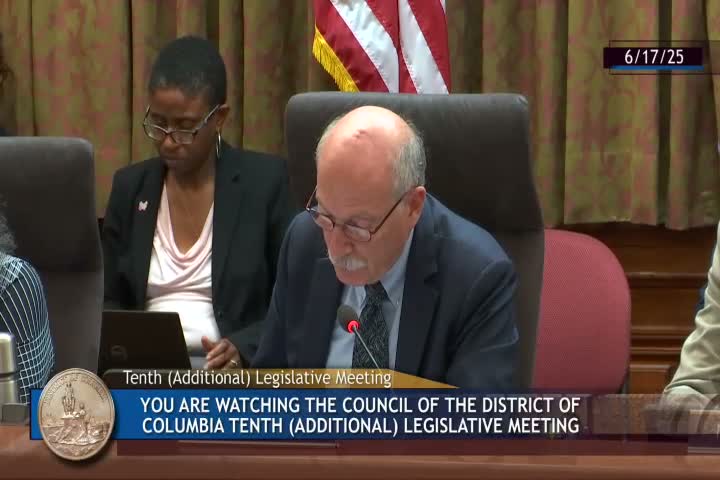
Councilmember Brooke Pinto moved and the D.C. Council approved first reading of the PeaceDC Omnibus Amendment Act of 2025 (Bill 20‑6‑187) on Tuesday, a multi-part public safety package that includes changes to pretrial detention presumptions, firefighter survivor benefits, college-credit recognition for Metropolitan Police Department recruits and a controversial expansion of citation authority for special police officers on WMATA.
The sponsor, Councilmember Brooke Pinto, said the package focused on “empowering our young people, preventing violence, supporting our public safety workforces, and reducing recidivism,” and asked colleagues to support a narrowly tailored amendment allowing up to 20 of the academy’s last credits to be certified if the MPD enters a partnership with an accredited university. "We really tried in developing PCC to focus on 4 categories," Pinto said, and described the credit pathway as a "bridge" for recruits who have some college but not the full 60 credits required.
Supporters of Pinto’s credit amendment argued it balanced recruitment challenges and training standards. Councilmember Charles Allen said the amendment "strikes a really good balance" and urged fine-tuning between first and second reading. The council adopted Pinto’s amendment by voice vote without recorded opposition.
The bill also included language to extend certain pretrial detention presumptions for violent offenses. Several members, including Councilmember Robert White, voiced concern about the lack of data tying expanded pretrial detention to improved public safety. White said, "There is no known correlation today between college credits and your success as a police officer," and cautioned against expanding detention without clear evidence of benefit.
One of the most contested provisions would have granted some special police officers (SPOs) on WMATA the authority to issue civil citations for fare evasion. Critics — including Councilmembers Lewis George, Allen and Henderson — said the provision had not had adequate public vetting, could create inconsistent standards between SPOs and sworn police officers, and raised oversight gaps for contracted SPOs. Councilmember Louis George (Lewis George) moved an amendment, joined by Councilmember Allen, to strike the SPO citation authority and require further public process and oversight. That amendment passed on a roll-call vote, 8–4 (Bonds, Felder, Fruman and Pinto voted no; Henderson, Lewis George, McDuffie, Mendelson, Nadeau, Parker, White and Allen voted yes).
After further debate about the pretrial detention components and other sections of the omnibus, the council voted on Bill 20‑6‑187 as amended. The roll-call vote recorded 8 yeas, 2 noes and 2 present; the measure was approved for first reading. Several members said they expect additional amendments and policy work before second reading, particularly regarding detention presumptions and implementation details of training-accreditation partnerships.
What’s next: the bill will return for second reading, where members said they will refine the MPD credit pathway, the SPO provisions as applicable, and seek additional data on the pretrial provisions. The council also requested follow-up with agencies (including WMATA and the Office of Administrative Hearings) to clarify training, oversight and administrative-hearing consequences tied to civil citations.