Get Full Government Meeting Transcripts, Videos, & Alerts Forever!
Get email alerts on the Energy topic
No spam. Unsubscribe anytime.
Oregon House approves statewide financial‑responsibility rules for bulk fuel terminals
Summary
Lawmakers passed House Bill 4,100 requiring bulk fuel terminals to hold certificates of financial responsibility, strengthen self‑insurance tests, and fund program administration by industry fees to ensure response and cleanup costs are covered after major spills or seismic events.
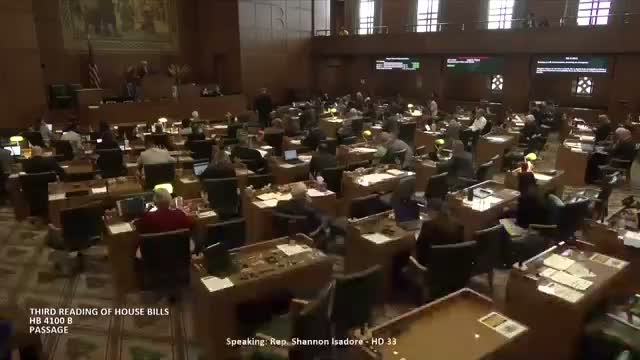
House lawmakers on March 5 approved House Bill 4,100, a bipartisan measure that forces bulk fuel terminals to demonstrate in advance they can cover response, cleanup and other liabilities from major spills or disasters. Representative Isidore, a co‑carrier, told colleagues the bill creates a certificate-of-financial-responsibility framework administered by the Department of Environmental Quality and leaves emergency rule authority intact.
The bill’s authors and supporters said it will ensure local governments, tribes and the state are not left holding the bill after a catastrophic Cascadia‑zone earthquake or major terminal failure. “This bill requires bulk fuel terminals to demonstrate in advance that they have the financial capacity to cover spill‑related liabilities,” Representative Isidore said on the floor. Representative Nelson emphasized the equity and public‑health stakes, noting terminals are disproportionately sited near lower‑income communities in North Portland and elsewhere.
Supporters said the Environmental Quality Commission will set financial assurance standards that reflect real risk factors, that facilities relying on self‑insurance must meet solvency or credit tests and quarterly reporting requirements, and that DEQ will have enforcement authority to suspend operations or impose civil penalties for uncertified facilities. Representative Tran described the bill as potentially requiring up to $300 million per terminal in insurance capacity and said the industry has agreed to fund program fees so the work is not paid for from the general fund.
Opponents raised affordability and oversight questions. Representative Osborne warned the compliance costs could raise fuel prices for rural communities, farmers and truck drivers and pressed carriers to explain who ultimately bears higher costs. Other members sought clarity on distribution rules for pooled funds and on how local jurisdictions could access money quickly after an incident.
The bill requires DEQ to meaningfully include local governments in rulemaking and to adopt standards ensuring rapid access to funds for emergency response, public health coordination and environmental cleanup. House members voted to pass the measure on third reading; the clerk declared HB 4,100 repassed after the constitutional majority was reached.
The next step is rulemaking by the Environmental Quality Commission and DEQ to specify financial‑assurance formulas, reporting requirements and the process for local access to funds in an emergency.