
Senate Public Safety Committee advances bills on posse authority, speed‑limiting devices, driver medical indicators and procurement restrictions
Get AI-powered insights, summaries, and transcripts
Sign Up Free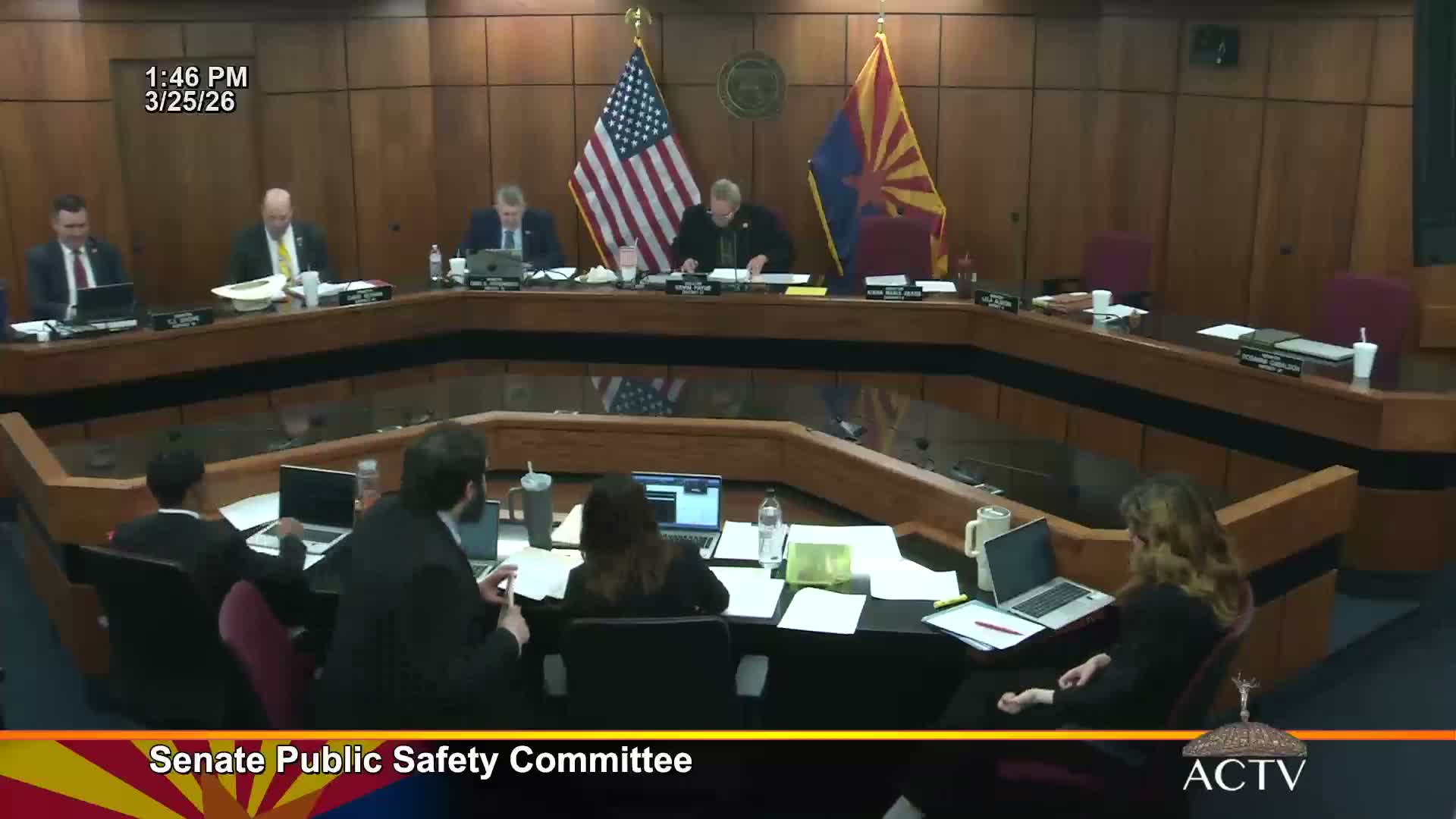
Summary
The Senate Public Safety Committee on March 18 gave due‑pass recommendations to several measures: HB 40‑18 (clarifying sheriff authority over posses), HB 24‑17 (speed‑inhibiting devices option), HB 27‑71 and HB 27‑72 (corrections and driver medical indicators), HB 24‑18 (task‑force funding), and HB 21‑70 (procurement restrictions); HCR 20‑59 also received a split recommendation.
The Arizona Senate Committee on Public Safety on March 18 advanced a package of bills and a concurrent resolution addressing sheriff authority, traffic‑safety alternatives, corrections, medical indicators for driver IDs, law‑enforcement funding and procurement rules for technology vendors.
The committee gave due‑pass recommendations to multiple measures after brief staff presentations and testimony from law‑enforcement and advocacy groups. Major actions included moving HB 40‑18, which staff said clarifies the sheriff’s authority over volunteer posses; HB 24‑17, which would allow certified speed‑inhibiting devices in lieu of some license suspensions; HB 27‑72, which would add a medical/DNR indicator to driver identification cards; and HB 21‑70, a procurement bill restricting certain China‑linked companies from state IT contracts.
HB 40‑18: posse and reserve clarification Sam, a committee staff presenter, told members HB 40‑18 affirms a sheriff’s exclusive authority—when activated and acting under written policy—to regulate the organization and equipment of volunteer posses and reserve organizations, pointing to ARS 11‑4‑441. Clint Van Wolfen of the Maricopa County Sheriff’s Office testified that the bill is intended as a clarification, not an expansion, and described posse and reserve volunteers as trained, supervised resources used for search and rescue, emergency response and patrol support.
A committee member who explained a dissenting vote warned that the bill concentrates authority in an elected official with "very few guardrails," urging stronger oversight. The transcript records HB 40‑18 as receiving a due‑pass recommendation (recorded as 5 ayes, 1 no, 1 not voting).
HB 24‑17: speed‑inhibiting devices as an alternative to suspension Staffer Kiana described HB 24‑17 (effective 07/01/2027) as allowing the Arizona Department of Transportation (ADOT) to require certified speed‑inhibiting devices in lieu of license suspension for specified offenses (aggressive driving, certain juvenile excessive‑speed offenses, and point‑accumulation suspensions). The bill directs ADOT to certify devices, publish approved device lists for courts, set technician qualifications, impose civil penalties for manufacturers that fail to report required data and provide appeal procedures.
Joe Domena of the Steer Safe Coalition and other supporters said the measure is optional for drivers and framed it as giving people a choice to remain mobile while addressing safety concerns. Opponents raised privacy and enforcement concerns—one member described the proposal as complex, potentially costly to drivers, and difficult to enforce. The committee gave HB 24‑17 a due‑pass recommendation (transcript shows 5 ayes, 2 noes).
HB 27‑71 and HB 27‑72: corrections costs and medical indicators HB 27‑71, a technical change concerning program cost recovery for rehabilitation programs administered by the Arizona Department of Corrections, Rehabilitation and Reentry, was presented as a minor language adjustment by Representative Kyle Powell (LD 14). The committee gave the bill a due‑pass recommendation.
Representative Powell also sponsored HB 27‑72 (effective 01/01/2027), which would allow licensees to request an indicator on a nonoperating identification license showing an advance health‑care directive (for example, a do‑not‑resuscitate designation or health care power of attorney). Powell said ADOT has provided the method and that the indicator would appear on the back of the card; licensees would need to obtain a replacement card to receive it and pay the usual replacement fee. The committee unanimously recommended HB 27‑72 (recorded as 7 ayes, 0 noes).
HCR 20‑59: resolution in support of county sheriffs Representative Gail Griffin sponsored House Concurrent Resolution 20‑59, which reaffirms legislative support for county sheriffs and cites constitutional and statutory bases for sheriff duties and authorities. The committee’s recorded recommendation on the resolution was split (transcript records 4 ayes, 3 noes).
HB 24‑18: funding for major incident regional task forces Staff explained HB 24‑18 would appropriate $600,000 in FY27 to the Arizona Criminal Justice Commission (ACJC) to be distributed evenly among the five original major incident division task forces (Cochise, Coconino, Navajo, Pinal and Yuma). Jen Morrison of the Arizona Sheriffs Association said the equal distribution has been practiced since FY22, with $450,000 of FY26 already distributed and $150,000 pending, and urged codification of that distribution. The committee recorded a due‑pass recommendation for HB 24‑18 (7 ayes, 0 noes).
HB 21‑70: Protection Procurement Act Staff described HB 21‑70 as barring state agencies from contracting for electronic or information technology with companies domiciled in or controlled/majority owned by the People’s Republic of China unless no reasonable alternatives exist. The bill would require certification to the Arizona Department of Administration and impose civil penalties (including a $100,000 penalty for false certification and temporary debarment) if a firm knowingly misstates its status. Matt Fioridi, representing State Armor Action, testified in favor, citing perceived national‑security and supply‑chain risks. The committee gave HB 21‑70 a do‑pass recommendation (transcript records 4 ayes, 3 noes).
What’s next All measures that received due‑pass recommendations will move forward to the next legislative step per committee procedure; individual bill status and any amendments will be reflected in subsequent calendars. The committee adjourned after brief closing remarks and thanks to staff.
Quotes used in this article are taken verbatim from the committee transcript and are attributed to speakers who identified themselves during the hearing.