
Oro Valley staff outline rezoning that would add protected open space while allowing limited commercial and housing
Get AI-powered insights, summaries, and transcripts
Sign Up Free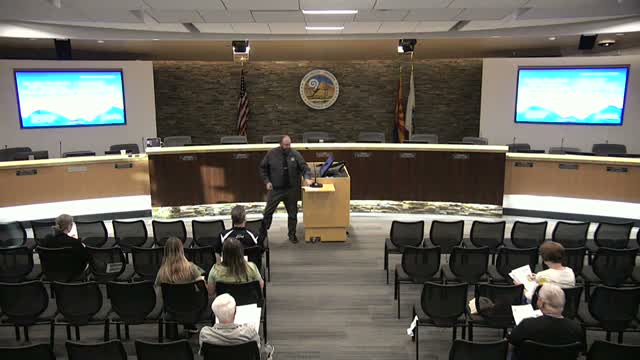
Summary
Town planning staff presented a rezoning and general‑plan amendment for portions of Rooney Ranch that would convert Area 4 to park, add about 10 acres of permanently protected open space and allow limited commercial and residential uses in Areas 2 and 3; residents pressed staff on traffic, trails, drainage and whether donated land would be sold.
Michael Spathe, a principal planner for the Town of Oro Valley, told neighbors at a neighborhood meeting that the town is proposing a general‑plan amendment and a planned‑area development (PAD) rezoning for portions of Rooney Ranch along Oracle Road to increase permanently protected open space and revise permitted uses.
Spathe said Areas 3 and 4 were donated to the town in 2019 and Area 2 remains privately owned by developer Kitchell. “I want to reiterate the town does not have any immediate plans for development,” he said, adding that the town’s aim is to increase natural open space from about 77 acres to about 87 acres and to limit development to locations that reduce impacts on neighbors.
Under the staff proposal, the general‑plan amendment would change Area 4’s designation from low‑density residential to park, permitting natural open space, trails and trailheads only. The PAD amendment would revise permitted uses in Areas 2–4, reduce some building heights and concentrate potential development in locations set back from adjacent homes. Spathe noted that buildings within 200 feet of Oracle Road would be capped at 24 feet, with taller maxima farther back, and that the proposal removes 77 single‑family lot entitlements currently allowed in Area 4.
An engineer on the staff team, Mr. Laws, described the traffic data staff used. He said Arizona Department of Transportation counts from 2024 show the Pushview‑to‑Tangerine section carries about 33,600 average daily trips (about 44% of capacity) and the Pushview‑to‑Linda Vista section about 45,000 trips (about 58% of capacity). “When we look at traffic related to a development, we analyze level of service at the intersections,” Mr. Laws said, explaining that project‑level traffic studies will analyze peak‑hour impacts and intersection delays as proposals advance.
Residents raised questions across several topics at the meeting, including whether the town intends to sell or lease donated land, trail locations, privacy, emergency egress, drainage and nighttime noise from commercial services. A resident urged the town to show a park‑only option and asked, “Why can't we keep as much of that as possible?” Another attendee told staff, “This whole plan is profoundly inconsistent with all the values of this community and the new plan coming in.”
Staff responded that Area 2 is privately owned and cannot be rezoned without the owner’s agreement, that the town would try to preserve proposed open space as permanent and managed by parks staff, and that fire, police and drainage reviewers must sign off on any development plan. Spathe said the council has directed staff to proceed with the selected concept but that council will hold public hearings: Planning & Zoning Commission is scheduled for April 14 and Town Council for May 6; both will be opportunities for neighbors to comment.
The meeting record and materials will be posted on the project page (ovprojects.com) and staff said they will forward a summary of public comments to commission and council as part of their packets. The town emphasized that specific traffic, drainage and site‑design details will be determined in later project‑level studies if the rezoning and general‑plan amendment advance.