Lifetime Citizen Portal Access — AI Briefings, Alerts & Unlimited Follows
House and Senate Education Committee adopts interim study on adult education after Goodwill, Notre Dame presentations
Loading...
Summary
The joint House and Senate Education Committee voted to adopt an interim study proposal on adult education after hearing Goodwill Industries of Arkansas and University of Notre Dame researchers describe the Excel Center model, outcomes, and funding constraints.
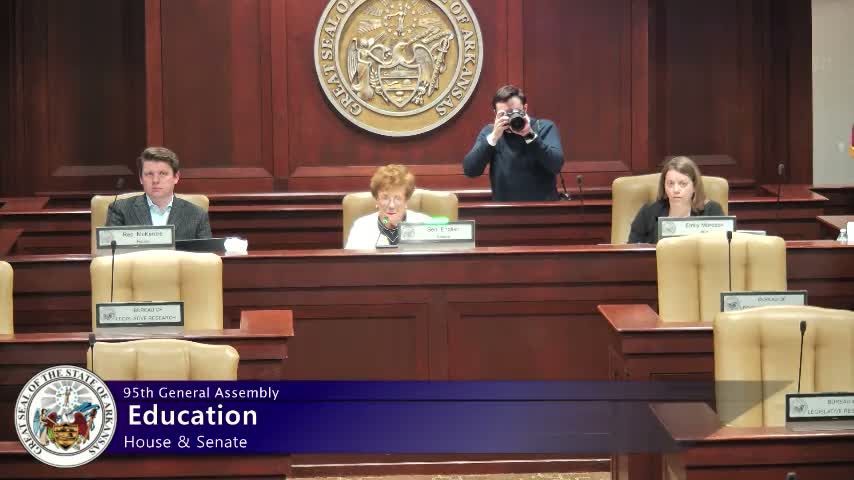
The House and Senate Education Committee voted to adopt an interim study proposal (ISP) on adult education during a joint meeting that featured presentations from Goodwill Industries of Arkansas and independent researchers from the University of Notre Dame.
Goodwill representatives said Arkansas faces a substantial adult‑education gap and urged state consideration of multiple diploma‑granting pathways. "Approximately 10 percent to 11 percent of Arkansans over the age of 19 do not have a high school diploma or GED," said Brian Marsh, president and CEO of Goodwill Industries of Arkansas, adding that this amounts to "more than 300,000" adults statewide. Marsh described the Excel Center — a Goodwill‑operated, diploma‑granting public adult charter high school in Little Rock and Springdale — as a model that provides licensed teachers, childcare, transportation vouchers and life coaches that remove common barriers to completion.
Rachel Fulcher Dawson of the University of Notre Dame's Lab for Economic Opportunities summarized the lab’s evaluation of Excel Center students, reporting that graduates were 12% more likely to be employed, saw a reported 38% increase in earnings, and experienced a 49% decline in criminal charges in the first year after graduation. "For every $1 spent, we see over $20 in benefits," Dawson said, and she added that including criminal‑justice outcomes raises the estimated return to about $60 per $1 invested.
Why it matters: Committee members said the ISP will allow staff to gather data, reconcile existing state adult‑education spending and oversight, and clarify whether state funding could support expansion of diploma‑granting adult high schools beyond Goodwill’s two campuses. Goodwill presenters and researchers framed the Excel Center as one proven pathway among others that could address workforce and family economic outcomes.
Members raised procedural and substantive questions during floor discussion. Senator Sullivan said he "take[s] issue" with what he described as an opening statement that painted Arkansas as among the worst nationally, arguing the state has many progressive programs. "I'm kinda tired of people coming in front of this body and telling us how bad we are," he said. Members asked for follow‑up on baseline state spending for adult education; staff and presenters said some details would be provided to committee staff and in subsequent materials.
Formal action and next steps: Senator Flowers moved to adopt the interim study proposal; the chair called a voice vote that was recorded as passed. Shortly after, Senator Love raised a point of order saying he is not on the committee and asked that the vote be redone; the chair acknowledged the point and staff noted the ISP will be considered going forward and that staff follow‑up is expected. The ISP record and any re‑vote or scheduling will be handled through standard committee procedures and the House Committee on Education as the study develops.
Speakers quoted or cited in this article include Brian Marsh (president and CEO, Goodwill Industries of Arkansas), Edie Stewart (Chief Mission Officer, Goodwill Industries of Arkansas), Rachel Fulcher Dawson (Lab for Economic Opportunities, University of Notre Dame), Senator Sullivan, Senator Flowers and Senator Love.
The meeting continued with a separate adequacy funding briefing; next procedural steps for the ISP include staff data collection and possible tours of Excel Center campuses at members’ requests.