
Assembly committee advances bill to fund grocery access and limit food deserts
Get AI-powered insights, summaries, and transcripts
Sign Up Free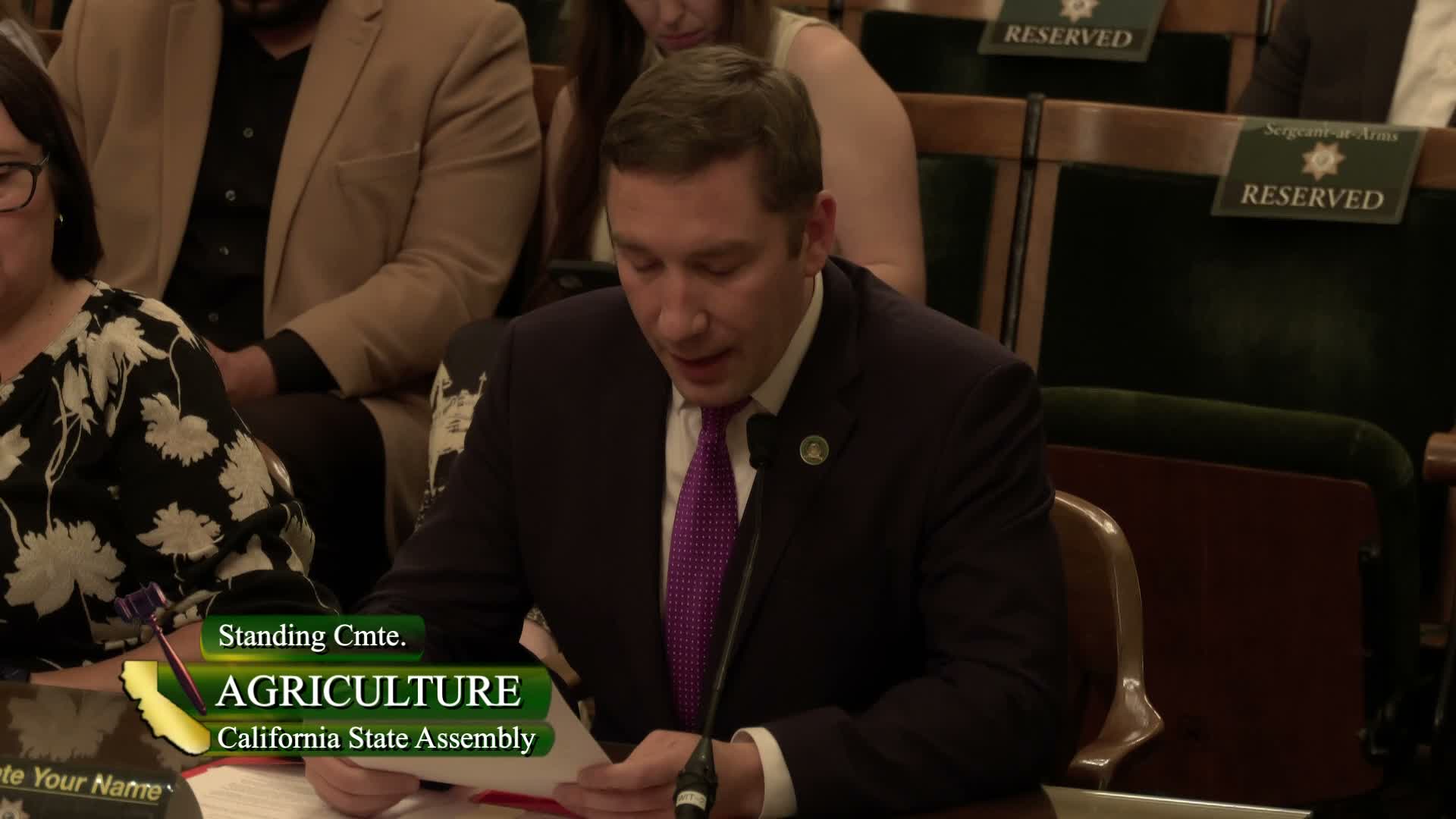
Summary
The Assembly Agriculture Committee voted to send AB 1674 to the Housing and Community Development Committee after witnesses and members debated a provision that could condition housing approvals on preserving grocery-store space; the author pledged to work with opponents on amendments.
Assemblymember Aarons introduced AB 1674 as a food‑desert elimination grant program aimed at preserving and expanding grocery‑store capacity in underserved communities, particularly where housing redevelopment has displaced small, ethnic or neighborhood‑serving stores.
"AB 1674 would create the food desert elimination grant program to support grocery stores in underserved areas," Aarons told the committee, saying the bill would require developers to maintain or mitigate any loss of grocery capacity in new housing projects so access to healthy food does not depend on a ZIP code.
Local residents testified in support. Diana Gonzales, chair of the San Miguel Neighborhood Association in North Sunnyvale, said her neighborhood risks losing Fair Oaks Plaza, "a community hub that has served residents for over 50 years," and warned that seniors, low‑income families and communities of color would be disproportionately affected if neighborhood grocery options vanish. Himanshu Sethi, a Sunnyvale resident, said a Change.org petition opposing recent closures had drawn more than 3,400 signatures.
Industry groups urged caution. Skyler Wanakott, representing the California Business Properties Association, said the bill’s section 3 could impose a state requirement on housing projects that currently fall under local zoning and land‑use decisions, adding cost, delay and uncertainty for developers. Kareem Driesi of the California Building Industry Association called the draft language "problematic," noting that conditioning approval on preserving site capacity for a large grocery (15,000 square feet minimum) or requiring payment into a fund could create barriers for affordable housing developers.
The committee’s questions focused on definitions and geographic differences. The author described the bill’s working definition of a food desert as a census tract meeting thresholds for both low access and low income — for example, a poverty rate of 20% or higher or a median family income under 80% of the area median — and sketched proximity metrics (roughly a half‑mile in urban areas and larger distances in rural areas). Members from very rural districts pressed for a carve‑out or different treatment for places where distances between grocery stores can be tens or hundreds of miles.
Aarons repeatedly told members he was committed to revising section 3 and working with the building community and opponents to find "win‑win" solutions, including incentives or density bonuses to encourage retention of retail space while allowing housing development.
Majority Leader Edgar Curry moved the bill "do pass" to the Housing and Community Development Committee; Assemblywoman Ramson seconded. The chair announced the motion passed with five affirmative votes and that the file would remain on call for absent members.
The committee left the specific housing‑related language to further work, directing the author to negotiate with stakeholders and the committee that will next consider the bill.