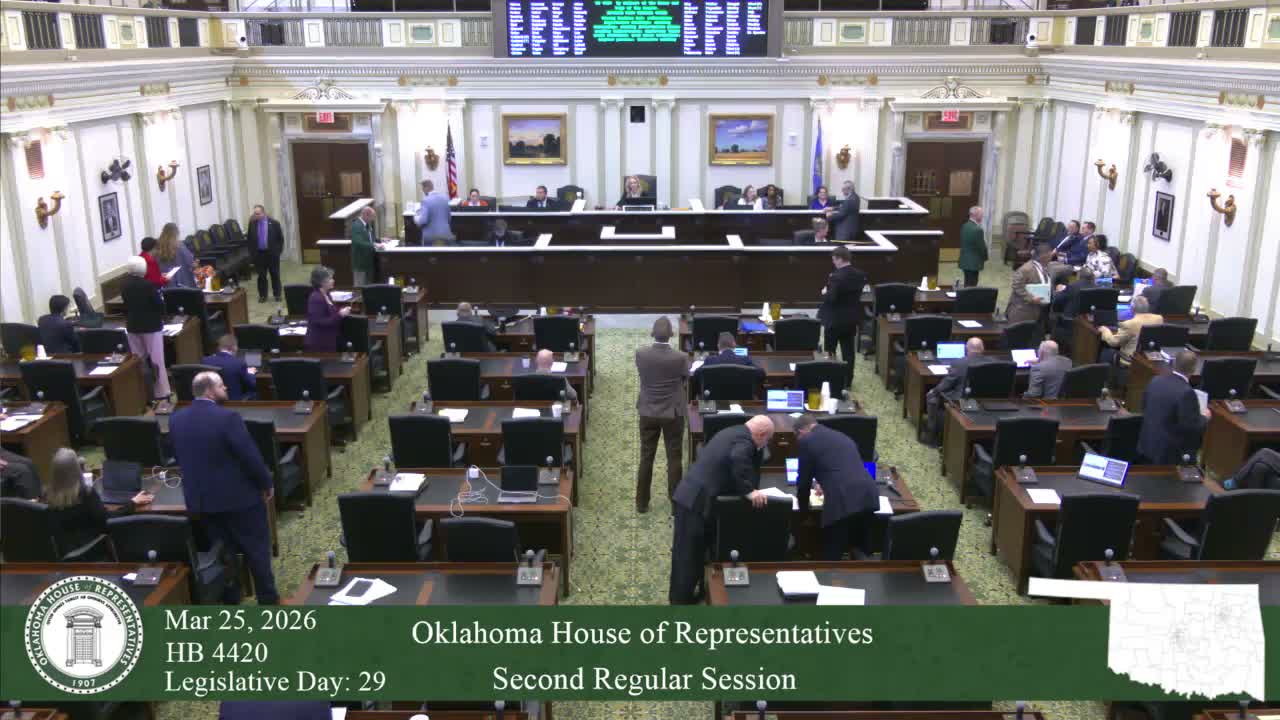
House passes 'Strong Readers Act,' reinstates third‑grade retention and funds credentialing academies
Loading...
Summary
The Oklahoma House voted 86–6 to pass House Bill 4,420, the Strong Readers Act, reinstating third‑grade retention with phased implementation, a revised SRA funding formula (60/30/10) and summer teacher credentialing academies with $3,000 stipends; the House also approved an emergency clause to begin summer programming.
Representative Hilbert moved final passage of House Bill 4,420, the Strong Readers Act, and the House approved the bill on a roll call that the clerk recorded as 86 ayes and 6 nays. The House also voted to declare the bill an emergency by the same margin, allowing parts of the law to be implemented this summer.
Hilbert framed the bill as a response to persistent low literacy, telling colleagues that "73 percent of our third graders cannot read at grade level" and arguing the measure will create stronger statutory clarity and accountability. He described the central funding change as "a base level of support of 60% for all students, and then there's 30% for tier 2, and then 10% based on performance and growth metrics," saying the formula removes a disincentive that previously reduced funds when students improved.
The sponsor emphasized the bill's phased rollout and intervention timeline. Hilbert said much of the Strong Readers Act is already being implemented at local schools and that the retention provision is designed to take effect after a two‑year implementation window: "the third graders in the 27‑28 school year would be the first subject to retention," he said, allowing districts two school years for intervention before the retention determination.
To support teacher training, the bill funds statewide summer teacher credentialing academies in the science of reading and includes a $3,000 stipend for participating educators so they can complete credentials quickly. As Hilbert explained, the emergency designation was requested so "we could start the summer credentialing academies this summer." He also said the bill sets a recurring higher education allocation of $5,000,000 to support institutions that run credentialing programs and encourages philanthropy and local business contributions to supplement state funds.
Members asked about cost, rollout, parental notification and staffing. In response to funding questions, Hilbert said the exact budget increase will be negotiated in budget talks with the governor and Senate but argued that a recurring $5,000,000 higher‑ed allocation is preferable to a one‑time large gift. On family engagement he noted districts must notify parents and provide a plan within a 30‑day window when students are identified as behind, saying that notification will be accompanied by an intervention plan.
Supporters portrayed the bill as a research‑driven effort to restore reading outcomes; critics raised concerns about retention, implementation capacity and long‑term funding certainty. The House adopted the measure and declared an emergency; the bill will now proceed to the Senate (or to the governor as required by procedure) for the next steps in the legislative process.
The House vote on final passage was 86 aye, 6 nay; the emergency declaration passed by the same margin. No further procedural action was recorded on the floor after the vote.