
Committee backs bill to create veterans specialty court grant program
Get AI-powered insights, summaries, and transcripts
Sign Up Free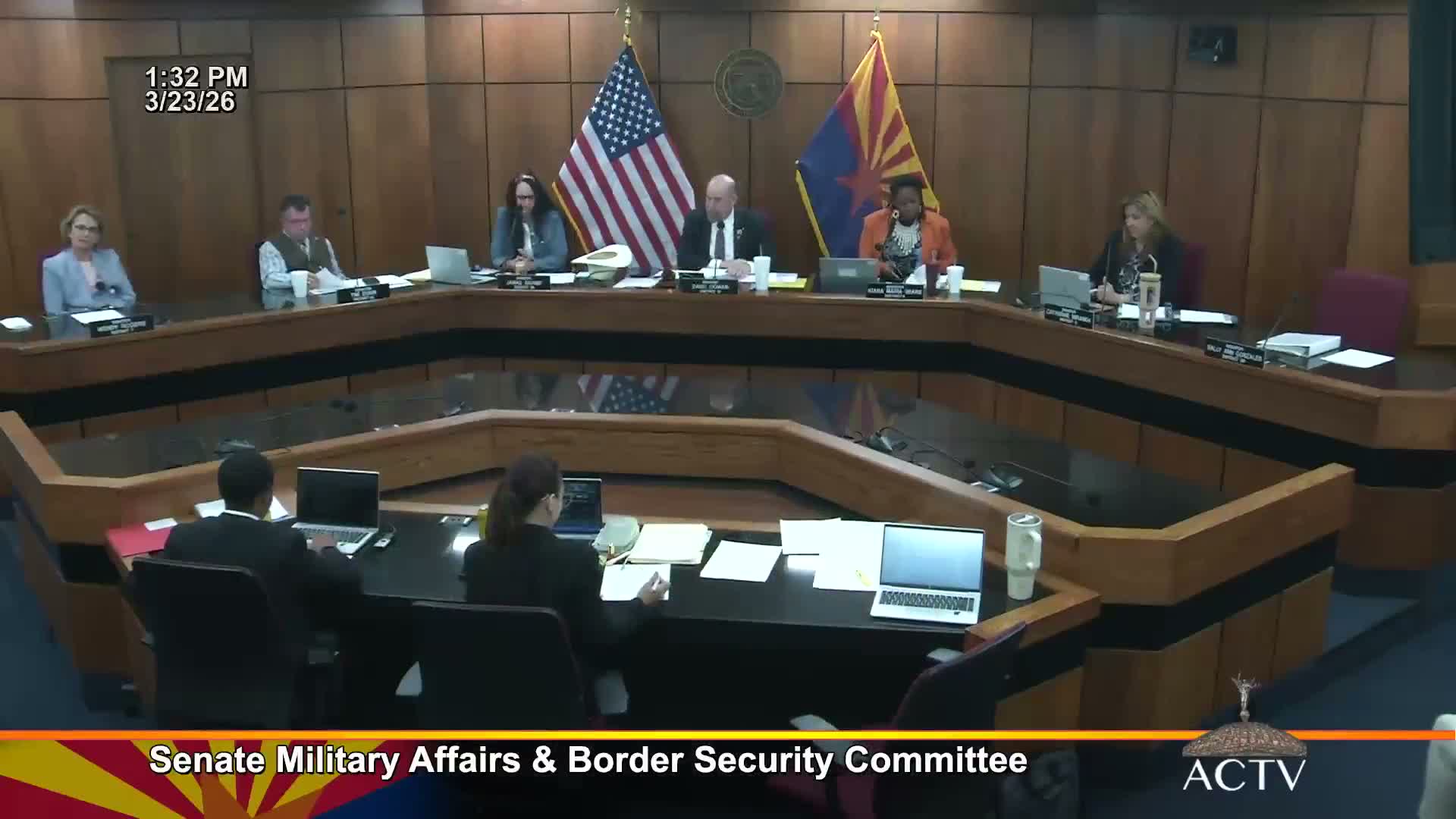
Summary
The Arizona House Military Affairs and Border Security Committee gave HB 2960 a due-pass recommendation after hearing sponsor testimony and a veteran's account; the bill would establish a veterans specialty court grant program, require interagency data sharing, and set reporting standards.
Representative Travers told the Military Affairs and Border Security Committee that House Bill 2960 would expand and sustain veterans treatment courts across Arizona by establishing a veterans specialty court grant program and a veterans treatment court fund.
The bill text, read for the committee, would require the Administrative Office of the Courts to administer the grant program and work with stakeholders to set best practices and data-collection standards. It also directs the Arizona Department of Corrections, Rehabilitation and Reentry to identify incarcerated veterans and collaborate with the Arizona Department of Veterans Services to share monthly lists of incarcerated veterans to help connect them to benefits and services.
“Arizona HB 2,960 represents an important step in supporting veterans who enter the criminal justice system as a result of service-related challenges,” Representative Travers said, describing veterans courts as diversionary programs that prioritize rehabilitation over punishment and connect participants with mental health, substance-use and peer support services.
Raymond Perez, a graduate of a veterans treatment court, gave the committee a firsthand account of the program’s effects. Perez said he struggled with homelessness, addiction and incarceration before entering the court, and credited its services and case team with his recovery. “It is because of Veterans Treatment Court that I was able to make positive life changes. Now I stand before you 13 years clean, sober, and tobacco free,” Perez said.
Committee members asked how veterans courts operate in the community and were told programs typically convene prosecutors, judges, mentors and treatment providers to review participants’ progress. Representative Travers cited Lake Havasu City as an example of a local model and described treatment plans that track veterans’ needs and outcomes.
A committee member moved HB 2960 with a due-pass recommendation. Several members spoke in support, sharing local experience with veterans courts and praising the bill’s data-sharing provisions. The committee clerk announced the tally as 6 ayes, 0 nos, 1 not voting; the measure received a due-pass recommendation.
The committee did not take further action on amendments; the bill’s reporting and data-sharing requirements remain part of the proposal. The committee moved on to other business following the vote.