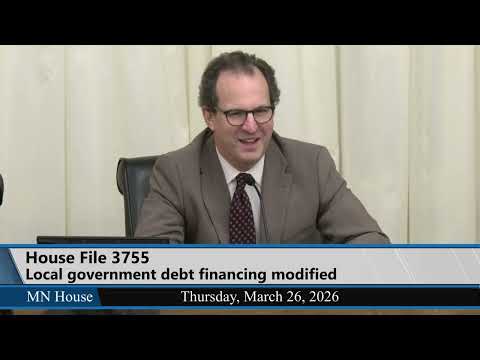
Committee hears technical public‑finance fixes in HF3755; amendment clears way for port authority term bonds
Loading...
Summary
The tax committee heard HF3755, a largely technical bill to harmonize public notice periods, remove a school‑bond provision, and allow port authorities to issue term bonds. Testimony described the changes as routine and potentially cost‑saving for port debt structures; the bill was laid over for possible inclusion in the omnibus tax bill.
The House tax committee reviewed House File 3755, a technical public‑finance bill that would tidy statutory language and change how certain public entities issue debt. Joe Bagnoli of the Minnesota Institute of Public Finance described the proposal as the department’s typical technical bill and said stakeholders had not expressed controversy.
Bagnoli told the committee the A1 amendment deletes the provision about school‑district debt and that two provisions remain: lowering a public notice minimum for one issuance type and allowing port authorities to use term bonds rather than being restricted to serial bonds. “The second provision relates to the issuance of debt for port authorities... This change would allow essentially the port to do either, port authorities to do either, sorts of debt,” Bagnoli said.
Representative Roach pressed for precision on notice periods after Bagnoli said the change moved a minimum to 10 days; House research clarified that, after the deletion of section 1, the 10‑day change applies to section 2 (page 2, lines 21–22), lowering the minimum notice from 14 to 10 days for the enumerated issuance.
Committee members and the presenter described the port‑bond change as potentially lowering costs by allowing more flexible debt structures. The chair moved HF3755, as amended, and members voted to lay the bill over for possible inclusion in the omnibus tax bill.
The committee did not take a roll‑call vote on final passage; the action recorded in committee was to lay the amended bill over for further consideration.