
Council approves Boca Raton Resort master plan changes, adds construction safeguards
Get AI-powered insights, summaries, and transcripts
Sign Up Free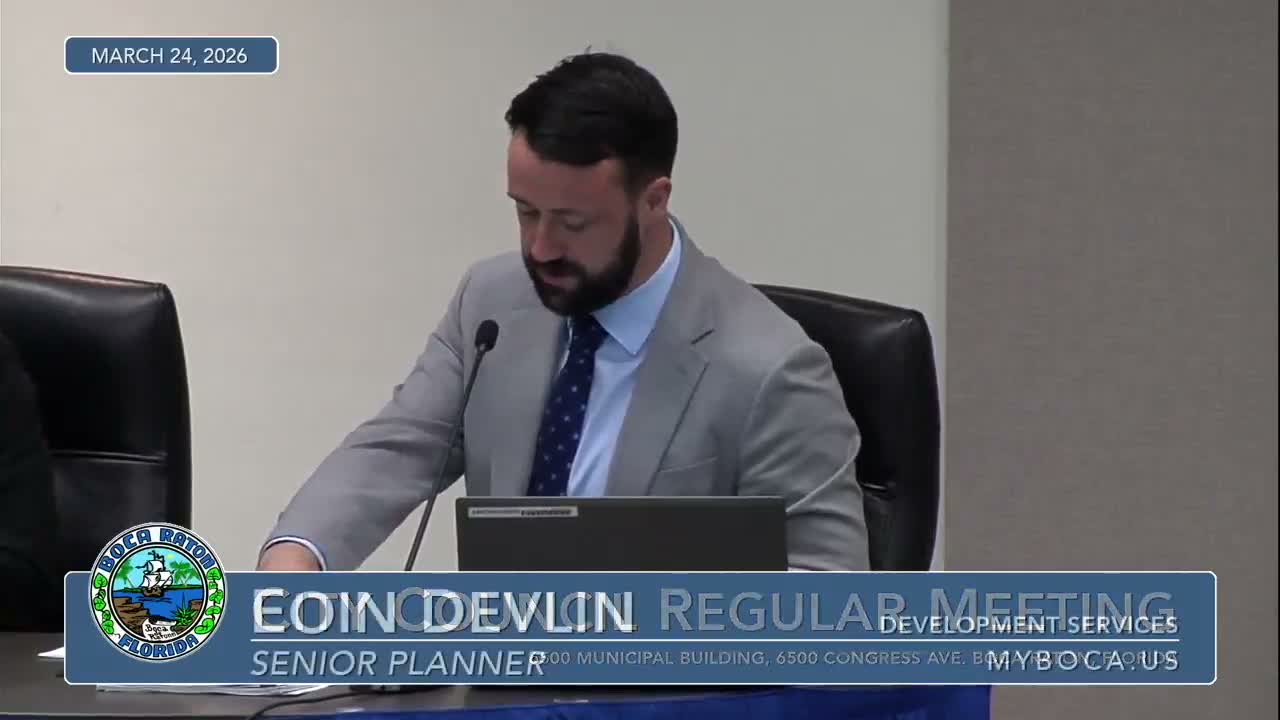
Summary
After a lengthy quasi‑judicial hearing and public comment, the City Council adopted a set of ordinances and resolutions allowing a new 8‑story, 76‑unit residential building and related master‑plan updates at the Boca Raton Resort & Club. The council approved the package with clarified language on construction sequencing, pedestrian access and a corrected acreage notice.
The Boca Raton City Council voted unanimously Wednesday to approve a future‑land‑use amendment, rezoning and site plan for a 5.224‑acre portion of the Boca Raton Resort & Club that will allow construction of an eight‑story, 76‑unit residential building and other site changes.
The package — carried by Ordinances 57‑80 and 57‑81 and Resolutions 16‑20‑26 and 17‑20‑26 — passed 5‑0 after a multi‑hour quasi‑judicial hearing that included a staff presentation, a detailed applicant presentation and nearly two hours of public comment. Council adopted the versions published in the agenda with a staff correction to a scrivener’s error on advertised acreage and added clarifications on pedestrian access and construction sequencing.
Why it matters: The approvals permit a major redevelopment on a long‑standing resort property that the city and residents have discussed for years. The council’s additions on construction logistics were intended to protect nearby single‑family and multifamily neighborhoods during a multi‑year build‑out.
City staff said the application complies with the comprehensive plan and that the project remains within previously established maximum residential units for the campus. Senior planner Owen Devlin told the council the project preserves more tree canopy than currently exists on site after mitigation and will add pedestrian connections into downtown. “The applicant is consistent with the comprehensive plan,” Devlin said during his presentation.
Residents focused much of their public testimony on trees and the planned use of the Meisner Boulevard entrance for construction access. Margie Alloy, a nearby resident, urged a small alignment shift of the proposed internal road to avoid damage to mature trees and said the limit‑of‑work line appears to place construction activities inside the trees’ root zones. “By shifting the line approximately just 30 feet you would significantly increase the likelihood that these trees would survive,” Alloy told the council.
The applicant, represented by attorney Bonnie Miskill and design lead Jim Tinson, described a design strategy intended to retain and augment the existing canopy and to relocate an internal road so the new building sits farther from single‑family homes. Miskill said the owner has spent hundreds of millions of dollars renovating the campus in recent years and committed to additional measures in response to concerns.
Concessions and conditions: In response to public concerns, the applicant agreed to construct ADA ramps at the Meisner Boulevard entrance and to work with staff to develop a construction sequencing plan with explicit pedestrian and bicycle safety measures and off‑site parking for construction workers. Staff also preserved language giving the city discretion to limit times of day for certain construction movements to avoid peak pedestrian hours.
Council member discussion centered on striking a balance between letting the detailed traffic‑management work occur during the later MOT/permitting stage and placing safeguards in the development order. Several members said they prefer logistics be resolved with the contractor and staff, while insisting the council retain the ability to require protections if needed.
What happens next: With the council’s motions and the corrected documents, the applicant can proceed into the permitting phase; staff will review construction sequencing and MOT details before building permits are issued. The development approvals remain subject to normal permitting and code compliance checks.
Vote and procedural notes: Ordinances 57‑80 and 57‑81 and Resolutions 16‑20‑26 and 17‑20‑26 were adopted on the floor after the public hearing; roll calls show each passed 5‑0. The council also noted that the public notice contained a scrivener’s error on acreage that staff corrected prior to the vote.