
Chief Justice Patricia Guerrero outlines judicial security, remote proceedings and AI guidance in State of the Judiciary address
Get AI-powered insights, summaries, and transcripts
Sign Up Free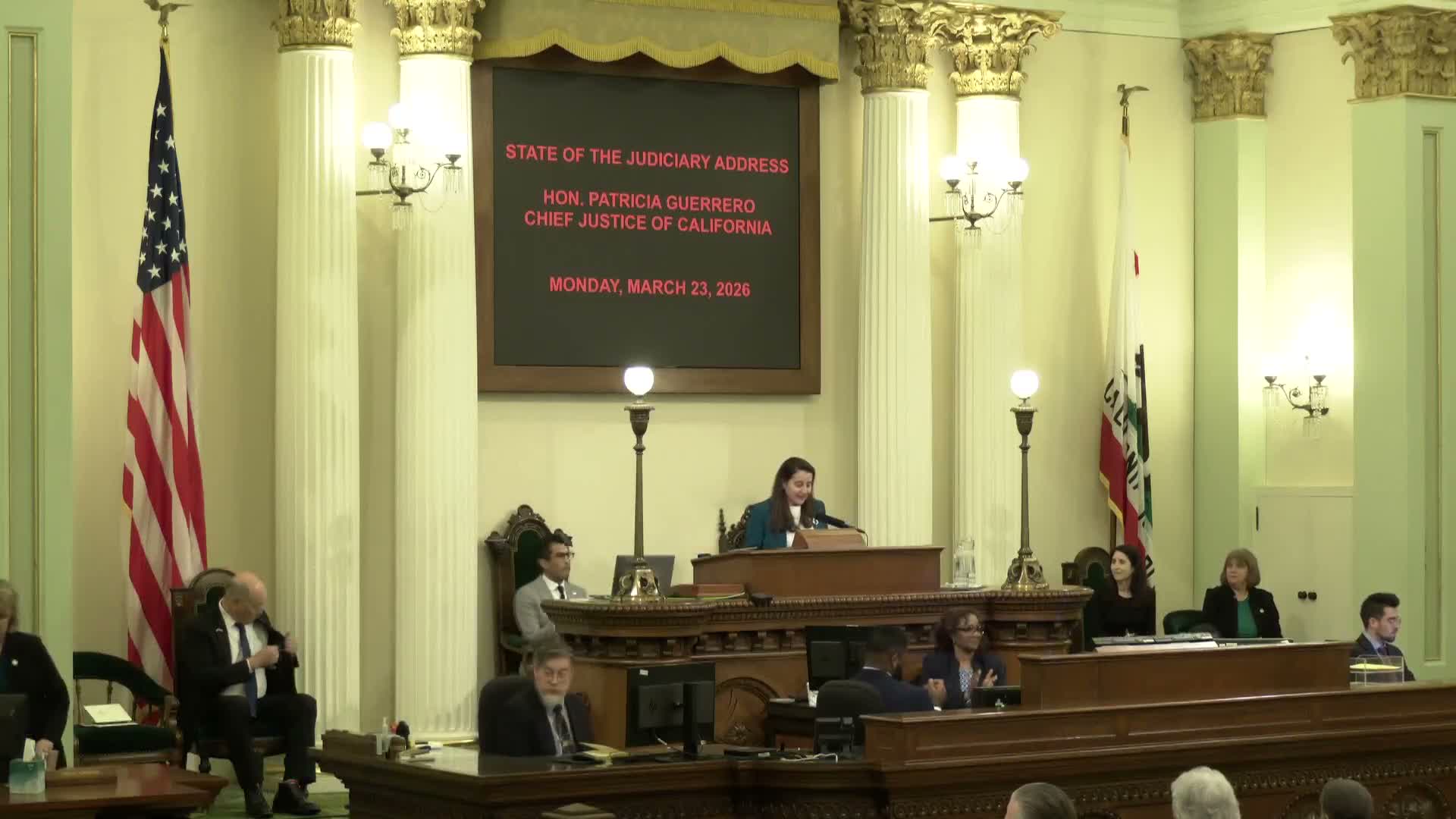
Summary
Chief Justice Patricia Guerrero told a joint convention the judiciary is prioritizing security, remote proceedings, CARE Act implementation and AI guidance, and urged resources to fill judgeship gaps and protect court access.
Chief Justice Patricia Guerrero delivered the State of the Judiciary address in a joint convention with the Legislature, stressing judicial independence, security for judges and court staff, and access to justice across California.
Guerrero said recent events have heightened concerns about judicial security and described efforts by the Judicial Council to secure funding and pursue legislative protections for judges’ privacy. “We should all emphatically speak out against normalizing personal attacks against judges,” she said.
She highlighted remote proceedings as a widely used public service: since March 2022, the courts have conducted over 6 million proceedings remotely, with a one‑year period (Sept. 2024–Aug. 2025) averaging more than 7,000 remote hearings per day and about 95% overall satisfaction, according to data Guerrero cited. She warned that statutory authority for some remote proceedings is scheduled to expire at the end of the year or on 2027‑01‑01 and urged collaboration to preserve access.
The Chief Justice reviewed the Community Assistance, Recovery, and Empowerment (CARE) Act data: between October 2023 and January 2026, 3,810 petitions were filed, courts ordered 925 care agreements, and 1,835 individuals remain actively engaged in the process, figures she said are published by the Judicial Council.
She called for continued funding to address trial court needs and cited an ongoing shortfall in authorized judgeships: the latest judicial needs assessment (October 2022) identified a need for about 98 additional judicial officers. Guerrero noted recent temporary assignments to cover caseloads and cited Riverside County’s dismissal of cases under Penal Code Section 1050 due to congested calendars as an example of strain on the system.
On technology, Guerrero said the Judicial Council’s AI task force published guidance for generative AI use in courts and is now focusing on deepfakes and admissibility questions. She emphasized rules and standards that stress accuracy, oversight and the primacy of human judgment.
Guerrero also reviewed corrective steps taken after the February 2025 bar exam problems, including scoring adjustments, expanded provisional licensing, and a return to in‑person testing under the National Conference of Bar Examiners format.
She closed by thanking legislators for collaboration and urging continued support for resources that ensure courts can serve all Californians.
The address was printed in the journal as a separate appendix at the request of the court.