Get Full Government Meeting Transcripts, Videos, & Alerts Forever!
Get email alerts on the Water Quality topic
No spam. Unsubscribe anytime.
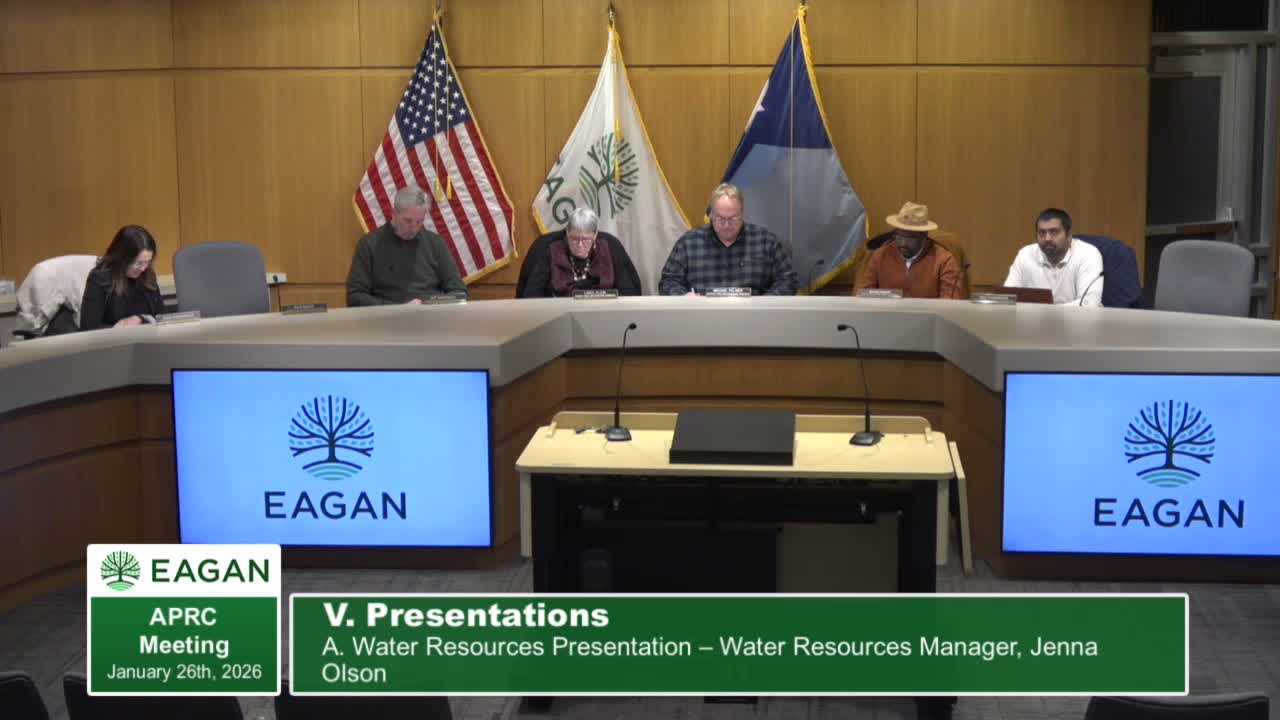
Eagan water resources manager says long-term monitoring shows improving lake quality, warns of chloride and invasive risks
Summary
Jenna Olsen, Eagan’s water resources manager, told the Parks and Recreation Commission that long-term monitoring shows overall improvement in the city’s index lakes but flagged ongoing risks from chloride, invasive species and climate-driven seasonal shifts. She outlined monitoring, treatment and community outreach plans.
Jenna Olsen, Eagan’s water resources manager, told the Parks and Recreation Advisory Commission that long-term monitoring shows steady improvement in the city’s index lakes while cautioning that chloride, invasive species and changing seasonal patterns remain threats.
Olsen said Eagan monitors a cross-section of its larger, shallow lakes twice a month from June through September for chlorophyll a, total phosphorus, Secchi clarity and dissolved oxygen. "Eagan has just over 1,300 water bodies across its 34 square mile area," Olsen said, noting the city’s program has gathered data since the 1990s and uses that record to guide management.
Why it matters: the monitoring program underpins decisions on in-lake treatments, stormwater management and habitat work that affect recreation, fisheries and neighborhood water quality. Olsen said the city has used targeted in-lake treatments, such as strategic aluminum sulfate (alum) applications, aeration systems in 13 lakes and mechanical and contract removals of aquatic weeds to reduce nutrient availability and maintain recreational access.
Olsen described how different water bodies are managed depending on type—constructed storm basins, wetlands, shallow lakes and deeper lakes—and explained that shallow lakes are especially vulnerable because sunlight reaches the bottom and supports dense plant and algal growth. She summarized in-lake and watershed approaches the city uses: engineered treatment systems (rain gardens, infiltration features), in-lake alum treatments to bind phosphorus, invasive-plant removal (contracted scuba work and aquatic harvesting) and fisheries management including targeted stocking and inter-lake transfers.
On regulatory coordination, Olsen said the city works with the Minnesota Pollution Control Agency (MPCA) and Department of Natural Resources (DNR) when impairments are regulatory issues; MPCA permitting and oversight are central when formal impairment plans are required. She said the city has successfully addressed some nutrient impairments and is awaiting public notice to delist the remaining nutrient-impaired waters.
Commissioners asked whether the state’s residential phosphorus fertilizer ban had materially reduced nutrient levels. Olsen said that while the ban helps, much current nutrient loading remains bound in sediments and legacy runoff, making local effects harder to isolate. She also said recent climate shifts—shorter winters or reduced ice cover and hotter summers—can give plants a head start in spring and exacerbate plant growth and algal blooms.
Olsen closed by describing outreach and access initiatives, including new fishing piers, a free tackle-box pilot program to lower barriers to fishing, translated neighborhood fishing guides and expanded Lake Fest programming. Commissioners thanked Olsen for the presentation. The commission did not take a vote on policy that night; Olsen said updates to the city’s water quality and wetland management plan are forthcoming as part of broader guide amendments.