Committee advances 'Noah's Law' to increase penalties for adults who sell deadly synthetic opioids to minors
Loading...
Summary
The House Judiciary Committee gave SB 11-70 a do-pass recommendation after emotional family testimony and opposition from civil-rights advocates. The bill would trigger aggravated sentencing when an adult's drug sale to a minor is shown to have contributed to the minor's death and would classify certain cases as dangerous crimes against children.
Sen. Karen Warner urged the committee to back SB 11-70, saying current law does not provide a clear pathway to prosecute adults who sell deadly synthetic opioids to minors. Warner said she is pressing the bill after the overdose death of a constituent and described the measure’s mechanics: an initial autopsy would be followed by a secondary review when narcotics-related complications are suspected, and a subsequent conviction could result in aggravated imprisonment terms if the second autopsy shows the drug caused death.
The measure’s sponsor noted it would classify offenses as a dangerous crime against children when the victim is 15 or younger and would allow prosecutors to seek enhanced terms where selling a dangerous or narcotic drug to a minor contributed to a death. "For some reason, we still have not been able to charge or prosecute the individual that sold this, which is the impetus for this bill," Warner said.
Family members of victims gave personal testimony. Vanessa Ayala, whose 17-year-old son Noah died after consuming a substance she described as a 'poison,' told the committee that "a substance that will kill you after the first time of use should not be called a drug. It should be called a poison." Gustavo Ayala, Noah's father, urged passage: "My son did not get a second chance. He did not get to grow up, build a future, or come home again. For that, I ask the committee to please pass Noah's law."
Marilyn Rodriguez, speaking for the ACLU of Arizona and Arizona Attorneys for Criminal Justice, opposed the bill and warned it could sweep in juveniles and people with substance-use disorders by mandating aggravated maximum sentences and limiting judicial discretion. Rodriguez noted existing sentencing ranges and argued that judicial discretion remains important, especially given current Department of Corrections constraints.
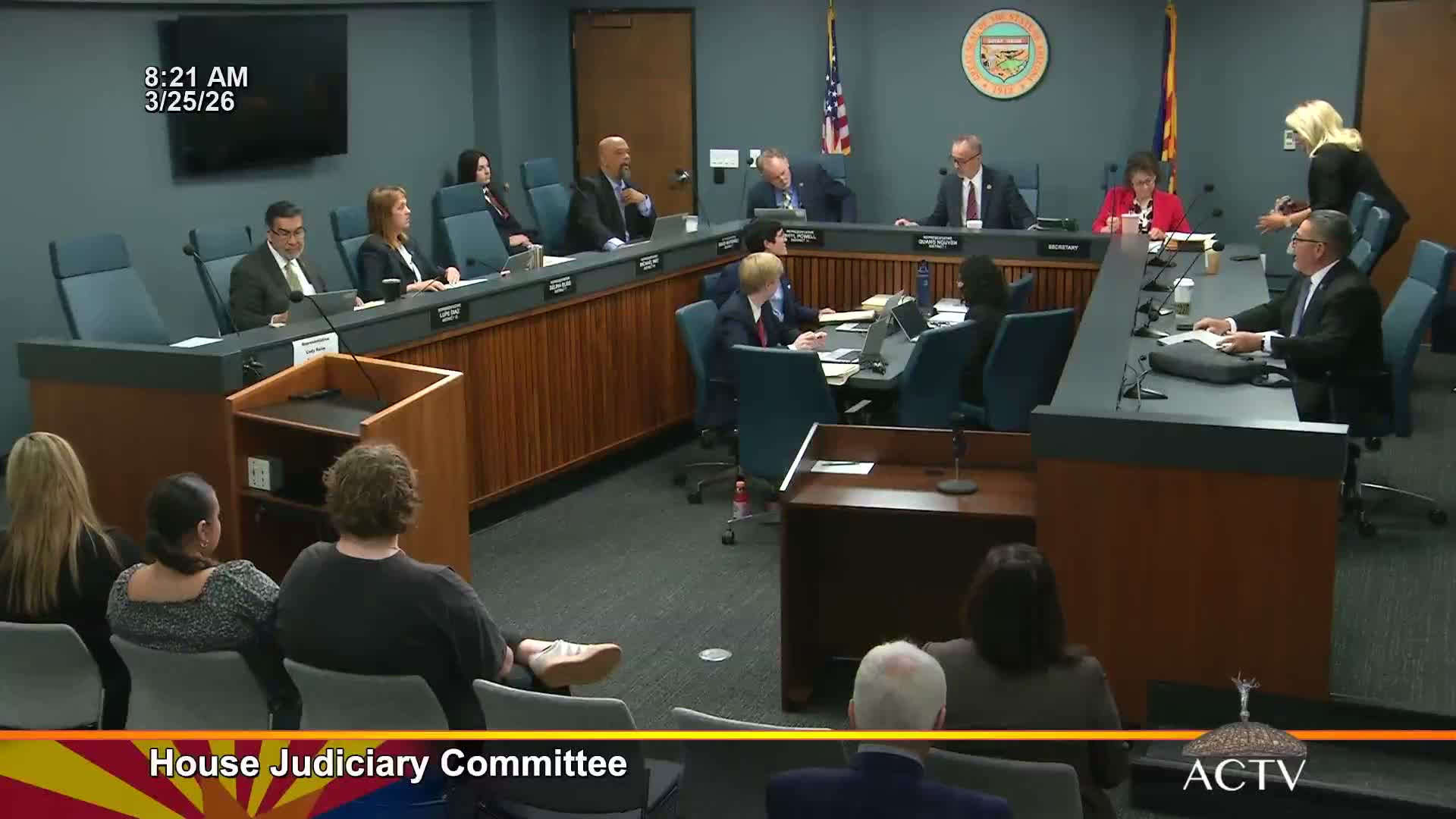
Committee members discussed potential drafting changes to reduce collateral impacts on minors who share substances among peers. After final discussion, the committee voted to give SB 11-70 a do-pass recommendation.
Votes and next steps: the committee recorded the recommendation on SB 11-70 as a do-pass, with the chair announcing the result as 5 ayes, 2 nays, and members noted an absent. The bill will move forward with the committee’s recommendation and any amendments discussed.