
Committee advances bill requiring university research-security policies after ASU oversight presentation
Get AI-powered insights, summaries, and transcripts
Sign Up Free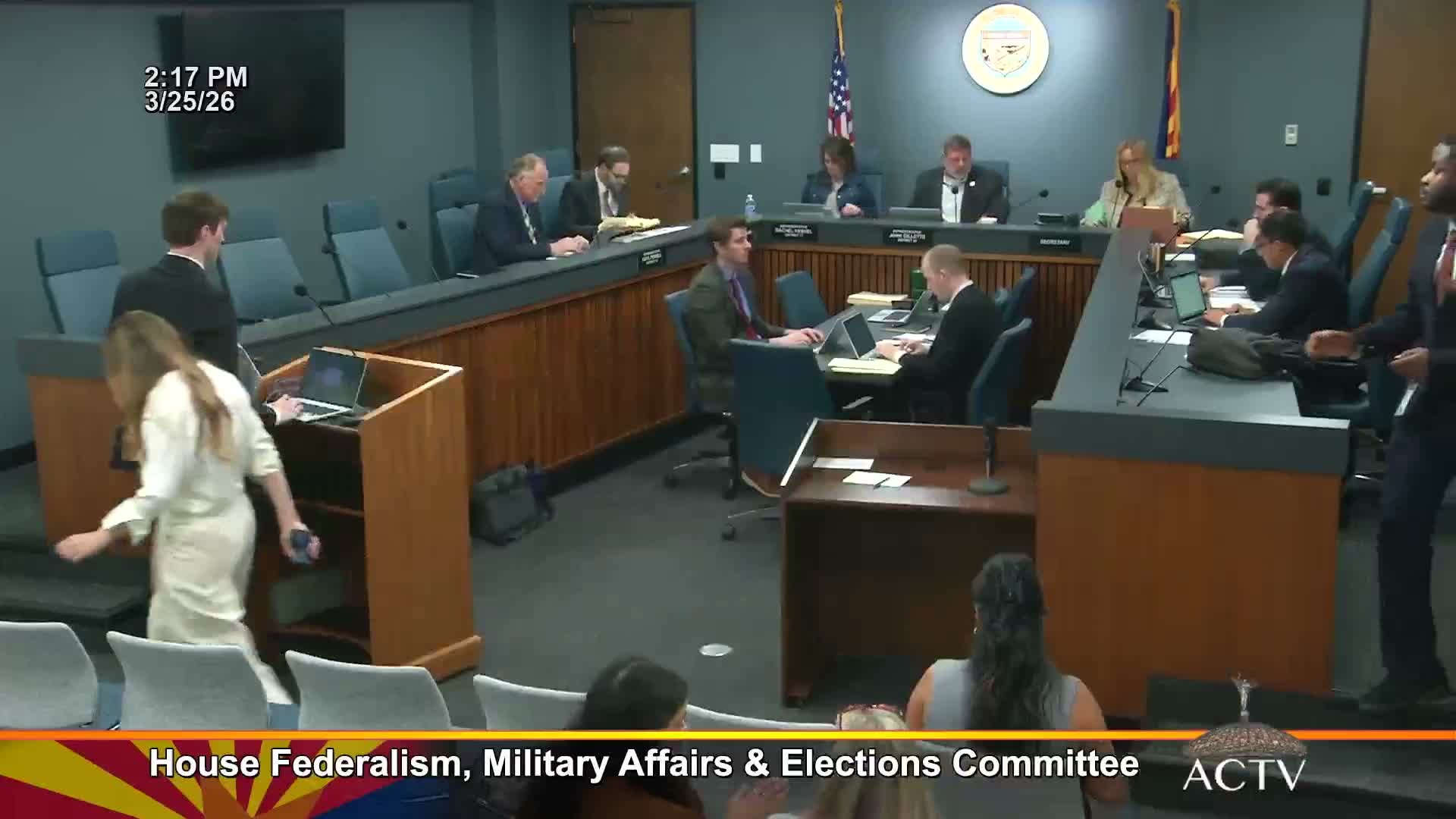
Summary
After a committee presentation alleging extensive ASU collaborations with Chinese institutions and possible Wolf Amendment issues, the House committee voted 4-2 to give Senate Bill 13-27 a due-pass recommendation; the bill would require the Arizona Board of Regents to adopt research-security policies and yearly reporting for foreign contributions exceeding $250,000.
Chairman Gillette opened the hearing with an 18-month review of foreign-funded research tied to Arizona State University, telling members his staff had collected numerous Form 117 filings and flagged collaborations coauthored with Chinese institutions that he said could implicate the Wolf Amendment and federal export controls. He said his team found thousands of coauthored publications and questioned whether certain projects were properly vetted.
‘‘Our higher institutions are prohibited from doing these type of military technology and space work with our adversaries,’’ Chairman Gillette said, summarizing his presentation and the documents the committee would forward to federal authorities.
Senate Bill 13-27, explained by committee staff, would direct the Arizona Board of Regents to require each public university to adopt a research-security policy and submit an annual report to the governor and legislative leaders listing any grants, gifts or contracts from foreign sources exceeding $250,000. The bill would also require reporting elements and create review procedures within ABOR.
Marina Macklin, a former federal national-security staffer and vice president at American Global Strategies, testified in support. Macklin said many Chinese universities implicated in the presentation are tightly integrated into state and military systems, creating legal and strategic risks when U.S. institutions collaborate on dual-use technologies. ‘‘Ultimately, we need to stop subsidizing adversary military capabilities with U.S. funding,’’ she told the committee.
Members asked about enforceability, what counts as federally sensitive research, and whether the bill would meaningfully change federal oversight. Macklin and staff said the policy is intended to supplement — not replace — federal export controls by increasing institutional transparency and internal safeguards.
The committee voted to return Senate Bill 13-27 with a due-pass recommendation, 4 ayes to 2 noes. The written record and the chairpresentation will be made public and sent to federal review offices as noted by the chair.