
Committee advances educational wild‑rice measure after tribal and DNR testimony
Get AI-powered insights, summaries, and transcripts
Sign Up Free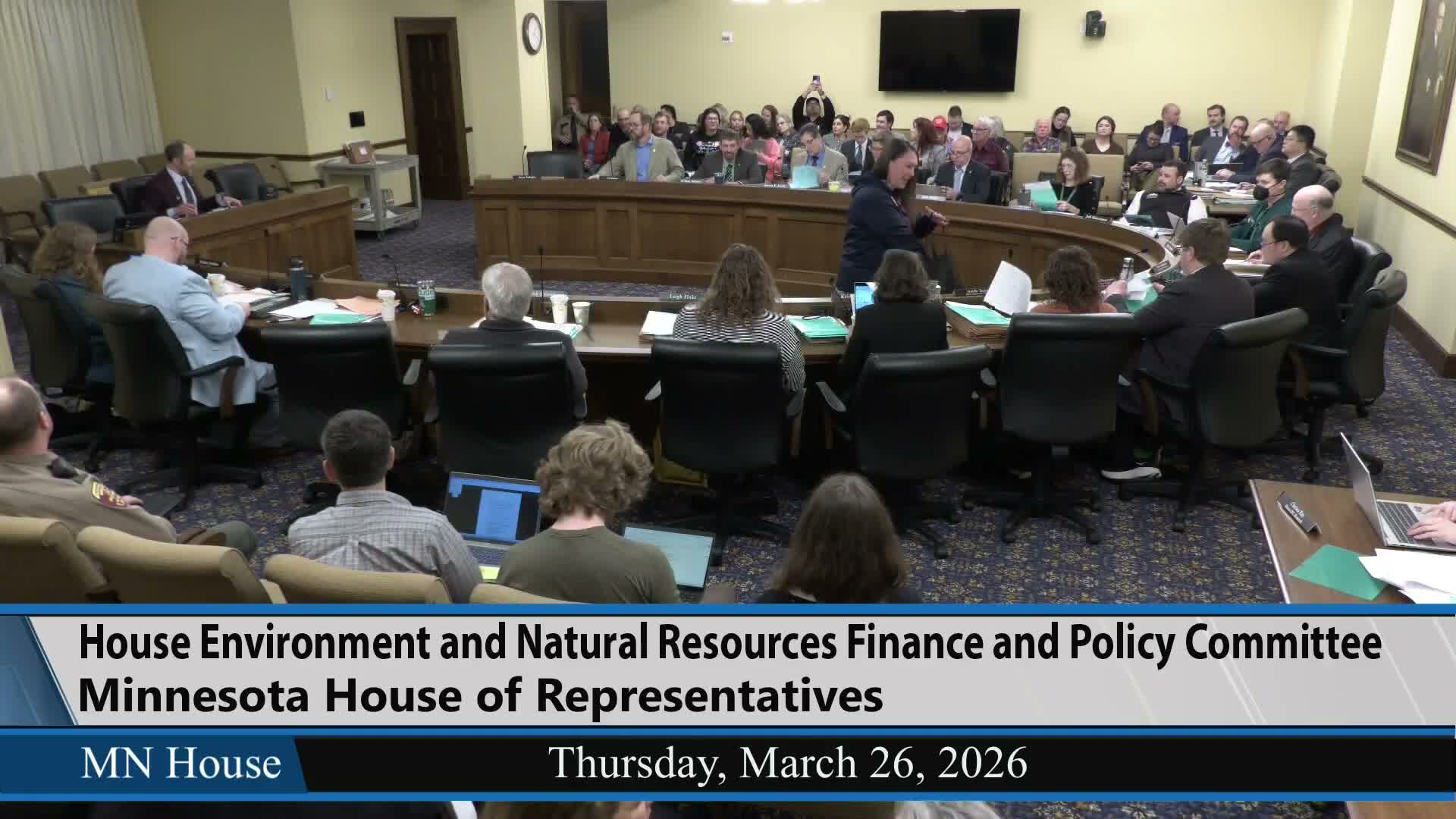
Summary
Rep. Sam Faulkner’s DE1 amends HF 3896 into an educational statute aimed at protecting wild rice (manoomin) rather than criminalizing inadvertent actions; tribal witnesses described cultural importance and DNR raised operational and enforcement concerns. The amendment was adopted and the bill was laid over.
The House Environment and Natural Resources Finance and Policy Committee on Wednesday heard extensive testimony on HF 3896, an author‑sponsored bill intended to protect wild rice (manoomin) in Minnesota waters through education and local tools rather than broad criminal penalties.
Author Rep. Sam Faulkner described the DE1 amendment as shifting the bill from criminal penalties toward an educational, "good neighbor" approach that would inform boaters about avoiding motors and damaging wakes within 150 feet of wild rice beds. "The intent is...to make it clear that we shouldn't drive motorboats through wild rice beds," Faulkner said, and added the aim is to avoid turning uninformed people into criminals.
Multiple tribal witnesses and advocates urged the committee to act. Liana Goose of Leech Lake Nation said wild rice is a treaty‑protected food source and described harvesting as cultural practice: "My son told me, 'Mom, I love manoomin.' I told him, 'me too.' That is what we mean when we say manoomin is our relative." Goose warned of a multi‑factor decline in wild rice acreage and recounted an incident where a hunter drove through a rice bed during a harvest, creating a safety risk for harvesters.
Gina Peltier of the Rise and Repair Alliance recounted traditional, low‑impact harvest techniques and invited committee members to witness a harvest firsthand. Evan Mulholland of the Minnesota Center for Environmental Advocacy and others urged support for the bill as a commonsense protection for Minnesota waters and wildlife.
Representatives asked technical and policy questions. Lieutenant Colonel Robert Grecki, assistant director of enforcement for the DNR, told the committee he supports education but has operational concerns about definitions of "uncultivated wild rice bed," enforcement mechanics, and potential shifting of conservation officers away from other duties. Grecki also noted DNR is working on a statewide inventory and prefers to coordinate on implementation details.
Members debated timing and scope: some urged faster statutory protections given reported annual declines in some areas of 5–7 percent; others urged more data and education first. The DE1 amendment was adopted by voice vote and HF 3896 was laid over for further work, with members encouraging continued collaboration between tribes, DNR and authors.