
Intellectual freedom bill draws outside legal groups' support; committee lays it over
Get AI-powered insights, summaries, and transcripts
Sign Up Free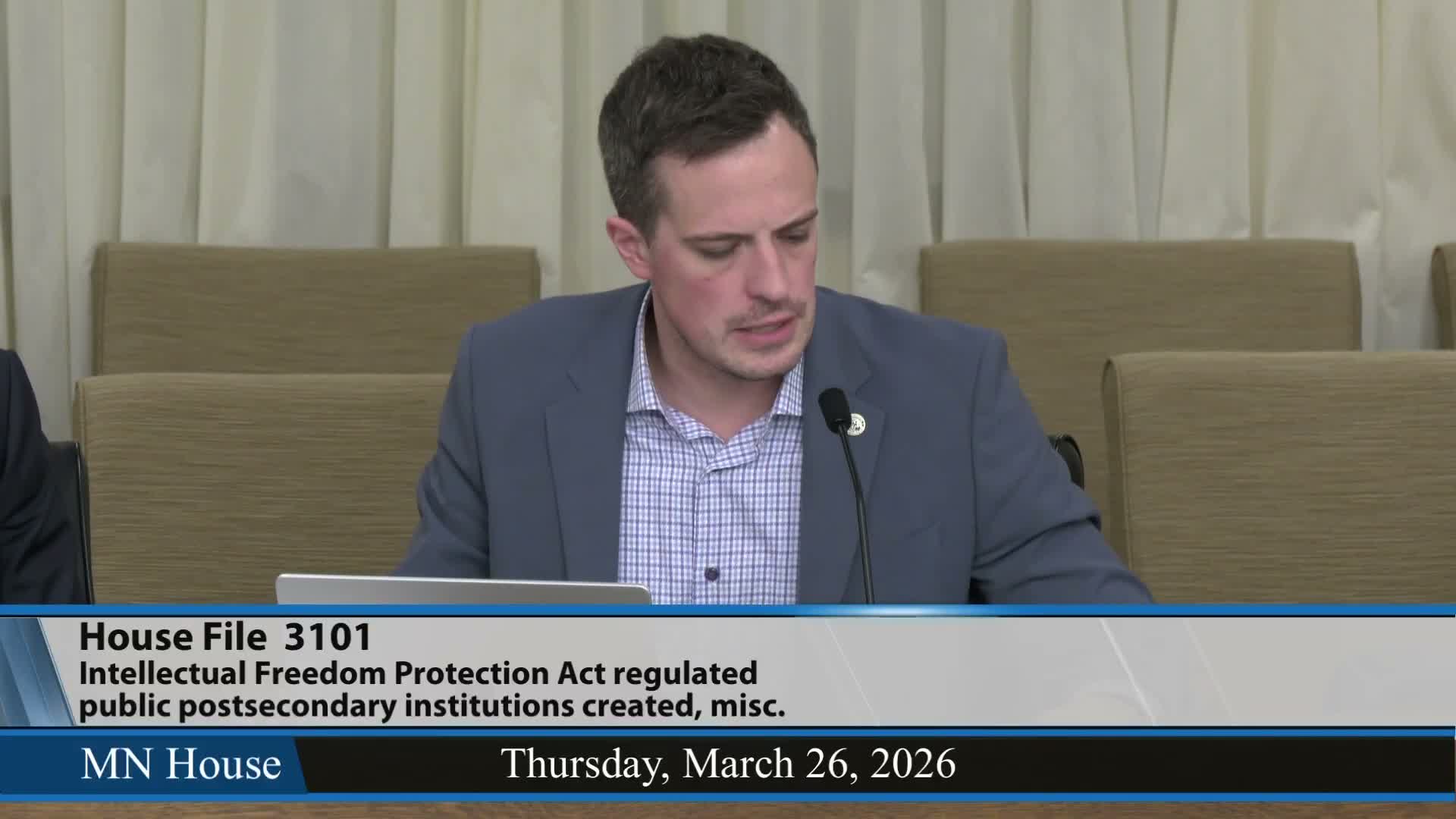
Summary
HF3101 would create an intellectual freedom protection and viewpoint-neutrality requirement at public postsecondary institutions. Witnesses from FIRE and the Pacific Legal Foundation testified in support, arguing the bill prevents compelled ideological statements; a committee vote to send the bill to Judiciary tied and it was laid over.
Representative Reimer presented House File 3101, termed an "intellectual freedom protection act," which would prohibit public postsecondary institutions from conditioning employment, admission, promotion or access to benefits on the adoption of particular political or ideological beliefs. The bill includes a transparency component and enforcement mechanism, the author said.
Tyler Coward, lead counsel for government affairs at the Foundation for Individual Rights and Expression (FIRE), testified in support, saying mandatory DEI statements at some universities "compel" viewpoints and that the bill protects academic freedom and free expression. Colleen Lindgren and Brandon Beyer of the Pacific Legal Foundation argued the bill promotes equal protection by preventing ideologically based requirements for employment and admissions.
Members asked whether the bill would affect historically underrepresented communities and hiring practices aimed at increasing representation. Representative Noor raised concerns about whether restricting consideration of background or experience could undermine efforts to improve student success; Representative Reimer said the bill is intended to protect individuals from compelled ideological conformity while still allowing merit- and experience-based hiring.
The author moved the bill to the Judiciary Committee; a roll-call resulted in a 7–7 tie and the motion did not prevail. The measure was laid over for further consideration and possible amendment.