Senate labor committee advances three bills to curb workplace AI surveillance and require displacement notice

Minnesota Senate Labor Committee · March 25, 2026

Get AI-powered insights, summaries, and transcripts

Sign Up Free
AI-Generated Content: All content on this page was generated by AI to highlight key points from the meeting. For complete details and context, we recommend watching the full video. so we can fix them.

Summary

The Minnesota Senate Labor Committee voted to recommend three related bills — SF 4576 (displacement notice), SF 4686 (electronic monitoring limits), and SF 4689 (automated decision systems safeguards) — after testimony from labor, business and agency witnesses and adoption of author amendments. The measures now move to state and local government committees.

Chair McEwen on Thursday opened a Senate Labor Committee hearing and the panel recommended passage of three bills intended to limit abusive workplace uses of artificial intelligence and require notice when AI-driven displacement occurs.

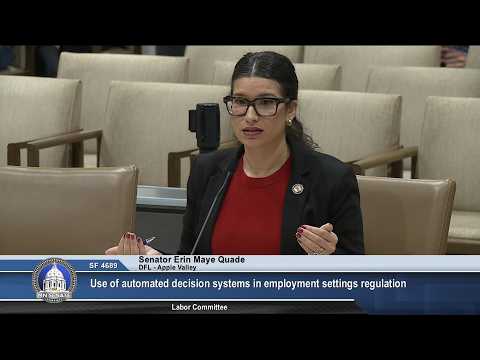
Senator Maye Quaid, the bills’ author, summarized the package as a set of common-sense protections that preserve the benefits of new technologies while preventing their misuse. “Automated decision systems cannot terminate a worker,” she said, and workplaces must provide pre- and post-deployment notices, access to data, and a human review and appeal process for employment decisions influenced by AI.

Why it matters: Testimony showed sharply different perspectives. Aaron Rosenthal, research director at North Star Policy Action, argued the bills address rapidly advancing AI risks — displacement, digital surveillance and opaque decision-making — and pressed for worker voice and transparency. “AI capacity is doubling roughly every seven months,” Rosenthal said, and Minnesota should act now to avoid unchecked workplace harms. By contrast, business witnesses raised drafting concerns. Lauren Shodhorst of the Minnesota Chamber of Commerce warned that broad or inconsistent definitions could sweep in routine tools such as scheduling or GPS fleet tracking and impose burdens that are difficult for small employers to meet.

The measures, as amended, include: a displacement-notice bill (SF 4576) requiring advance notice and transitional employment periods when AI displaces a defined share or number of workers; an electronic-monitoring bill (SF 4686) that prohibits intrusive off-duty or private-area surveillance, limits sale or transfer of worker data, and bans implanted monitoring devices; and an automated-decision-systems bill (SF 4689) that bars employers from relying solely on ADS for high-consequence employment decisions, prohibits inferring sensitive private traits, and guarantees workers access to data and human appeals.

Committee action and next steps: Authors offered A2 amendments that tightened several definitions (for example changing 'assist' to 'partially or fully replace' in the ADS definition), directed penalties to the Workforce Development Fund, and added an effective date of Jan. 1, 2027 for SF 4689. The committee adopted the A2 amendments and recommended each bill to pass and be re-referred to the Committee on State and Local Government by voice votes. The Department of Labor and Industry said it is preparing a fiscal note and has not yet provided technical assistance.

Different stakeholders asked the committee to resolve several drafting issues before final passage: harmonize AI definitions across statutes, narrow scope so common enterprise software is not unintentionally captured, clarify how state rules interact with federal WARN/Worker Adjustment rules, and consider vendor point-of-sale disclosure so purchasers know what a product contains.

What to watch next: The bills will go to the Committee on State and Local Government (and may require additional referrals such as Judiciary or Finance). Authors signaled openness to amendments addressing vendor disclosure and definitional concerns as the legislation proceeds.