Get Full Government Meeting Transcripts, Videos, & Alerts Forever!
Get email alerts on the Trail Project topic
No spam. Unsubscribe anytime.
Board recommends putting Blaine Wetland Sanctuary trail segments 1 and 2 out to bid despite council pause
Summary
The Natural Resource Conservation Board voted to recommend that the City Council allow staff to put trail segments 1 and 2 out for bid to test costs. Staff discussed two load-rating design options, estimated costs, funding sources and timing; the recommendation will go to council for final approval.
The Natural Resource Conservation Board voted to recommend that the City Council allow staff to put the Blaine Wetland Sanctuary trail segments 1 and 2 out for bid, with segment 1 split into 1A (north–south) and 1B (east–west) at bid time to give the city flexibility on alternatives and load ratings.
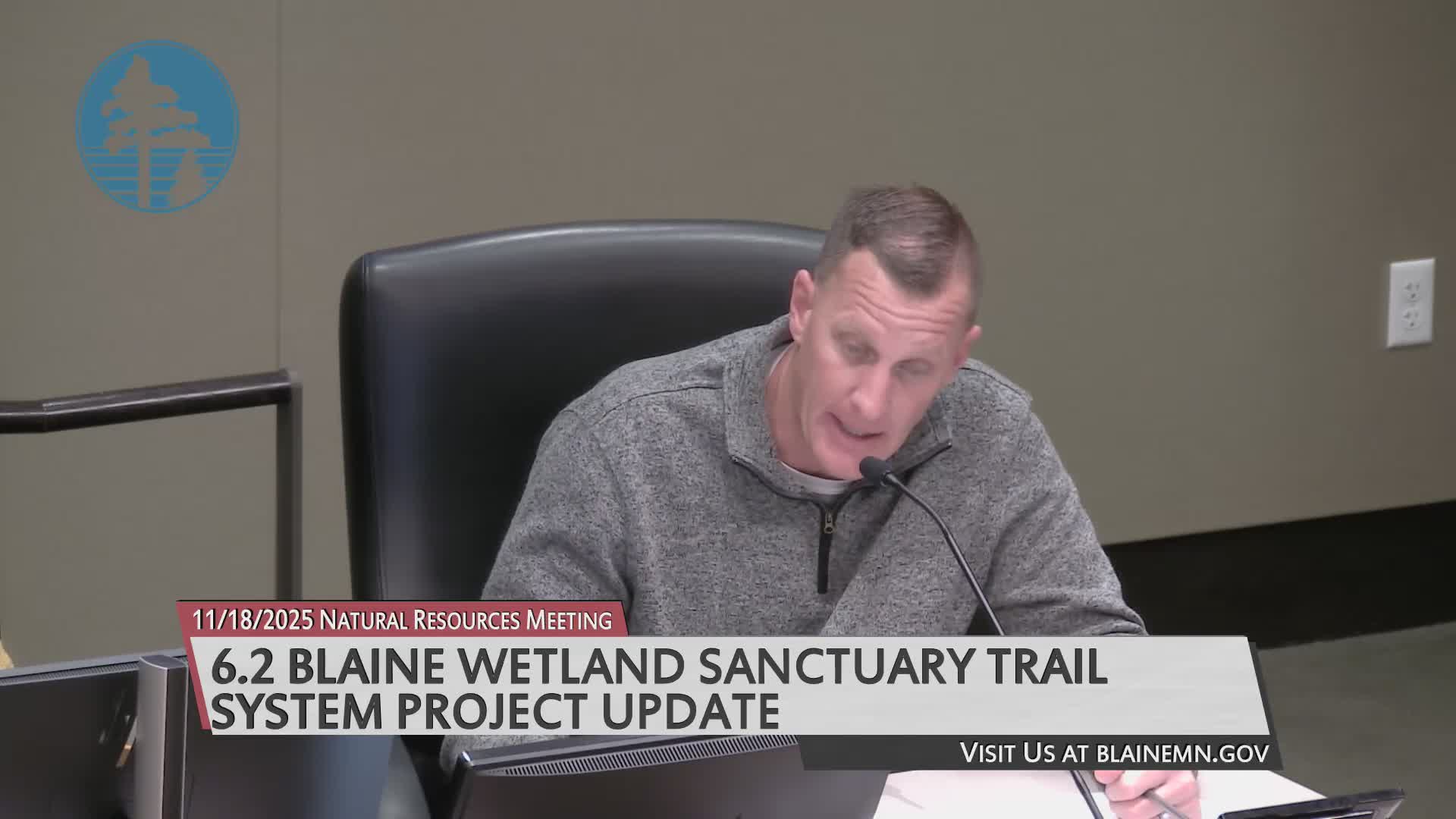
Board members made the motion after staff reviewed why the council had previously asked for a pause: projected low ending balances in the 2026–2030 open-space CIP and uncertainty about wetland-credit revenue. One board member said bidding will "test the waters" so the city can see real costs before committing. The motion was moved and seconded and the board recorded 'aye' votes and forwarded the recommendation to the council.
Project engineer Brent Larson (introduced by staff) reviewed design and phasing options and presented preliminary estimates. Larson said Stantec has nearly completed construction plans and specifications and that the project could be bid once the council directs staff to proceed. He described two structural load-rating options for the boardwalk: a 2,500-pound design for light UTV/golf-cart maintenance access or a heavier 5,000-pound design that would allow more frequent maintenance and emergency-vehicle use.
"So just for segment 1 ... just over $4,000,000 for that at the 5,000 (pound)" Larson said, later noting a 2,500-pound option could save roughly 10 percent (about $400,000) on that segment. He added that segment 2 would add roughly $1.1–1.7 million depending on the chosen loading standard, and that completing all three segments was estimated at about $9.5 million. Larson and staff emphasized these are estimates, not bid prices.
Staff explained funding sources the board could use if the council authorizes bids: park-dedication fees (about $4,800 per lot, with 35% directed to the open-space fund and 65% to the park fund) and a $1.0 million short-term advance from park-dedication funds to cover cash flow if the city chooses to start construction earlier; staff said the advance would be repaid in 2028 from park-dedication receipts. Staff also noted roughly $914,000 in existing open-space funds remained available to carry over into the project.
Board members questioned emergency access and vehicle weights. Staff said police and fire UTVs and fully equipped emergency vehicles can approach the 2,500-pound threshold when loaded and that heavier loading designs will reduce maintenance needs. The board asked staff to keep bids broken into logical sections and alternates so the city can pair back work if bids come in over budget.
Outcome and next steps: The board formally recommended that the City Council allow staff to put segments 1 and 2 out for bid; staff will present the recommendation to the city manager and to the council for its approval. Staff said plans and specifications are near complete and, if council approves, staff could post bid documents as soon as the December posting schedule allows.
Why it matters: The recommendation tests actual market pricing and affects how much of the trail system can be built in the near term, how emergency responders can access the sanctuary, and whether the city will need to use short-term park-dedication advances to cover construction cash flow.
Next steps: The recommendation will be taken to the city manager and council; if the council approves, staff expects to post bid documents and proceed according to the bidding schedule.