Get Full Government Meeting Transcripts, Videos, & Alerts Forever!
Get email alerts on the Economic Development Grants topic
No spam. Unsubscribe anytime.
Tamarac OKs tenant‑improvement grants for two small businesses, citing economic attraction goals
Summary
The commission approved reimbursement grants — $48,636.07 for A Touch of Sterling and up to $100,000 for Origins Cafe — through the city's tenant-improvement program aimed at attracting new businesses and jobs to Tamarac.
The Tamarac City Commission on Jan. 29 approved two tenant-improvement reimbursement grants designed to attract small businesses into underused commercial spaces.
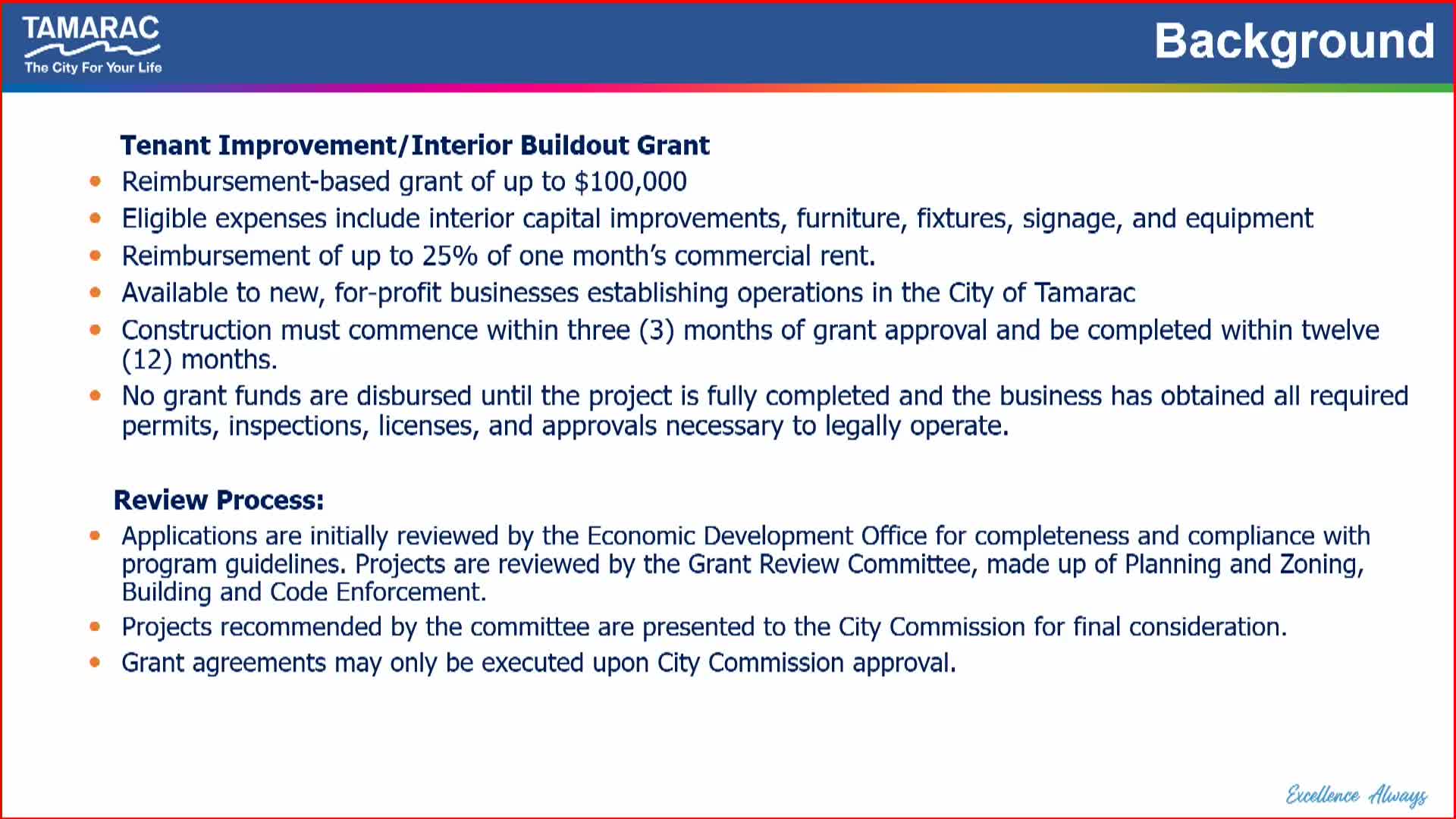
Economic Development Administrator Kenneth Lopez presented the applicants and the program rules: grants are reimbursement-based with a maximum award (typically $100,000), require permits and completed construction before funds are released, and are intended to incentivize interior build-outs and job creation.
A Touch of Sterling — a beauty supply/servicing operation proposed for North University Drive — requested $48,636.07 to cover interior build-out, signage, fixtures and limited electrical improvements. Staff said the business expects to create roughly 2.5 jobs initially.
Origins Cafe (Jamaka Coffee Traders), planned for a Commercial Boulevard outparcel, applied for the program cap of $100,000 to support a micro‑roastery and cafe; staff noted eligible project costs exceeded $130,000 but the grant is capped at $100,000. The applicant projected about five jobs at opening.
Commissioners asked procedural questions about construction timelines and program oversight; both grants were approved by unanimous votes. Staff reminded commissioners the program is reimbursement-based — applicants must finish projects, close permits and meet code before receiving funds.
The approvals follow the city's broader economic-development goal of revitalizing shopping centers and attracting new tenants to underutilized storefronts.