
Senate stalls on budget as senators clash over $3.5 million gap for private school scholarships and childcare expansion
Get AI-powered insights, summaries, and transcripts
Sign Up Free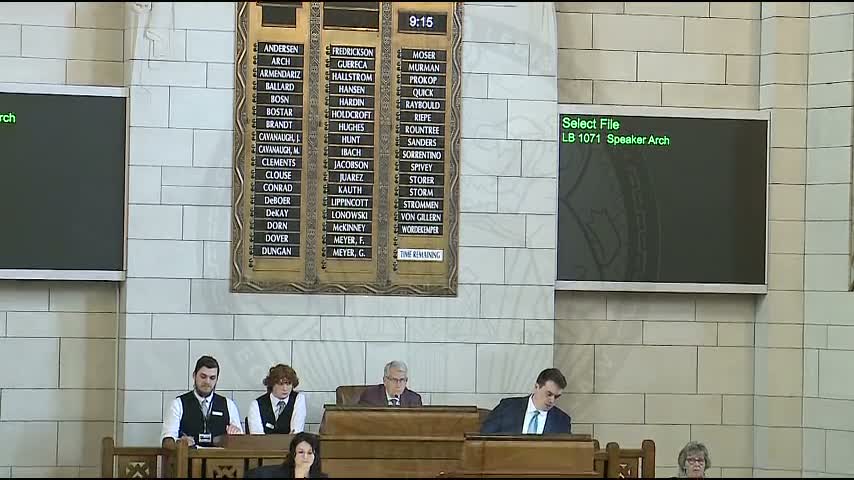
Summary
Nebraska senators spent the day debating LB10‑71 and AM29‑20, which packages a one‑year $3.5 million gap for private school scholarships and an expansion of childcare subsidies (LB304). Lawmakers split on constitutional and fiscal grounds; procedural votes halted final action before recess.
The Nebraska Legislature’s Senate spent extended floor time debating a budget compromise that pairs a one‑year $3.5 million gap payment for scholarship‑granting organizations with an expansion of childcare subsidies, a package supporters say prevents family disruption and opponents say risks unconstitutional use of the budget.
Senator Ben Hansen, a floor sponsor of the compromise, told colleagues the AM29‑20 package aims to "move the budget forward" while protecting families: the amendment combines a one‑year gap appropriation of roughly $3.5 million to keep students in place and restored childcare subsidy funding tied to LB304. "This helps the people of Nebraska in many ways," Hansen said, urging colleagues to find bipartisan compromise.
Why it matters: AM29‑20 touches both a permanent program change proposed in LB304 (raising the childcare subsidy eligibility to 185 percent of poverty) and a temporary appropriation to allow students who rely on scholarship granting organizations to remain enrolled during a transition to federally enabled tax credits. Opponents contended the gap funding effectively routes public dollars to private schools and could set a precedent that bypasses constitutional limits on appropriations.
Legal and fiscal clash: Senator Carol Conrad argued the chamber should not use the budget to enact substantive policy. "We have no money," she said multiple times while warning that constitutionally rooted restrictions (Article III, sections noted on the floor and the 1947 Rain v. Johnson decision cited in debate) limit using appropriations to carry substantive measures. Conrad successfully brought AM27‑82 to a vote; that amendment—offering a different restoration for developmental disability rate adjustments—failed, recorded as 12 ayes and 32 nays.
On the other side, Senator Raybould and others pointed to private fundraising and SGO readiness as a practical alternative to taxpayer funding. Raybould said scholarship‑granting organizations had already reported more than $9.1 million in eligible private contributions and quoted assurances from school leaders that "no child will be disenrolled." Supporters responded that private funds may not guarantee immediate stability for every family and that the $3.5 million is a narrow, one‑year bridge to avoid upheaval for low‑income students.
Procedural status: The chamber recorded a roll‑call vote to end debate (reported as 29 ayes, 12 nays) and later placed the house under call so absent senators would return. A later motion to invoke cloture on the broader budget effort was not adopted; the Senate recessed for lunch before reaching a final disposition on the complete AM29‑20 package.
What remains unresolved: The core disagreement is procedural and constitutional as much as fiscal—supporters say the amendment is a practical, short‑term fix and a necessary compromise to pass a constitutionally required budget; opponents argue it blurs the line between appropriations and substantive policy. The floor will resume consideration after recess with committee sponsors continuing to press for passage and opponents urging caution or alternative funding routes.
The Senate paused its session for recess; no final approval of the full amended budget had been recorded before the break.