Lebanon school board appoints Hattie B. Stokes principal, approves devices, change orders and E‑Rate; discusses cell‑phone rule and pre‑K funding
Loading...
Summary
At its March 17 meeting the Lebanon Community School Corporation board appointed Rick Hunt as principal of Hattie B. Stokes, approved routine personnel and purchasing items (including K–8 iPads and an E‑Rate network purchase), authorized renovation change orders after discovering deteriorated hydronic piping at the preschool, and heard updates on a new statewide student cell‑phone requirement and pre‑K funding plans.
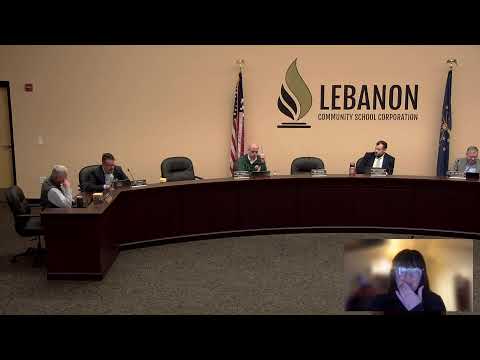
The Lebanon Community School Corporation board met Tuesday evening at Lebanon High School and approved several personnel and project items while devoting significant time to legislative and pre‑K funding updates.
Superintendent Dr. Milliman opened with recognitions and grant news, saying the district will receive a second year of a comprehensive mental‑health grant after funds were released, and praised staff who presented at recent conferences. “We will now be able to put those funds to use in the same way we did previously with more mind‑body medicine, opportunities for our staff,” Dr. Milliman said.
The board approved routine consent agenda staff matters and, by subsequent vote, appointed Rick Hunt as principal of Hattie B. Stokes with a contract beginning July 1. Dr. Milliman said the appointment recognizes Hunt’s work launching the district preschool; Hunt told the board he is “excited to finish this school year and continue to help build that out with the idea also of beginning to focus on, leading Hattie B. Stokes.”
Finance and facilities items were also approved. The board authorized renovation change orders after staff described unforeseen deterioration of hydronic piping at the preschool that required removal and replacement; finance staff characterized the piping as rusted and said it posed a real risk of flooding if not addressed. The board also approved the regular K–8 iPad purchase cycle (sole‑source for Apple devices, budgeted from debt service) and an E‑Rate project to buy switches and wireless access points for Hattie B. Stokes and Lebanon High School. District staff explained E‑Rate requires spending up front and yields roughly 70% federal reimbursement; the equipment package was described as roughly $630,000 with net local spend near $180,000 after reimbursement.
Dr. Milliman and finance staff reviewed the district’s pre‑K funding approach and longer‑term finance choices. He reiterated that pre‑K is a tuition‑based program because the State of Indiana provides no per‑student tuition support for pre‑K; the district is leveraging operating‑referendum revenue (described as “a little north of $600,000” being applied to pre‑K operations, plus an additional ~$150,000 added in year one) to cover instructors and other operational costs. To expand access, the district plans a sliding tuition scale and a proposed preschool access fund to deliver sustainable local support.
On legislation, Dr. Milliman highlighted a recently passed change that expands the period during which student cell phones must be kept "powered off, stored, and inaccessible" to the entire school day, not only instructional time; he warned that implementing and enforcing that standard will require careful administrative guidance and handbook revisions. “The law says that... student cell phones must be powered off, stored, and inaccessible throughout the entire school day,” he said, and added that the district is working through the operational details.
Finance staff presented a 10‑year forecast and explained an option for 2026 created by Senate Enrolled Act 1: districts may choose how a homeowner property‑tax credit is applied for this year only. Mister Dennis recommended protecting the debt service fund for 2026 (absorbing an estimated ~$600,000 impact in operations) to keep the district’s debt service tax rate lower in future years; he said many peers will instead preserve operating balances now and raise debt service later. The board heard the projection and the rationale for the recommended approach.
Claims and payroll covering two payrolls and a set of claims totaling about $4.22 million were presented and approved. The board also approved several out‑of‑state and overnight trips outlined in the materials and set the next regular meeting for April 21.
The meeting ended after routine business and no public commenters were recorded in the transcript.
The board’s actions take effect as documented in board minutes and personnel contracts; staff said they will return with handbook language and additional guidance on implementing the cell‑phone requirement and with further detail on the preschool access fund plan.