
Sedona leaders present balanced housing strategy aiming to bring families and workers back
Get AI-powered insights, summaries, and transcripts
Sign Up Free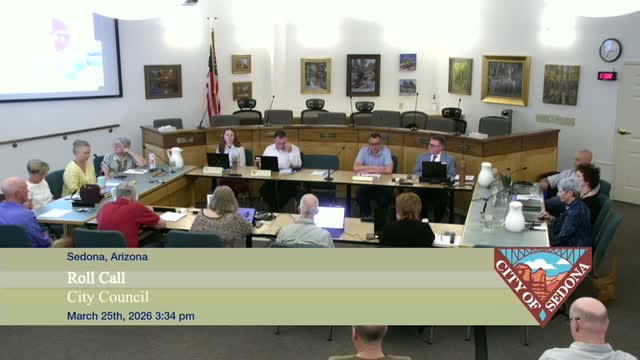
Summary
City staff proposed a 10‑year balanced housing strategy targeting roughly 775 new and repurposed units to restore working‑age families and reduce cost‑burdened seniors; council and the school board asked for safeguards to limit conversions to short‑term rentals and for next steps on site selection and incentives.
City staff on March 25 laid out initial results of a balanced housing strategy designed to reverse decades of demographic change and help replenish school enrollment and the local workforce.
"You have 10,048 people," said Community Development Director Tony Allender, presenting demographic and housing data that showed a notable COVID bump and a forecast that Sedona’s population will peak near 2030 then trend downward. Allender told the joint meeting of the Sedona City Council and the Sedona Oak Creek Unified School District that the daytime population (about 15,571) underscores Sedona’s role as an employment center.
Allender highlighted rapid aging and household shifts: "Today our median age is 64.1, and 48 percent of our population is age 65 or older," he said, noting children now account for a small share of the population and that household size has fallen to roughly 1.9 persons. The presentation showed that housing units have grown (22% since 2000) while residents have not, and that much of the vacancy category reflects second homes and short‑term rentals (STRs).
Staff noted STRs rose from roughly 10% of housing stock in 2020 to 18.1% today and that single‑family homes used as STRs increased from about 454 to 1,041 units — a change Allender said shifts market dynamics and affects long‑term housing supply.
To address that imbalance, staff proposed four priority household groups for a 10‑year target: working‑age families with children, working‑age households earning $50,000–$200,000, hospitality and service workers, and cost‑burdened seniors. "The model" Allender said, "shows approximately 775 units over 10 years — about 600 units for working‑age households and 175 income‑restricted senior units," with 221 units already in process.
The plan emphasizes unit mix: more 3‑ and 4‑bedroom units would be needed to attract families and increase school enrollment. Allender presented scenario modeling showing a 60/40 split favoring family‑oriented units could add several hundred children to district rolls.
Councilors and board members pressed staff on practical questions. Board member Charlotte probed an estimate Allender gave about redeploying senior‑occupied homes, asking whether those properties would in fact become available. Allender said the figure (about 88 redeployable units in one estimate) is an informed assumption and that some units will be lost to STR conversion or to sales outside the community.
Board member April asked how the city would limit conversion of new units to STRs. Allender described three levers: public ownership or long‑term leases (where the city or land trust controls use), incentive‑driven restrictions (delays on conversion in exchange for zoning or subsidy changes), and community land trusts.
Several speakers drew a link between housing and schools. "If we bring more working households with children back, we stand a better chance of keeping businesses and bringing back healthcare services," Allender said. Council members and board members agreed to pursue more frequent joint meetings and to form a small subcommittee to coordinate next steps, including site evaluation for public parcels and how incentives might be structured.
Public commenters offered a range of views. Resident Lita Boyd urged economic diversification in addition to housing; resident Sean Smith called for more multifamily housing to attract families; resident Henry Silbarger questioned some staff numbers. The boards agreed to follow up with more detailed regional comparisons and a schedule for community engagement.
Next steps: staff will return with specific site options, regulatory or incentive mechanisms to limit STR conversion, and more precise regional trend data. The council and school board asked staff to work with Logan Simpson (the consultant) to move from analysis to proposed strategies in a later presentation.