
Richland PFD says REACH is stable after refinancing and seeks updated interlocal agreements
Get AI-powered insights, summaries, and transcripts
Sign Up Free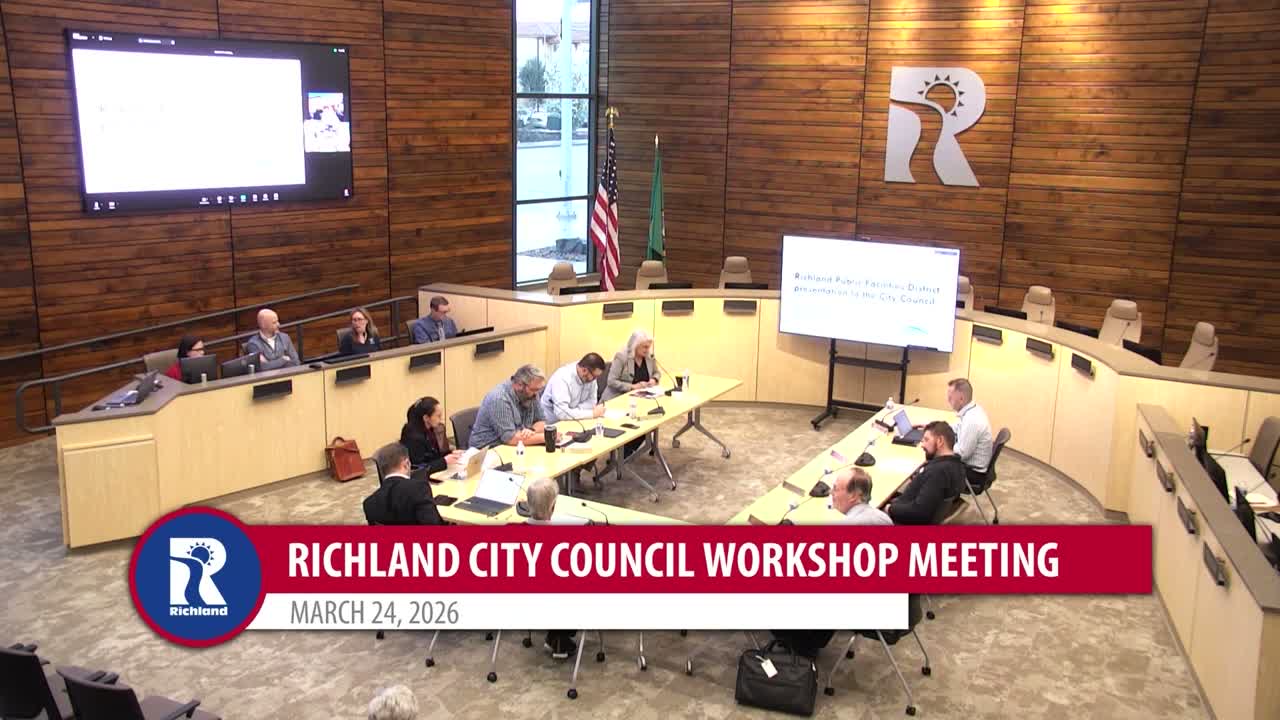
Summary
Steve Wiley told the Richland City Council the Richland Public Facility District has restructured debt, grown reserves and is prioritizing planning and business cases for REACH upgrades and potential expansion; he asked the council to renegotiate interlocal agreements and maintain lodging‑tax support before any ballot measure.
Steve Wiley, a representative of the Richland Public Facility District, told the city council on March 24 that the PFD has moved from a precarious post‑recession position to a financially stable stance after recent refinancing and steady local tax‑base growth.
Wiley said the PFD currently receives roughly $1,000,000 a year in income and that about three‑quarters of the PFD’s funds come from the state sales‑tax rebate; he noted the state rebate (0.33%) brings the PFD about $750,000 a year and that a separate 0.2% local sales tax measure, if approved by voters, would bring an estimated $4,500,000 annually. “Right now we get about $1,000,000 a year in income,” Wiley said, and he added the district’s tax base has grown about “over 6 and a half percent per year” on average.
The nut graf: Wiley described two near‑term financial moves that changed the PFD’s outlook. The district obtained a 10‑year bank loan at lower interest to avoid a statutory refinancing constraint, which reduced near‑term bond payments and freed cash flow; paired with the existing lodging tax contribution the PFD estimates it could generate financing capacity for roughly $12 million in projects. Wiley also said the state extended PFD bonding authority from 2025 to 2056, giving the district more time for long‑term planning.
Council members pressed Wiley on accounting details after the presenter acknowledged that some income statements showed negative net figures in recent years. Wiley attributed the discrepancy to accounting and timing of inter‑entity transfers, pointing to a $250,000 transfer to a PFD account and a $103,000 movement that appear as expenses on city statements even though fund balances rose year‑over‑year. He offered to follow up with staff for a detailed reconciliation.
Wiley outlined prioritized projects and rules the PFD will follow before incurring new debt: develop cost estimates, produce business plans, and submit financial risk analyses to the Washington State Department of Commerce. He identified specific planning contracts already under way for an amphitheater upgrade, REACH basement remodeling, landscaping and signage work in partnership with the Port of Kennewick, and said any expansion or new debt (for example a proposed $10–12 million expansion or a children’s museum) would require a formal business case.
On governance and funding mechanics, Wiley asked the council to update overlapping interlocal agreements that were written in the early 2000s to reflect current finances and ownership possibilities (including potential reconveyance of land from the Army Corps). He also requested continued or increased lodging‑tax contributions (the city’s lodging contribution has remained $125,000 for 25 years) to improve bonding capacity. “We exist to support the economic and cultural development of the city and we cannot be successful without your support,” Wiley said.
Council members generally supported a cautious approach: they urged the PFD to first increase earned income and demonstrate stewardship before pursuing voter approval for additional taxes. Wiley agreed, saying the PFD’s next two years will focus on planning, community engagement and proving the financial viability of projects before asking voters to consider a 0.2% sales tax.
The presentation closed with Wiley offering to provide follow‑up financial reconciliations and additional details to council staff and members. The council took no action at the workshop; it moved on to the next agenda item.