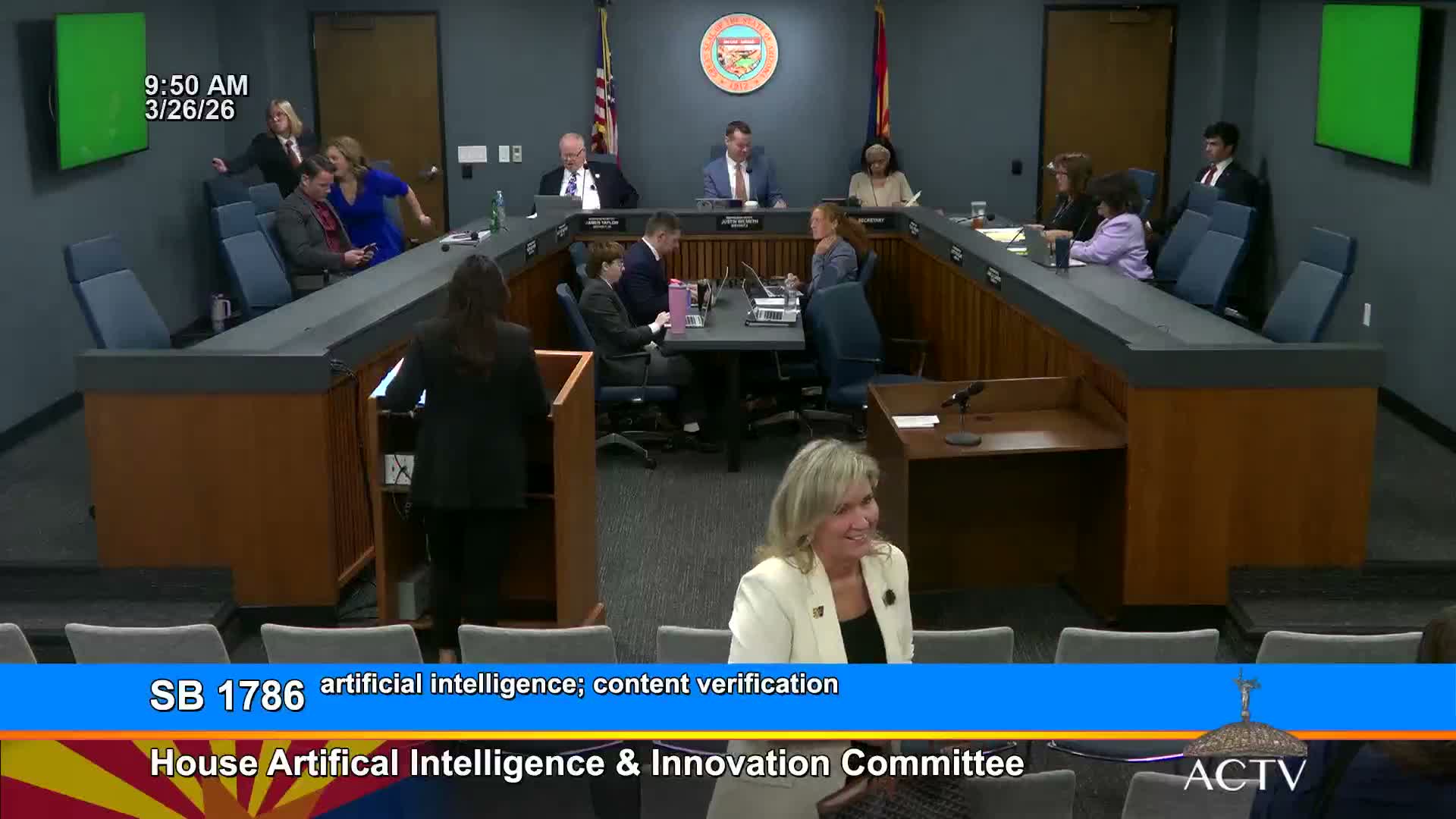
Arizona committee adopts amendment and advances bill requiring provenance metadata on AI‑generated media
Get AI-powered insights, summaries, and transcripts
Sign Up FreeSummary
The Artificial Intelligence and Innovation Committee voted 4‑2‑1 to give Senate Bill 17‑86 a due‑pass recommendation after adopting an amendment that requires covered providers using generative AI to add provenance data (watermarking/metadata) to altered or AI‑created audio, image or video, with specified exceptions and an effective date of Feb. 1, 2027.
The Arizona Artificial Intelligence and Innovation Committee advanced Senate Bill 17‑86 on March 25, 2026, agreeing to an amendment and voting 4 aye, 2 nay and 1 absent to send the measure to the floor with a due‑pass recommendation.
Legislative staff summarized the bill for the committee: the measure would require covered providers that use generative AI to include provenance data—such as watermarking or metadata—on any video, image or audio content the systems create or significantly modify, and to make that provenance difficult to remove. Staff also described an amendment sponsored by the committee chair that narrows some obligations, excludes certain interactive experiences and non‑user generated media, and says a provider need not include identifiable individual information in provenance data unless the user elects to include it; the amendment sets an effective date of Feb. 1, 2027.
Chairman Wilmeth, speaking for the bill sponsor, described the intent as consumer‑facing transparency so ‘‘the public does not get deceived’’ by realistic AI content. ‘‘This is Wild Wild West policy,’’ the chair said, framing the proposal as an initial step to alert consumers when video or audio has been generated or substantially altered by AI.
Some members raised drafting and scope concerns. Representative Travers (representative on the committee) said he opposed the bill because the definition of a covered provider may be ‘‘incredibly specific’’ and exempt entities that could still produce generative AI content; he also warned that language allowing identifiable information when a user ‘‘opts in’’ left the term ‘‘user’’ undefined and could create ambiguity. Other members discussed constitutional limits, noting the bill’s threshold for covered systems (more than 1,000,000 monthly users) was aimed at avoiding undue interstate regulation.
Vice Chair Taylor moved adoption of the Wilmeth amendment; the committee approved the amendment by voice vote. The committee then approved moving the amended bill to a roll call; after brief vote explanations the chair announced the tally: 4 aye, 2 nay, 1 absent. The committee’s action was a procedural recommendation (due‑pass) to the full legislature; the bill will next be scheduled for floor consideration per legislative rules.
What’s next: SB 17‑86, as amended, will proceed to the legislative floor with a due‑pass recommendation and an amendment that contains exceptions and an effective date of Feb. 1, 2027.