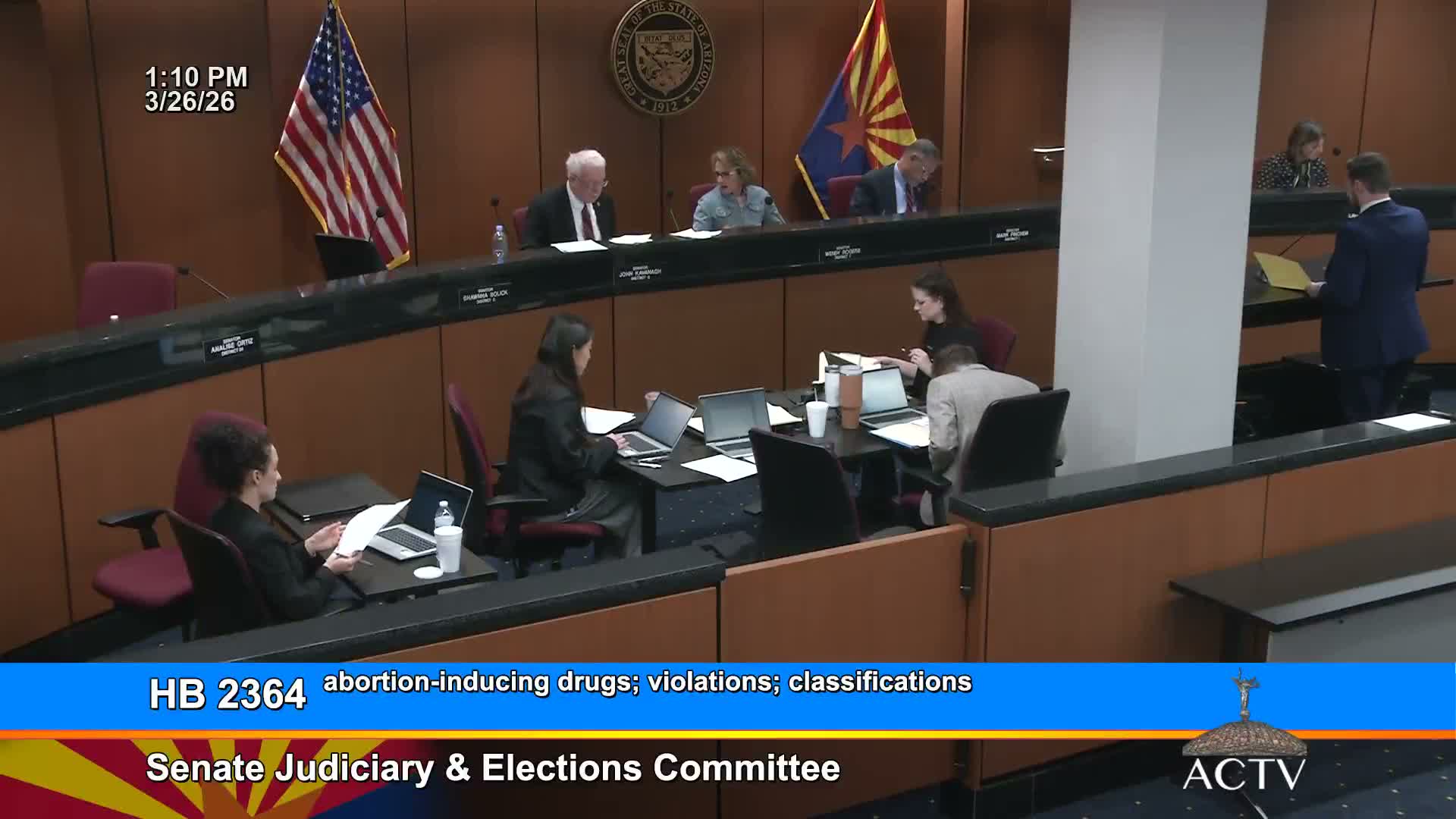
Committee advances bill criminalizing mailing of abortion‑inducing drugs despite constitutional concerns
Loading...
Summary
HB 2364 would make supplying abortion‑inducing drugs by mail a felony; backers say it closes enforcement gaps while opponents cite Proposition 1.39 and warn of legal challenges. The committee issued a due‑pass recommendation.
The Senate Judiciary and Elections Committee voted to give House Bill 2364 a due‑pass recommendation after hearing conflicting testimony about the risks and enforcement of mailing abortion‑inducing drugs.
The sponsor told the committee HB 2364 classifies knowingly providing abortion‑inducing drugs by courier, delivery, or mail as a class‑5 felony, makes it a class‑4 felony for a licensed provider to do so in the course of employment, and creates a misdemeanor for ordering such drugs knowingly by mail. Supporters presenting to the committee included a former clinic director who said pills distributed without medical oversight put patients at risk, and Arizona Right to Life, which argued the bill fills an enforcement gap.
Opponents cited procedural and constitutional concerns. A senator who voted no warned that the bill appears to conflict with Proposition 1.39, which enshrined abortion rights in the Arizona Constitution, and predicted costly legal challenges should the state pursue criminal enforcement. The ACLU and other critics were not recorded as testifying on this bill in the transcript excerpt, but committee debate focused on potential conflicts between state statutory language and recent court decisions.
The committee approved a due‑pass recommendation on HB 2364 by recorded vote. Supporters said the bill restores accountability for unlawful distribution; opponents said the proposal risks criminalizing patients and providers who rely on legally protected care, and may be preempted by constitutional protections or federal law. The transcript records both criminal case examples cited by supporters and sharply worded objections from members who emphasized voter‑enacted protections.
The bill will proceed toward the Senate floor, where proponents and opponents indicated litigation risk and constitutional arguments will likely shape the debate.