
Committee backs residency limit for groups of level‑2 and level‑3 registered offenders after contentious testimony
Get AI-powered insights, summaries, and transcripts
Sign Up Free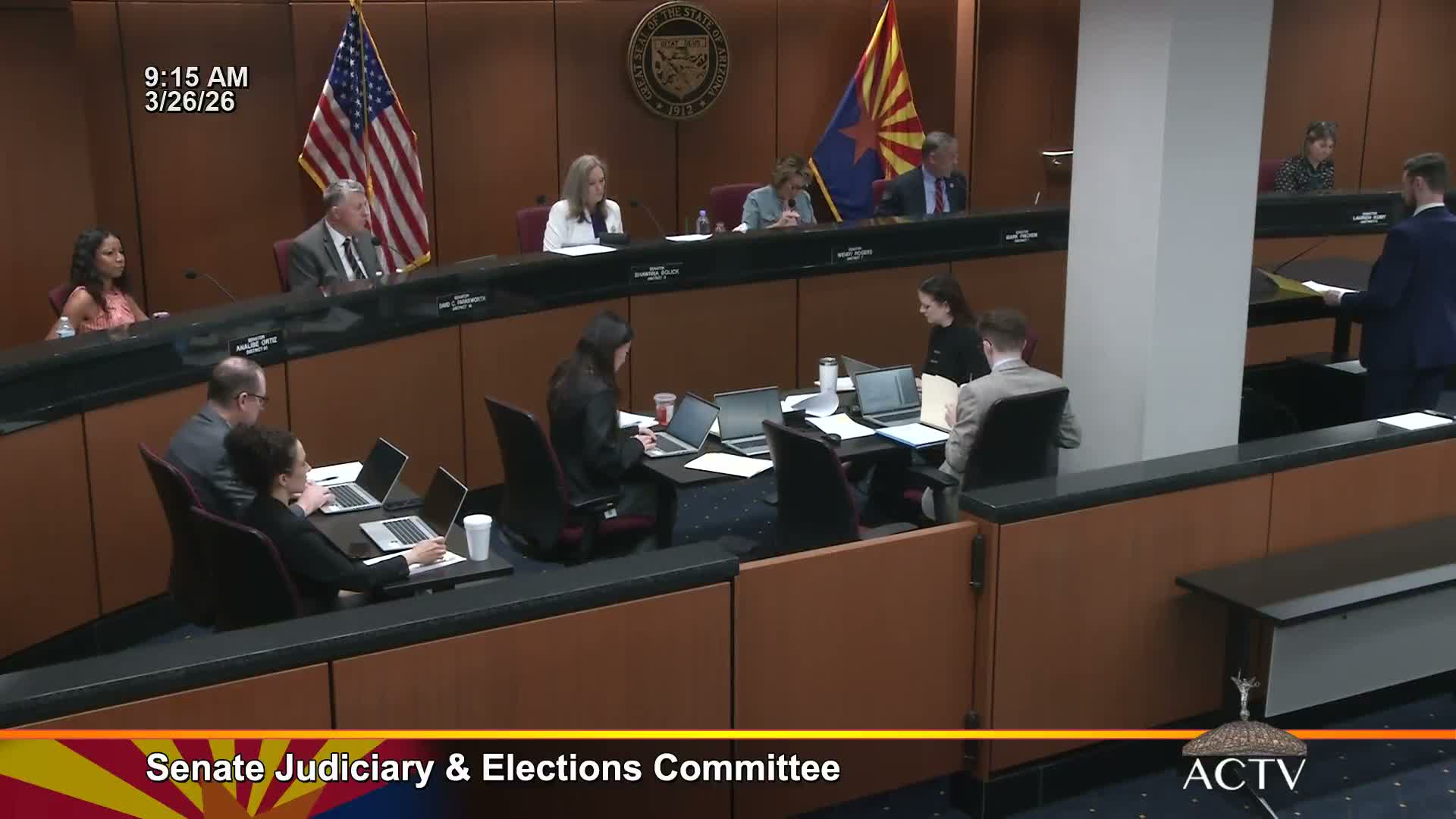
Summary
The Senate Judiciary and Elections Committee gave HB 2870 a due‑pass recommendation after heated testimony from Chandler neighbors and reentry operators. The bill prohibits multiple level‑2/level‑3 registered offenders from cohabiting in an unsupervised single‑family dwelling, with limited grandfathering for supervised facilities.
The Senate Judiciary and Elections Committee on March 23 advanced HB 2870, a bill that would bar two or more level‑2 or level‑3 registered offenders from living together in a single‑family home unless they are related or the residence is a certified, supervised reentry or behavioral health facility in operation by Jan. 1, 2026.
Sponsor Representative Wenninger framed the measure as a constituent response to incidents in the Ocotillo neighborhood of Chandler, saying neighbors reported repeated instances of multiple registered offenders occupying the same home. He said the bill grandfathered professionally overseen facilities and added carve‑outs to avoid displacing programs already supervised by the Department of Corrections or behavioral health providers.
In public comment, neighbors urged the committee to act. Tracy Bork, who said she has lived in Ocotillo for 22 years, called the occupants “monsters” and said residents feared for children’s safety after six registered offenders moved into one house. Lois Shugar, a nearby homeowner, described traffic, parties and a lack of visible supervision at the property and said the HOA and city were unable to resolve the situation.
Several witnesses and advocates urged caution. Sonia Jennings, a housing operator with reentry experience, said probation and parole resources are strained and that banning supervised group homes risks making formerly incarcerated people homeless and harder to supervise. Fred Haddad, who said he runs or rents to structured communal living programs, argued that supervised communal housing offers oversight and housing affordability for people who could not otherwise find private rentals.
Senator Kuby and other members questioned whether the bill would create cascading harms such as increased homelessness among people on supervision and whether existing homelessness and supervision systems could handle displaced residents. Kuby voted no, citing research and concerns about unintended consequences. Sponsor Wenninger said the bill sought a balance between public safety and oversight and noted the amendment that preserves facilities already operating under professional supervision.
After questions and limited floor time, the committee voted to give HB 2870 a due‑pass recommendation. The transcript records competing accounts of the bill’s likely effects on housing and supervision; supporters said it protects neighborhoods from unsupervised clusters of high‑risk offenders, while opponents warned it may reduce supervised housing options and hinder reintegration.
The committee’s next step is transmittal to the Senate floor; supporters and opponents indicated they expect negotiations over grandfathering and supervision standards if the bill proceeds.