
Parents, students urge Edmonds School District board to reject "Scenario 1" boundary map, citing community disruption
Get AI-powered insights, summaries, and transcripts
Sign Up Free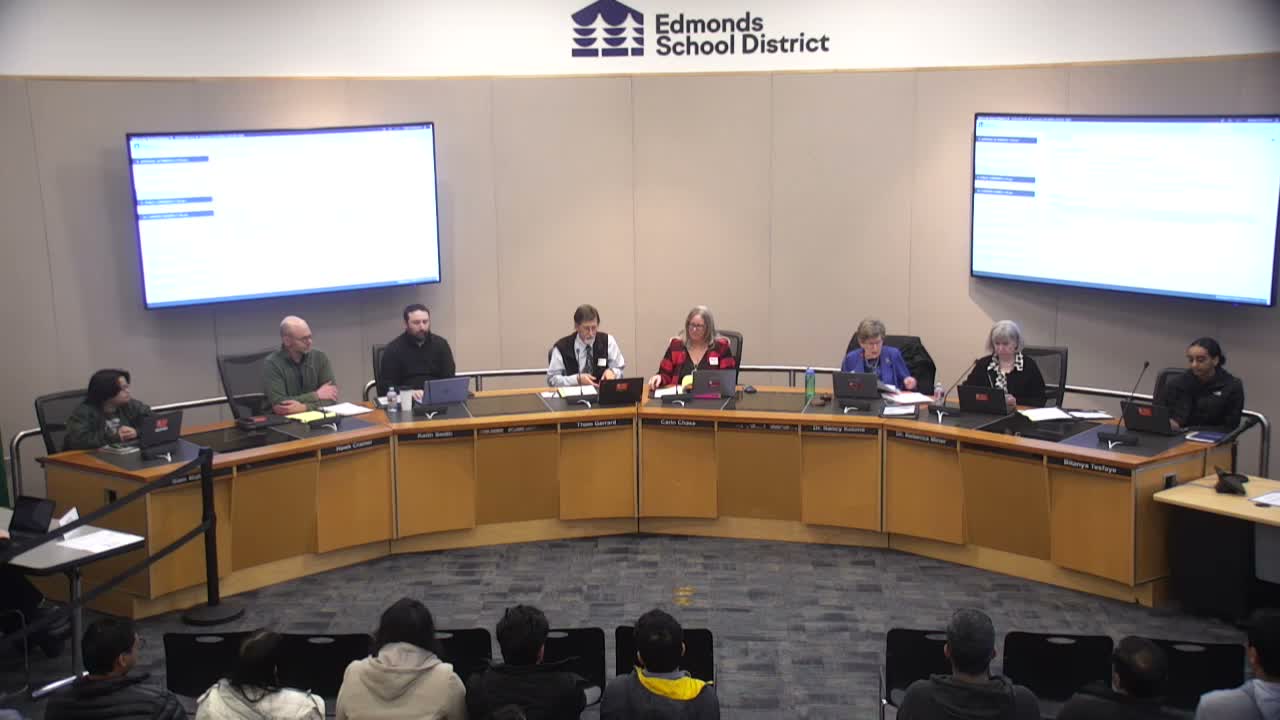
Summary
Dozens of parents and student representatives told the Edmonds School District board they oppose a proposed boundary plan called Scenario 1, saying it fragments neighborhoods, risks student safety and would move students from higher‑performing Hilltop Elementary to lower‑performing Martha Lake.
Dozens of residents and student representatives urged the Edmonds School District Board of Directors on Tuesday to reject a proposed boundary map known as "Scenario 1," saying the plan would fragment established neighborhood groupings and disrupt students’ learning and social connections.
Ekta, who identified herself as a parent and resident of the Bellflower Road area, told the board Scenario 1 "fails to meet the board policy 6960 factor number 6," which she said requires maintaining established neighborhood groupings. "We ask that you reject Scenario 1 and maintain our neighborhood's assignment to Hilltop Elementary," she said.
Pranita, another parent from Beltsover Road, cited state accountability data she said the petitioners used: "83.6 percent of Hilltop students meet ELA standards compared with 65.6 percent at Martha Lake; in math it’s 85 percent at Hilltop versus 61.9 percent at Martha Lake," she told the board. She said reassigning students would contradict the district’s commitment to instructional consistency.
Vaibhav Deshmukh, a district parent, said Hilltop’s projected overage is modest — "only a 1% to 3% variance over the next decade" — and argued that map changes would produce large disruption while doing little to solve capacity at Martha Lake, which he said appears at or near 100% capacity in 2025 projections. He handed a printed petition of signatures to the board secretary and said "135 members from our immediate neighborhood" had signed opposing the change in the previous three days.
Board members acknowledged the comments and described next steps. Director Smith said she planned to take the concerns back to the committee that developed the maps; Director Gerard thanked the attendees for organized, articulate participation and said the board values the input.
Why it matters: Boundary assignments can change students’ travel routes, peer groups and access to school programs, and they are governed by district policy factors such as neighborhood continuity and minimizing disruption. Speakers at the meeting appealed to those policy criteria and to specific performance data as they urged the board to revise the proposal.
What happens next: The board did not vote on Scenario 1 at Tuesday’s meeting. Directors said they will bring feedback to the committee that drafted the map and the item will return for further committee review or a future board study session.
Sources and context: Public commenters read data they attributed to OSPI and presented a neighborhood petition to the board secretary. The board’s stated process for public comment limited remarks to three minutes per speaker; members repeatedly referred questions and requests for map rationale back to the boundary committee that prepared the scenario.