Board weighs selling or leasing UL property to pay for $23.7 million in capital projects
Loading...
Summary
Board members and staff reviewed competing scenarios for surplus land and buildings — including selling the Karcher site or leasing/selling the UL building — as a way to fund $23.7M in capital needs while balancing long‑term land needs for a potential second high school.
The Camas School District discussed how to fund roughly $23.7 million in capital projects at a board workshop, including whether to sell surplus properties or invest to lease the district’s UL building.
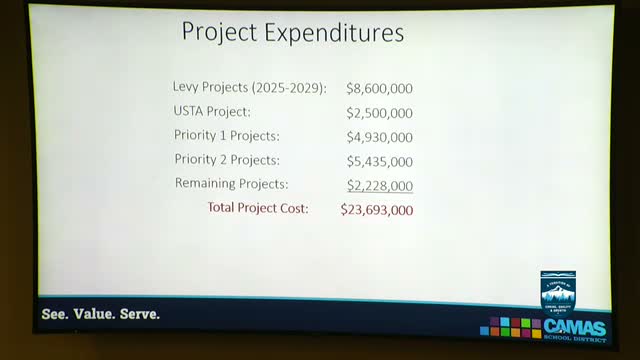
Kim, the district presenter introduced the capital list and said the district currently has $8.6 million in levy projects, about $3.0 million in the capital projects fund (with $2.5 million allocated to the USTA project), and approximately $15.4 million in impact fees that are restricted by statute. She summarized totals for current projects and priorities and warned that, “we have $32,800,000 in revenues, but over half of it is very specific in what we can spend it on,” and that longer term projects are phased because available funds are limited.
Sherman walked the board through school‑by‑school needs, pointing to the final phase of the Grama roof, Doc Harris field re‑turf, multi‑phase roofing at Liberty, resurfacing tracks and localized masonry and asphalt repairs at Camas High. Randy explained roofing conditions, noting some areas have up to five layers and earlier asbestos roofing that “will have to be abated,” increasing costs by an estimated 15–20 percent for abatement specialists.
The group then turned to how the district might use proceeds from surplus land sales. Kim presented three scenarios for the UL property and the Karcher parcel: use sale proceeds to cover priority 1 school projects; spend proceeds preparing the UL building for lease; or sell the UL building and corner lot while retaining other land. Kim said the Karcher appraisal was about $5.79 million and that, "if we were to focus on the Karcher proceeds going to school projects, we would be able to cover the priority 1 projects of $4,900,000." She added that even after spending sale proceeds, priority 2 projects still left roughly $7.7 million of work unfunded.
The district also provided numbers for the UL building’s carrying cost: roughly $215,000 annually for utilities and insurance and about $2,000,000 spent to date on operational and capital costs. Estimates to bring UL to a leasable condition ranged substantially; Kim said capital investments to make the building leasable could be roughly $8.9 million, while potential 10‑year lease revenue was estimated at about $10 million.
Asked to weigh in, Eric Fuller of Fuller Group said leasing the UL building was high risk. "From a real estate perspective, you would not do that," Fuller told the board, calling the investment high cost for a low return and warning there is no guarantee of tenants to make the investment pay off in a near term.
Board members debated keeping centrally located acreage for a future comprehensive high school versus selling to fund immediate capital needs, noting a comprehensive campus could require roughly 58–60 acres — an amount that would be difficult to buy in the district later. Several members asked staff to explore options such as demolition of an unusable structure, repurposing land as park/community space, and the feasibility and timeline for rezoning and sale.
Kim said staff will return with more analysis after looking into outstanding questions about DNR‑purchased parcels, rezoning complications, and more precise cost estimates for UL repairs. The board did not take a vote on any sale or lease at the workshop; members asked staff to provide follow‑up information to inform a later decision.
The most recent procedural step is the board’s direction to continue analysis and bring more detailed revenue and cost comparisons back to the board and to the district’s capital projects committee for further discussion.