Get Full Government Meeting Transcripts, Videos, & Alerts Forever!
Get email alerts on the Collective Bargaining topic
No spam. Unsubscribe anytime.
Battle Ground School Board reviews bargaining training and sets steps to prepare for May negotiations
Summary
At a special session, the Battle Ground School Board received a briefing on Washington collective-bargaining rules, the district’s fiscal constraints and the board’s role; members agreed to meet in an exempt session with bargaining attorney Josh Holiday to set parameters ahead of anticipated May negotiations.
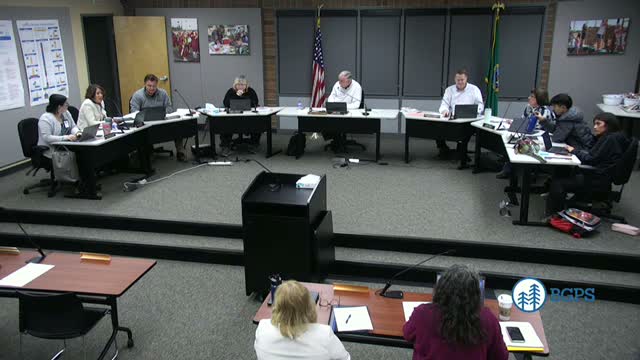
At a special session called to order at 7:05 a.m., the Battle Ground School Board received a briefing on collective bargaining law and the district’s negotiation process and agreed to schedule an exempt meeting with the district’s bargaining attorney to set bargaining parameters ahead of anticipated negotiations in May.
The briefing was delivered by Michelle Reinhardt, the district’s executive director of human resources, who framed the session around three goals: explain applicable Washington bargaining law, clarify the board’s governance role and outline community perspectives gathered by the Citizens Advisory Committee. "We have a duty to bargain," Reinhardt told the board, stressing that bargaining requires both parties to come to the table in good faith even though it does not guarantee agreement.
Reinhardt walked members through the scope of bargainable subjects, distinguishing mandatory items such as wages, hours and working conditions from permissive matters and legal limits. She also summarized district finances: the district serves roughly 13,000 students in 19 schools with about 1,600 total staff; approximately 77% of operating revenue is state-driven, local funding is limited (roughly 13% when a levy exists), and roughly 78.8% of expenditures go toward salaries and benefits. "Bargaining is budgeting," she said, noting those constraints shape what the board should set as fiscal parameters for negotiators.
Reinhardt reviewed common unfair labor practices and bargaining pitfalls — including regressive offers, adding issues late, ultimatums and bypassing ratification — and said the district and associations may seek enforcement or assistance from the Public Employee Relations Commission (PERC) if needed. She advised the board to set a clear fiscal ceiling and priority areas so the bargaining team can operate "within the box" and avoid surprises when tentative agreements come to the board for approval.
Board members asked operational questions about contract length and process. Members were told three-year contracts are common but reopeners or shorter agreements are possible. The board agreed to hold an exempt (nonpublic) meeting with Bargaining Attorney Josh Holiday and the district bargaining team before April to set the financial ceilings and priority areas that will guide negotiators. Board members discussed making personal notes on priorities to bring to that exempt session; Michelle said much of the detailed language work is done by the bargaining team and attorney and that larger priorities — for example class size or staffing levels — are the board’s focus.
During public comment, Ryan Anderson, who identified himself as a teacher, urged the board to remember the human impact of bargaining and to guard staff belonging and morale: "Bargains are scary. Contracts scary," he said. Mary Mendoza Hansel, speaking for union members, told the board that the union and HR "work together very closely" and urged professional collaboration for the students’ benefit. Jessica Cole of the Citizens Advisory Committee recommended the board see this presentation before the CAC meeting in future cycles to improve coordination.
The board wrapped by confirming next steps: schedule the exempt session with the bargaining attorney to set parameters, collect members’ priority items in advance, and expect bargaining activity to begin in May with preparatory meetings beforehand. The special session was adjourned at 7:55 a.m.
The board did not take any formal votes or motions at this meeting; the primary outcome is the plan to meet in exempt session to finalize bargaining parameters and timeline.