
Battle Ground board hears community pleas as district lays out $20 million reduction plan
Get AI-powered insights, summaries, and transcripts
Sign Up Free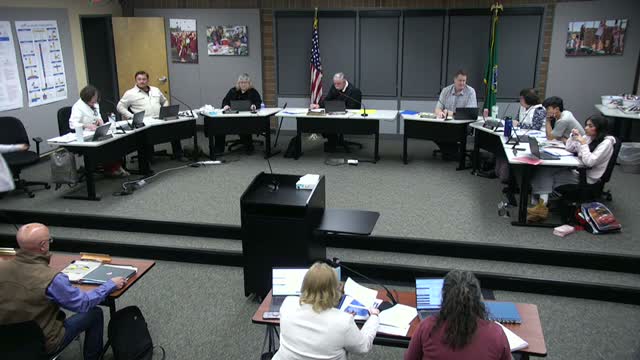
Summary
Facing reduced state funding, district staff presented outreach results and an initial plan that identifies about $16 million in reductions and seeks another ~$4 million; students and community members urged cuts be limited and urged preserving theater, Aspire and supports for vulnerable students. Board set an April 27 reduction resolution timeline.
The Battle Ground School District Board heard hours of student testimony, community feedback and a district presentation Monday as staff outlined how the district plans to cut roughly $20 million because of state funding shortfalls.
District staff walked the board through the engagement work they used to shape options — two listening sessions, a public thought‑exchange tool and an online “balancing act” exercise that drew more than 1,500 views and 223 submissions. The presentation emphasized the constraints state funding law places on where district dollars can be used and why some commonly suggested fixes (selling property, changing capital vs. operating uses) are not straightforward.
Why it matters: The board is weighing deep reductions that, staff said, will touch many programs. Students and families told the board that losing theater, magnet programs such as Aspire, or extracurriculars would harm engagement and opportunity for many learners — and some speakers urged the board to press the state for fuller funding instead of local cuts.
District presentation and numbers
A district presenter summarized outreach priorities — student safety and well‑being, core academics, supports for vulnerable students, and student engagement/opportunities — and explained tradeoffs. The presenter said the district has identified about $16,000,000 in reductions so far but still needs to find roughly $4,000,000 to meet the $20,000,000 target. “There is no easy cut,” the presenter told the board, adding the district will try to spread reductions to avoid eliminating entire programs when possible.
The staff presentation described several constraints that shape options: categorical state funding rules, safety‑net timing and limits on capital versus operating uses. Staff also warned that cutting transportation or other services can create follow‑on costs next year because state funding for those services is based on the prior year’s routes and costs.
Community and student reaction
Students from CAM Academy, River HomeLink and area high schools filled the meeting room to describe learning experiences and to urge the board not to eliminate programs that keep students engaged. Cassidy Moppin, a River HomeLink student who works in tech, said theater creates long‑term skills and community: “It creates lasting memories and builds bonds that can last a lifetime,” she said.
Desmond McTeer and Wesley Suter, sixth‑grade Aspire students, told the board their program should be preserved or reduced rather than cut outright because students would be forced back to home schools and would lose cohesive peer groups and supports.
Several public commenters framed the discussion as a broader funding fight. Ryan Anderson urged the board to fight state underfunding and “cut nothing,” telling the board that the state’s failure to fully fund basic education is a constitutional problem that should be remedied in Olympia.
Process and next steps
Staff proposed a two‑step communications and notification process: impacted programs and staff will be notified internally in the coming week, and the board will receive a formal reduction (RIF) resolution at its April 27 meeting. The presenter said staff prefer making a number of smaller reductions rather than eliminating whole programs when feasible, but acknowledged some programs may be fully cut because of cost pressures.
The board asked for clarifying information and additional time to digest the details. Members discussed whether to schedule another meeting to review the cuts in greater depth; ultimately they agreed to proceed with the regular April calendar and to add a special work session only if staff conclude it is necessary before the April 27 action.
The board did not vote on program‑level reductions Monday. Instead, it approved a timeline for internal notifications and set the reduction resolution for formal action on April 27.
What’s next
District staff will continue the technical work to convert the high‑level priorities into specific staffing and program proposals; the board will receive written detail on impacted programs and positions in coming weeks and will consider the RIF resolution on April 27. Community members and students told the board they will continue to press for alternatives and for state support as the district finalizes its plan.