
University researchers tell House Energy Committee revived Alaska Energy Data Gateway needs sustained funding, better heat and IPP data
Get AI-powered insights, summaries, and transcripts
Sign Up Free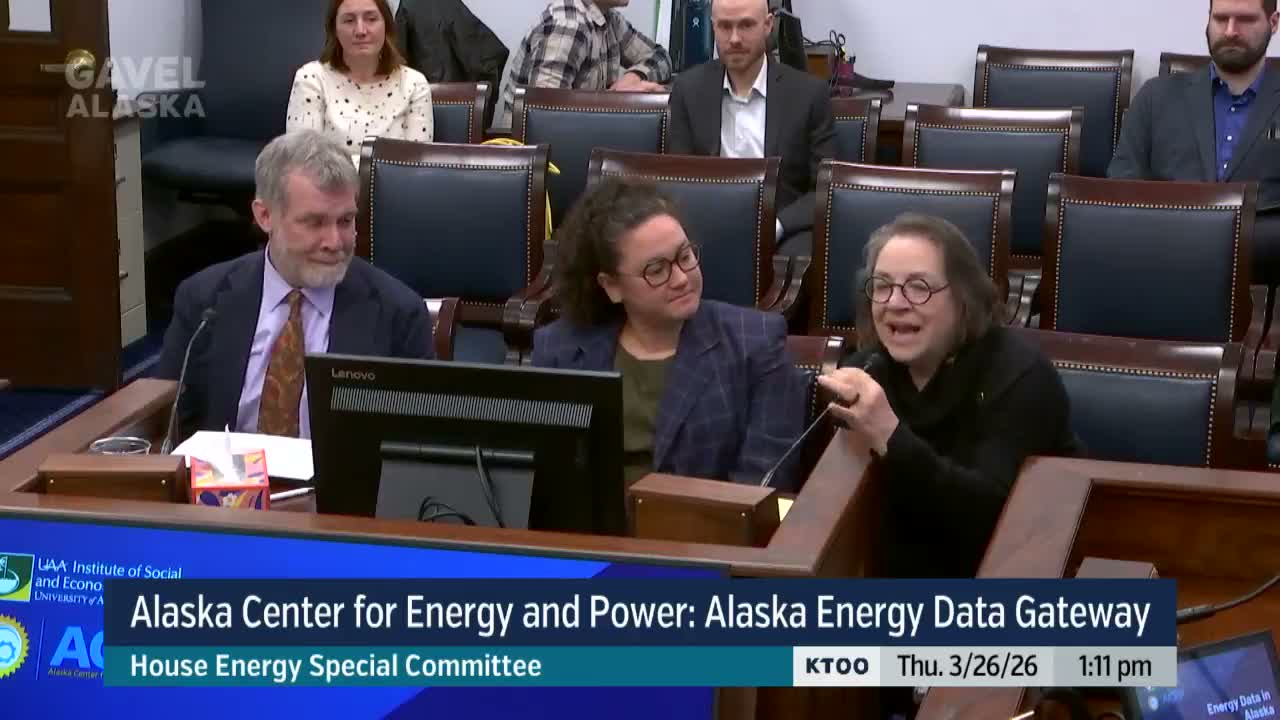
Summary
University of Alaska researchers demonstrated a revamped Alaska Energy Data Gateway (AEDG) to the House Energy Committee, saying the tool—useful for community and regional planning—relies on publicly available electricity data, lacks systematic heat and IPP details, and faces near‑term funding shortfalls.
Juneau — University of Alaska researchers on Thursday demonstrated a revitalized Alaska Energy Data Gateway to the House Energy Committee and urged lawmakers to consider funding and policy changes that would make energy data more complete and sustainable.
Diane Hirschberg, director of the UAA Institute of Social and Economic Research, Jeremy Casper, director of the Alaska Center for Energy and Power (ACEP) at the University of Alaska Fairbanks, and Vanessa Raymond, ACEP deputy director for strategic initiatives, showed the committee how the AEDG pulls state and federal datasets together into community and regional dashboards useful for planning, grant applications and evaluating projects such as Renewable Energy Fund proposals.
The tool, a publicly funded resource, was relaunched in a third version after legislative funding in 2024, presenters said. “This is a public resource ... funded by the state,” Raymond said, describing the AEDG as a central place where users can access demographic, generation and bulk‑fuel data for communities. The platform includes new features to visualize regional grids — for example, Bethel or the Railbelt — and, presenters said, allows users to customize charts and export data for briefings and grant work.
Why it matters: legislators said the gateway could help policymakers assess total energy costs and the effectiveness of subsidies such as Power Cost Equalization (PCE) or projects supported by the Renewable Energy Fund (REF). Committee members pressed presenters on whether AEDG can show not just energy rates but the total cost of energy to households, including infrastructure and fuel delivery costs — key inputs for evaluating long‑term electrification investments.
Data gaps and limitations
Presenters repeatedly flagged limits to available public data. “The current data is from 2022,” Raymond told the committee, noting that the Alaska Energy Statistics workbook — another critical dataset — is updated intermittently because no single agency is charged with maintaining it. Hirschberg explained earlier versions of the gateway fell out of date when continuous funding and automated ingestion were not in place.
The AEDG is currently electricity‑focused because public heat and transportation‑fuel data are sparse or private. Casper said sales of fuel oil and many heating uses are unregulated and therefore difficult to track: “Dealing with the heating side of things is very difficult,” he said. Presenters also said independent power producer (IPP) filings show sales but not full IPP capacity, and that there is no standardized, vetted intertie dataset across the state.
Funding and sustainment
Committee members asked how the AEDG is funded going forward. Casper said the project began as a FY2024 capital research appropriation, with an initial $1 million approved; follow‑on funding did not materialize as planned. Hirschberg said the team is “down to less than 10% of that funding left” and estimated about two to three months of runway without additional support.
Future needs and next steps
Presenters identified priority data items the state lacks: systematic heat and natural‑gas data, standardized IPP capacity information, and a vetted intertie dataset. They asked for continued collaboration with state agencies (such as DCCED/DCRA and the Alaska Energy Authority) and for legislative or administrative fixes that could increase automated access to certain datasets. Hirschberg and ACEP staff also offered to share recent survey results and workshop materials with the committee and suggested modeling tools to analyze tradeoffs among subsidy programs and investments.
What the committee asked for: lawmakers requested follow‑ups about whether the gateway’s data could be used to quantify how the Permanent Fund Dividend has historically been spent on energy, to compare community cost and reliability metrics, and to explore how the gateway might integrate public procurement or cost information for large projects.
The meeting concluded after presenters agreed to distribute documentation; Co‑chair Holland thanked the presenters and adjourned the committee at 2:34 p.m.