
Researchers unveil updated Alaska Energy Data Gateway, flag missing heat and producer data
Get AI-powered insights, summaries, and transcripts
Sign Up Free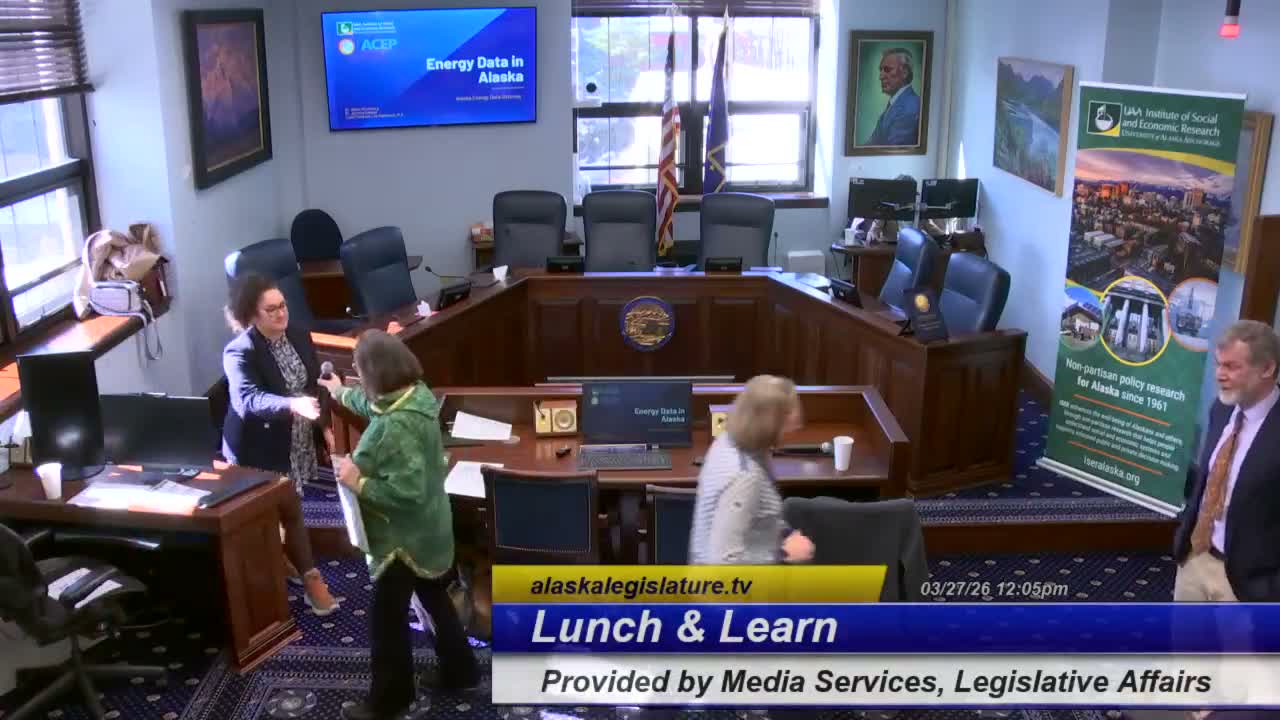
Summary
Presenters from the Alaska Center for Energy and Power and the Institute of Social and Economic Research briefed the Alaska Legislature on the Alaska Energy Data Gateway, a legislatively funded public portal that centralizes community and grid-level energy data; they said the tool improves access but still lacks comprehensive heat-use and independent-producer capacity datasets.
Researchers from the Alaska Center for Energy and Power and the Institute of Social and Economic Research presented an updated Alaska Energy Data Gateway to the Alaska Legislature on March 28, 2026, saying the publicly funded portal centralizes community- and grid-level electricity data but still lacks reliable heat-consumption and producer-capacity information.
Vanessa Lee Raymond, deputy director for strategic initiatives at the Alaska Center for Energy and Power, said AEDG is “an Alaskan product” built with state funding and designed to make community-level energy and socioeconomic data accessible. “This is a public resource, and it's funded by the state,” Raymond said, adding the interface allows users to pull community summaries, custom charts and downloadable graphics for briefings and grant applications.
Jeremy Casper, director of the Alaska Center for Energy and Power, described ACEP’s role in the project and outlined the center’s programs and staffing. Casper said ACEP and partners maintain roughly $14,000,000 in annual expenditures and that about $2.5 million of that is unrestricted state funding, with the rest coming from federal grants and contracts. “We work on energy problems that are relevant to Alaska,” Casper said, summarizing ACEP’s work on marine energy, grid integration, education programs and the energy data gateway.
Diane Hirschberg, director of the Institute of Social and Economic Research at the University of Alaska Anchorage, placed AEDG in ISER’s broader public-research mission. “ISER was founded by the legislature in 1961,” Hirschberg said, noting ISER’s multidisciplinary staff and long history of providing data and analysis to state policymakers.
Presenters traced AEDG’s development: an initial launch in 2010, a second version in partnership with Lawrence Berkeley National Laboratory that ran to 2024, and a third rebuild launched in May 2025. Since that launch the team has followed an iterative release cadence, updating the site every two to three weeks and soliciting user feedback.
Despite those improvements, presenters emphasized persistent data gaps. Raymond said the portal’s definition of energy includes heat, but the state lacks a comprehensive, validated dataset on residential and building-level heat consumption. “We do not know how people spend their money on heat,” she said, noting that household heating can include fuel oil, electric systems, Toyo stoves and wood—some of which is not recorded in formal sales data.
Both Casper and Hirschberg said AEDG currently captures transaction and sales data but often cannot measure producer-side capacity—particularly for independent power producers such as tribal or nonprofit solar and wind projects—and that an intertie dataset showing physical grid connections is not yet available. Casper told legislators that filling those gaps will require voluntary data sharing from utilities, thermostat vendors or the development of new household surveys and inventories.
During a question-and-answer period, an attendee asked whether AEDG could include gasoline and diesel price or movement data. Casper answered: “Short answer is absolutely yes,” but cautioned that assembling statewide fuel-flow and heating-oil statistics is technically complicated and often requires household-level surveys or assumptions to validate models. Panelists pointed to possible data sources—including AHFC’s ACWARM building database and municipal carbon inventories compiled by the Alaska Municipal League—that could help estimate fuel consumption, while acknowledging privacy and reporting limits.
The presenters invited legislators and the public to test the gateway, provide feedback via the site and use the portal’s downloadable products for briefings and grant applications. Printed literature was made available after the briefing; presenters thanked the session sponsor and offered follow-up conversations with staff.