
Department of Law details new labor-relations role, staffing and LOA centralization to House Finance
Get AI-powered insights, summaries, and transcripts
Sign Up Free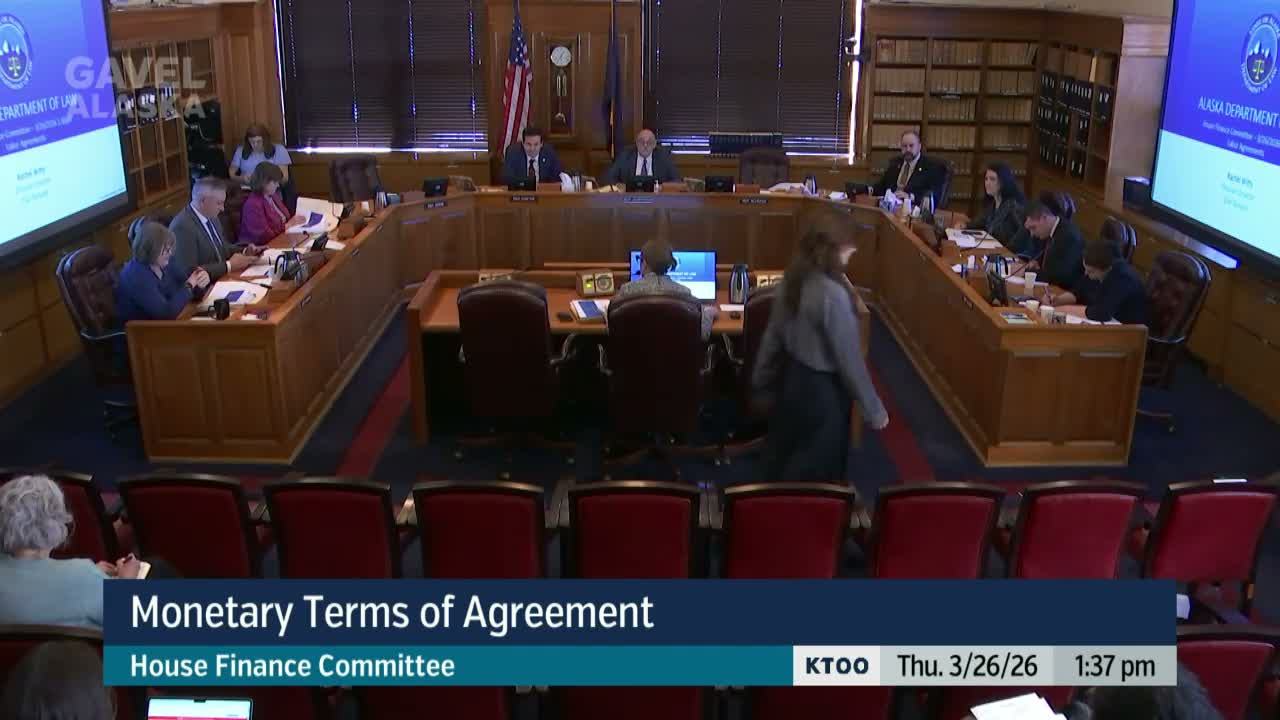
Summary
Department of Law Civil Division Director Rachel Witty told the House Finance Committee that labor-relations duties moved under Administrative Order 356, staff have been rebuilt (a new manager and four analysts), and departments were asked to resubmit letters of agreement after a June 2025 reset to improve fiscal tracking.
Rachel Witty, civil division director for the Alaska Department of Law, briefed the House Finance Committee on March 26 on the department's new responsibility for state labor relations after an administrative transfer in 2024.
Witty said Administrative Order 356 moved certain labor-relations functions from the Department of Administration to the Department of Law to ensure legal oversight, improve contract review and strengthen support for grievances and arbitrations. "The objectives were to ensure legal oversight during labor negotiations, improve review of contract terms and proposals, strengthen support for grievances, arbitrations and contract interpretation processes," she told the committee.
Witty described the unit's organization and staffing changes, saying Matthew Gendersina was hired in September as labor-relations manager and now oversees four labor-relations analysts. The positions are non-attorney, classified employees who are part of the Confidential Employees Association; Witty said the unit had a period of high vacancy rates before being staffed up.
On letters of agreement (LOAs), Witty said departments were required to resubmit outstanding LOAs after a June 2025 expiration and that the Department of Law has sought to centralize and winnow duplicative side agreements. She characterized the review as a fiscal-control effort: "There were over 100 requests, and I think there are currently 46 or 47 that are in effect," she said, and offered to provide exact counts to the committee after the hearing.
Members pressed Witty on pending negotiations and timeline risks. She said two active negotiations with the Public Safety Employees Association (troopers and airport police/fire) were continuing and that negotiating teams were working to produce monetary terms in time for legislative budget processes. "The parties are working very actively toward that goal," Witty said.
Committee members asked about use of outside counsel. Witty confirmed the Department retains contract counsel for bargaining support, naming the firm Clark Baird Smith (Chicago) and noting independent contractor John Wood serves on bargaining teams with variable hours depending on bargaining intensity; she offered to provide contract hourly rates on follow-up.
On grievances and payroll problems (notice-of-pay-problem or NOPP filings), Witty said the department had resolved 62 grievances, including four class actions, and that in class-action resolutions some employees received penalty pay. She said labor relations coordinates with the Division of Payroll and Department of Administration and that a combination of staffing, contractor transitions and earlier LOAs had contributed to prior payroll backlogs; she offered to supply the committee with NOPP statistics and average-overtime calculations.
Witty also reviewed the bargaining process: successor negotiations begin in late fall; if parties reach impasse they pursue mediation and, if required, interest arbitration under the Public Employment Relations Act. She told members that arbitration outcomes or a failure to fund monetary terms would require parties to return to bargaining and could affect when increases become payable.
The committee thanked Witty after an extended question-and-answer period; Witty said she would provide follow-up figures on LOAs, contractor rates and payroll/NOPP data. The committee went at ease at 2:43 p.m.