
Fairbanks officials urge HB 379 to ease service‑area rules so more neighborhoods can access road maintenance
Get AI-powered insights, summaries, and transcripts
Sign Up Free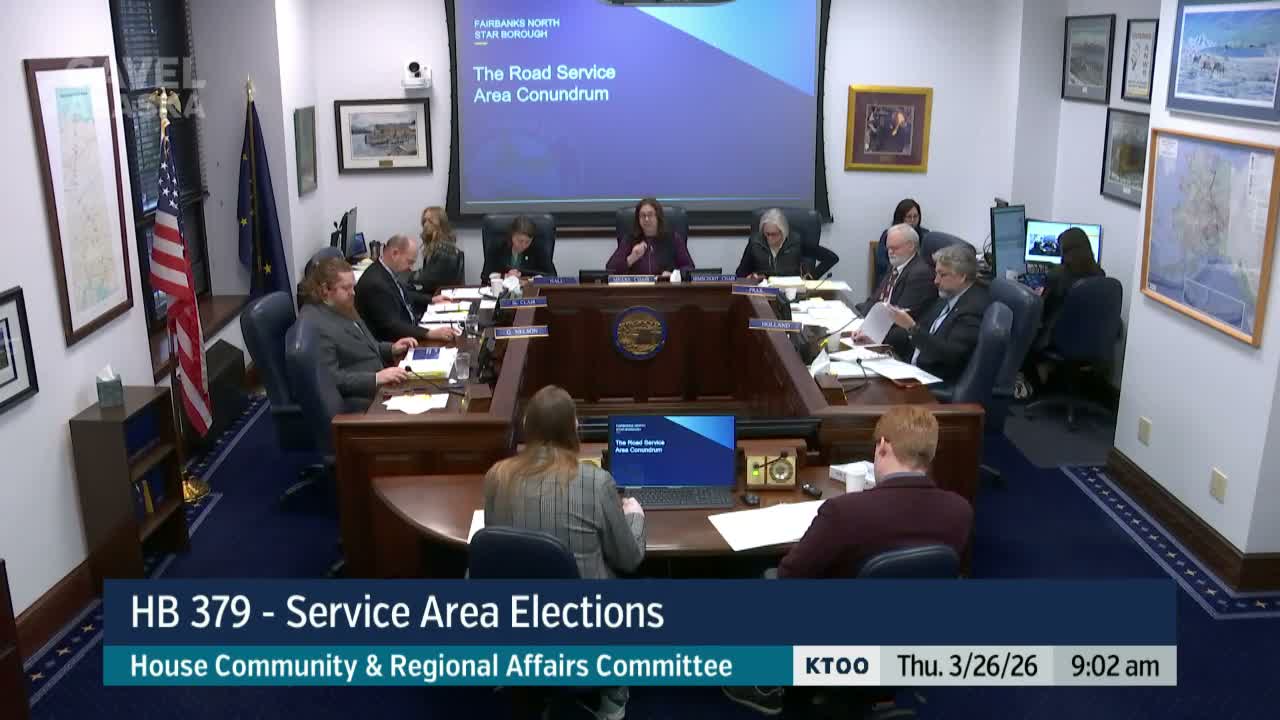
Summary
Representative Kerrick introduced HB 379 to give second‑class boroughs prospective flexibility on creating or altering service areas; Fairbanks officials and the Alaska Municipal League said the change would help neighborhoods gain road maintenance without disturbing existing service areas, while members questioned turnout, election costs and constitutional limits.
Representative Kerrick introduced House Bill 379 on March 26, a three‑page, prospective change to AS 29.35.450 that would allow second‑class boroughs greater administrative flexibility to alter, replace or abolish service areas created after the bill’s effective date (07/01/2026) while preserving voter approval for major changes.
Why it matters: Fairbanks North Star Borough officials told the committee that the current double‑vote requirement – where both the annexing neighborhood and the receiving service area must approve – has left some neighborhoods without road maintenance and created a patchwork of about 103 road service areas in the borough. Sponsors said HB 379 aims to enable practical regional or consolidated service models that new neighborhoods can join without undermining existing service areas.
Sponsor and municipal testimony: Representative Kerrick said HB 379 is a targeted, common‑sense update focused on road maintenance and local control. Mayor Hopkins of Fairbanks described how the double‑vote rule frequently blocks annexations, producing low success rates (about 40% of attempts in some periods) and high costs from special elections. Jill Dolan, Fairbanks Borough attorney, told the committee the bill does not alter existing service areas and that constitutional and statutory steps (including an initial determination that an existing service area can provide the service) still apply.
Local governance and tradeoffs: Testimony and committee questioning explored options for creating regional service areas prospectively, the prospect of more administrative responsibility for borough assemblies, and the heavy reliance on volunteers to run many service‑area boards. Committee members raised concerns that enabling additional service areas—even prospectively—could create unintended governance and fiscal consequences, including added administrative costs and potential resistance from residents who do not want new taxation or changing boundaries.
Context and finance: AML testimony placed the problem in a broader fiscal history: community revenue sharing and state support for local services have declined from historic highs, increasing pressure on local governments. Mayor Hopkins and AML emphasized that HB 379 is prospective only and that assembly control and local elections remain central safeguards.
What’s next: The committee set HB 379 aside for further work; staff and members signaled follow‑up on constituency impacts, turnout and administrative options for regional service‑area models.